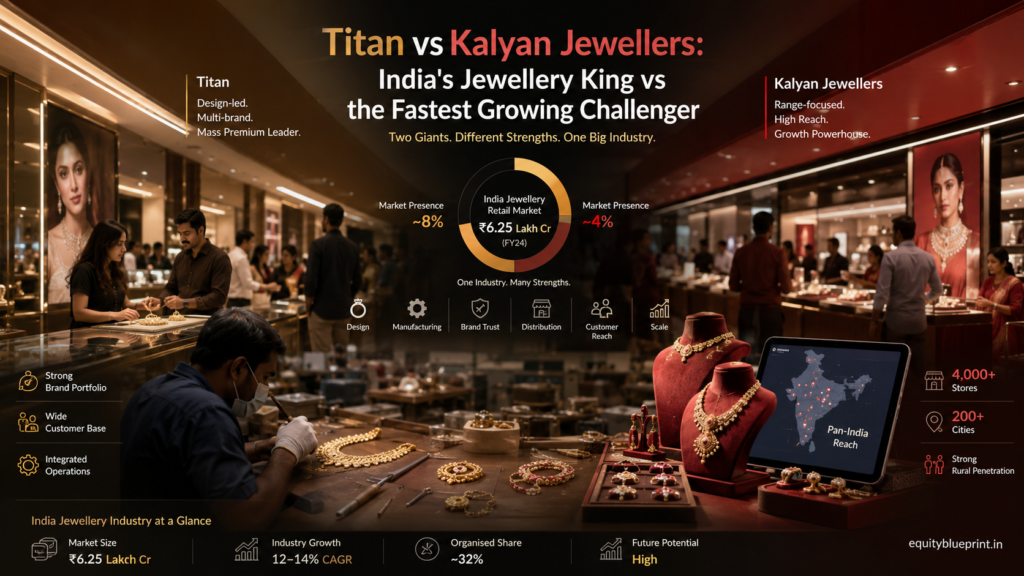
TL;DR (Executive Summary)
- Titan remains the quality leader in India’s jewellery industry, backed by Tanishq, CaratLane, superior brand equity, higher margins, and a diversified lifestyle portfolio.
- Kalyan Jewellers is the growth challenger, expanding aggressively through its capital-light FOCO model and rapidly increasing its presence across India.
- Investors often focus only on valuation. The bigger question is whether Titan’s premium valuation is justified by its quality advantage.
- If the jewellery industry continues formalizing over the next decade, both companies can create substantial shareholder value.
- Final verdict: Titan is the safer long-term compounder. Kalyan offers higher upside potential but comes with higher execution risk.
Introduction
India’s jewellery market is undergoing a structural transformation.
For decades, the industry was dominated by local family-owned jewellers and unorganized players. Today, customers increasingly prefer trusted brands that offer transparency, purity certification, better designs, and financing options.
This shift is creating massive opportunities for organized players.
Two companies stand out as major beneficiaries:
- Titan Company Ltd (through Tanishq, CaratLane, Mia and Zoya)
- Kalyan Jewellers India Ltd
But they represent very different investment propositions.
Titan is the established market leader.
Kalyan is the rapidly expanding challenger.
The key question for investors is simple:
Which stock is actually better and for whom?
Let’s find out.
Quick Snapshot
| Metric | Titan | Kalyan Jewellers |
| Business Position | Market Leader | Fast-Growing Challenger |
| Market Capitalization | Significantly Larger | Much Smaller |
| Total Store Network | 3,300+ stores | 388 showrooms |
| Geographic Reach | 435 towns | 23 states & UTs + International Presence |
| Business Portfolio | Jewellery, Watches, Eyewear, Fashion, Fragrances | Primarily Jewellery |
| Expansion Model | Mixed | Aggressive FOCO Expansion |
| Risk Profile | Lower | Higher |
| Growth Potential | Moderate-High | High |
| Valuation | Premium | Discounted |
Core Thesis
This Is Not a Better vs Worse Comparison
This is a comparison between:
Titan = Quality, Stability and Brand Dominance
versus
Kalyan = Growth, Expansion and Re-Rating Potential
Titan is what happens when a company already owns a dominant position and continues compounding steadily.
Kalyan is what happens when a company is still capturing market share and expanding aggressively.
One is a proven compounder.
The other is a growth story still unfolding.
Understanding this distinction is critical before looking at any valuation metric.
Layer 1 – Valuation Comparison
Most investors begin with P/E ratios.
That is often the wrong starting point.
The real question is:
What are investors getting for the valuation they pay?
Titan trades at a premium because investors are paying for:
- Brand leadership
- Superior governance perception
- Higher profitability
- Better capital allocation track record
- Multiple growth engines
Kalyan trades at a discount because investors still assign:
- Execution risk
- Higher business concentration
- Lower historical track record
- Smaller scale
However, the valuation gap creates an interesting opportunity.
If Kalyan continues executing successfully over the next few years, the market may gradually narrow this valuation discount.
What Investors Are Getting Wrong
Many investors assume:
Lower P/E = Better Value
That is rarely true.
A lower valuation only becomes attractive when growth remains sustainable.
The real investment debate is not:
“Why is Kalyan cheaper?”
The real debate is:
“Can Kalyan eventually earn a valuation closer to Titan?”
That answer depends entirely on execution.
Layer 1 Summary
Titan deserves a premium valuation.
Kalyan offers potential valuation re-rating.
The choice depends on whether investors prioritize certainty or upside.
Layer 2 – Growth Comparison
This is where the story becomes interesting.
Historically, Titan has been one of India’s most successful retail growth stories.
But today, Kalyan is growing from a much smaller base.
That creates a powerful growth runway.
The FOCO Advantage
One of the biggest developments in Kalyan’s business model is its increasing use of the FOCO model.
FOCO stands for:
Franchise Owned, Company Operated
In simple terms:
The franchise partner invests capital for the showroom while Kalyan manages operations, branding, inventory standards and customer experience.
This allows Kalyan to:
- Expand faster
- Use less capital
- Improve returns on capital
- Reduce balance-sheet pressure
This is a significant competitive advantage.
It enables growth without requiring massive debt-funded expansion.
Store Expansion
Titan already operates more than 3,300 stores across India.
Kalyan operates a much smaller network but continues expanding aggressively.
Because Kalyan starts from a smaller base, each new showroom has a larger impact on overall revenue growth.
This is one reason why Kalyan’s growth trajectory can remain stronger for longer.
The Non-South India Transformation
Many investors still view Kalyan as a South India-focused jeweller.
That perception is outdated.
The majority of Kalyan’s network is now outside South India.
This geographic diversification significantly increases its addressable market.
Same Store Sales Growth Matters
Professional investors closely monitor Same Store Sales Growth (SSSG).
SSSG measures how much existing stores are growing before considering new store additions.
Healthy SSSG indicates that customer demand remains strong even without opening new stores.
This metric should remain one of the most important indicators for investors in both companies.
Layer 2 Summary
Titan will continue growing.
Kalyan has the potential to grow faster.
The reason is simple: A smaller base plus capital-light expansion equals a longer growth runway.
Layer 3 – Business Model & Moat
This is where Titan clearly pulls ahead.
Titan’s Moat
Titan’s jewellery business is not just Tanishq.
It includes:
- Tanishq
- CaratLane
- Mia
- Zoya
Together, they target multiple customer segments.
Titan has also built successful businesses in:
- Watches
- Wearables
- Eyewear
- Fragrances
- Fashion
This diversification reduces business risk.
The CaratLane Advantage
Many investors underestimate CaratLane.
CaratLane gives Titan a strong digital presence and access to younger consumers.
This strengthens Titan’s ecosystem and increases customer lifetime value.
The Diamond Factor
One of the biggest reasons Titan commands a premium valuation is its product mix.
Titan has a larger share of studded jewellery compared to most competitors.
Why does this matter?
Because studded jewellery typically carries significantly higher margins than plain gold jewellery.
This helps explain:
- Higher profitability
- Better return ratios
- Stronger earnings quality
Kalyan’s Moat
Kalyan’s moat is different.
It is built around:
- Trust
- Regional understanding
- Wedding jewellery positioning
- Hyperlocal merchandising
- Fast expansion
Kalyan understands local preferences exceptionally well.
That capability becomes powerful when entering Tier-2 and Tier-3 cities.
Real-World Analogy
Think of Titan as Apple.
Premium.
Trusted.
Highly profitable.
Think of Kalyan as Xiaomi during its rapid expansion phase.
Growing quickly.
Capturing market share.
Still building its long-term moat.
Layer 3 Summary
Titan has the stronger moat.
Kalyan has the larger expansion opportunity.
Layer 4 – Risk Comparison
Every investment has risks.
The question is which risks matter most.
Structural Risks
Titan
- Premium valuation risk
- Slower growth due to large size
- Expectations already very high
Kalyan
- Execution risk
- Franchise expansion risk
- Brand-building risk
- Competitive pressure from larger players
Cyclical Risks
Both companies face:
- Gold price volatility
- Consumer spending slowdowns
- Economic downturns
- Wedding demand fluctuations
Gold Price Risk
Jewellery companies are uniquely exposed to gold prices.
Sharp increases can reduce affordability.
Sharp declines can impact inventory values.
Historically, Titan has developed sophisticated systems and processes to manage gold-price exposure, contributing to its reputation as a more stable operator.
Which Company Is More Vulnerable?
Kalyan.
Not because it is a weak business.
But because smaller, faster-growing companies naturally face greater execution risk.
Layer 4 Summary
Titan has lower business risk.
Kalyan has higher execution risk.
Layer 5 – Management & Capital Allocation
Great businesses become great investments only when management allocates capital wisely.
Titan
Titan’s management has built one of India’s strongest consumer brands over multiple decades.
Capital allocation highlights include:
- Consistent brand investment
- Multi-category expansion
- CaratLane acquisition
- Long-term shareholder value creation
Titan’s track record is already proven.
Kalyan
Kalyan’s management deserves significant credit for:
- Expanding beyond South India
- Improving brand perception
- Introducing the FOCO model
- Accelerating store growth
The next few years will determine whether Kalyan can convert rapid expansion into durable shareholder returns.
Layer 5 Summary
Titan wins on track record.
Kalyan wins on growth ambition.
Final Verdict
🏆 Winner for Growth: Kalyan Jewellers
Smaller base.
Faster expansion.
Larger runway.
Greater re-rating potential.
🛡️ Winner for Stability: Titan
Stronger moat.
Better diversification.
Superior brand strength. Lower execution risk.
💰 Winner for Income: Titan
Historically stronger cash generation and more mature business profile.
If I Had To Choose…
If my objective was:
Wealth Preservation + Consistent Compounding
I would choose Titan.
If my objective was:
Higher Upside Over The Next 5–10 Years
I would choose Kalyan Jewellers.
But if I could own only one stock for the next decade, my preference would remain:
Titan Company
Not because it will necessarily grow faster.
But because it combines:
- Brand power
- Trust
- Profitability
- Scale
- Capital allocation quality
in a way very few Indian consumer companies can match.
Key Factors To Monitor
- Same Store Sales Growth (SSSG)
- New showroom additions
- FOCO expansion success
- Studded jewellery mix
- EBITDA margins
- Market share gains from unorganized players
- Gold price volatility
- Consumer discretionary spending trends
Frequently Asked Questions (FAQs)
Which is better for long-term investment: Titan or Kalyan Jewellers?
Titan is generally the safer long-term compounder due to its stronger brand portfolio, diversification and execution track record. Kalyan offers higher growth potential but also carries higher risk.
Which stock is safer?
Titan is safer because of its market leadership, diversified business model and stronger competitive moat.
Which company has higher growth potential?
Kalyan Jewellers currently has higher growth potential due to its smaller base and aggressive FOCO-led expansion strategy.
Is Kalyan Jewellers’ debt a risk for investors?
Investors should monitor leverage levels, but the company’s increasing use of the FOCO model can help support future expansion with lower capital intensity.
How does CaratLane impact Titan’s valuation?
CaratLane strengthens Titan’s digital jewellery presence, improves customer acquisition among younger consumers and enhances Titan’s long-term growth narrative.
Can both stocks benefit from industry formalization?
Yes.
One of the biggest opportunities for both companies is the ongoing shift from unorganized jewellers to trusted organized brands. This trend could continue for many years.
Related Analysis
Kalyan Jewellers India Ltd (NSE: KALYANKJIL): Growing Faster Than Titan, Trading at Half the Valuation — Opportunity or Value Trap? Kalyan Jewellers India Ltd (NSE: KALYANKJIL): Growing Faster Than Titan, Trading at Half the Valuation — Opportunity or Value Trap?
Titan Company Ltd (NSE: TITAN): India’s Jewellery King at 70x P/E — Premium Quality or Premium Risk? Kalyan Jewellers India Ltd (NSE: KALYANKJIL): Growing Faster Than Titan, Trading at Half the Valuation — Opportunity or Value Trap?
The Hidden Economics of India’s $85 Billion Jewellery Industry The Hidden Economics of India’s $85 Billion Jewellery Industry
The Hidden Economics of India’s $85 Billion Jewellery Industry The Hidden Economics of India’s $85 Billion Jewellery Industry
HDFC Bank vs ICICI Bank: Which Banking Giant Is the Better Long-Term Investment in 2026? HDFC Bank vs ICICI Bank: Which Banking Giant Is the Better Long-Term Investment in 2026?
Suzlon Energy vs Waaree Renewable Technologies: The Phoenix vs The Speedster — Which Renewable Stock Is Better for the Next Decade? Suzlon Energy vs Waaree Renewable Technologies: The Phoenix vs The Speedster — Which Renewable Stock Is Better for the Next Decade?
NTPC vs Tata Power: Stability vs Growth — Which Power Stock Should You Own? NTPC vs Tata Power: Stability vs Growth — Which Power Stock Should You Own?
Disclaimer
The analysis provided on this blog, including the “5-Layer Framework,” is for educational and informational purposes only. I am not a SEBI-registered investment advisor. Stock market investing involves significant risk, and past performance is not indicative of future results. The views expressed here are my personal opinions based on my research and study of financial literature. This is not a buy or sell recommendation. Please conduct your own due diligence or consult a qualified, SEBI-registered financial advisor before making any investment decisions. The author may or may not hold positions in the stocks discussed.
About the Author

Nilendu Chatterjee is the founder of Equity Blueprint, a platform focused on helping retail investors approach the stock market with clarity, structure, and discipline. With over a decade of experience in the industrial sector and a strong passion for equity research, he brings a practical, ground-level perspective to fundamental analysis.
Through a framework-driven approach, Nilendu breaks down complex businesses into simple, decision-oriented insights—bridging the gap between professional-grade research and everyday investing. His work is centered on one goal: enabling long-term wealth creation by replacing speculation with structured thinking.