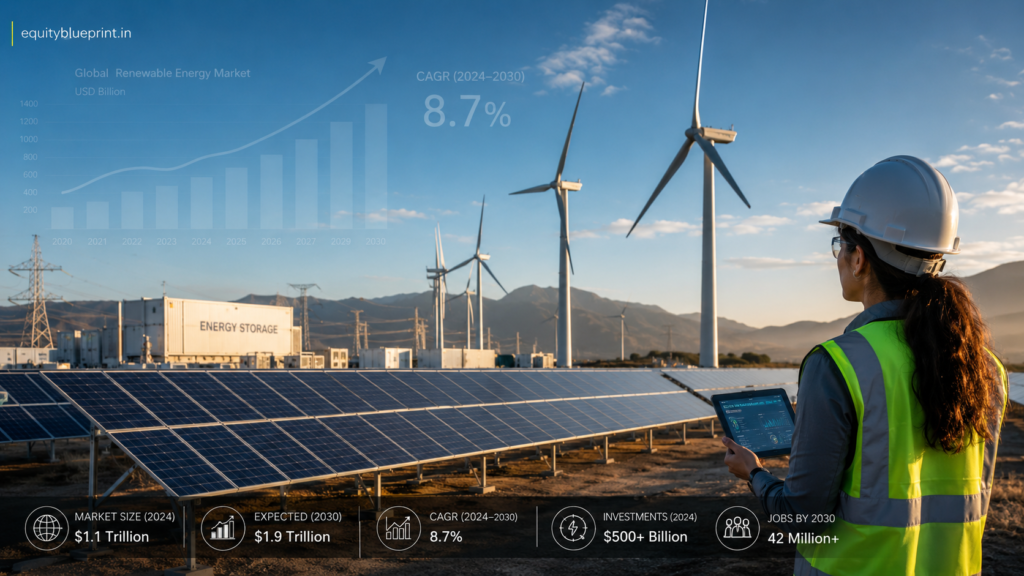
⚡ 60-Second Summary
If you only have one minute, here’s everything you need to know.
| Category | Takeaway |
| Industry | Renewable Energy |
| Industry Stage | Structural Growth |
| India’s Position | World’s 3rd largest renewable energy market |
| Biggest Opportunity | Rising electricity demand, AI, EVs and data centres |
| Biggest Risk | Execution delays and high debt |
| Best Business Model | Long-term contracted power generation (PPAs) |
| Most Important Metric | Operational Capacity + Capacity Utilisation Factor (CUF) |
| Industry Attractiveness | ⭐⭐⭐⭐⭐ (9.5/10) |
| Growth Potential | ⭐⭐⭐⭐⭐ (10/10) |
| Who Usually Wins? | Companies with superior execution, low-cost financing and disciplined capital allocation |
Equity Blueprint Insight
Renewable energy isn’t a technology race. It’s an execution race.
The companies that build projects faster, operate them better and finance them cheaper usually create the highest shareholder returns.
Who Should Read This Guide?
This guide is designed for:
✅ Beginners who want to understand how the renewable energy industry works.
✅ Long-term investors researching renewable-energy stocks.
✅ Students learning about India’s energy transition.
✅ Anyone interested in understanding where the biggest opportunities—and risks—lie within one of India’s fastest-growing industries.
Whether you’ve never analyzed a power company before or already invest in infrastructure businesses, this guide will help you think like a professional investor.
The Big Picture
Every time you switch on a light, you’re using one of the world’s most important industries.
Most people never think about where that electricity comes from.
They simply expect the lights to turn on.
Behind that simple expectation lies an industry that is transforming India’s economy.
Over the next decade, renewable energy won’t just power homes.
It will power:
- Artificial Intelligence (AI)
- Data centres
- Electric vehicles
- Steel plants
- Manufacturing
- Metro rail
- Airports
- Smart cities
In many ways, electricity is becoming the fuel of the digital economy.
And renewable energy is becoming the fastest-growing source of that fuel.
Why Should Investors Care?
Imagine trying to build a modern economy without electricity.
It’s impossible.
Every new factory, shopping mall, hospital, semiconductor plant or AI data centre requires more power than the generation before it.
As India’s economy expands, electricity demand is expected to grow for decades.
That means someone must build:
- New solar parks
- Wind farms
- Battery storage systems
- Transmission lines
- Grid infrastructure
Every one of these represents an investment opportunity.
This is why renewable energy has evolved from an environmental story into one of India’s biggest long-term infrastructure themes.
The Problem Renewable Energy Solves
For more than a century, electricity has largely been generated using fossil fuels such as coal, oil and natural gas.
While these fuels helped industrialise the world, they also created three major challenges.
1. They are finite.
Coal and oil take millions of years to form.
Once extracted and burned, they cannot be replaced.
2. They create pollution.
Burning fossil fuels releases carbon dioxide (CO₂), the primary greenhouse gas driving climate change.
3. They increase energy dependence.
Countries that import large quantities of fuel become vulnerable to global price shocks and geopolitical disruptions.
Renewable energy addresses all three challenges by generating electricity from resources that nature continually replenishes—such as sunlight, wind and flowing water.
Think Like an Investor
Imagine two apartment buildings.
One depends on buying expensive fuel every day just to stay open.
The other receives free sunlight every morning.
Which business would likely enjoy more predictable operating costs over the next 25 years?
That’s one of the biggest reasons investors find renewable-energy businesses attractive.
Once a solar or wind project is built, the “fuel” is essentially free. The challenge shifts from buying fuel to operating assets efficiently.
💡 Did You Know?
Unlike coal-fired power plants, solar parks don’t need to purchase fuel every day.
Sunlight costs nothing.
That’s why well-managed renewable companies can generate attractive operating margins once projects become operational.
Why India Is at the Centre of the Renewable Revolution
India is now one of the fastest-growing electricity markets in the world.
Several structural trends are pushing electricity demand higher every year.
These include:
- Population growth
- Urbanisation
- Manufacturing expansion
- Electric vehicles
- Air-conditioning
- Artificial Intelligence
- Data centres
- Digital infrastructure
At the same time, India has committed to expanding non-fossil electricity generation while targeting net-zero emissions by 2070.
These aren’t short-term trends.
They are decade-long structural changes that support continued investment across the entire renewable-energy ecosystem.
Renewable Energy Is More Than Solar Panels
One of the biggest misconceptions among beginners is that renewable energy simply means solar panels.
In reality, the industry includes:
- Utility-scale solar
- Wind energy
- Hybrid projects
- Battery Energy Storage Systems (BESS)
- Pumped hydro
- Green hydrogen
- Rooftop solar
- Transmission infrastructure
- Power distribution
Each segment follows a different business model.
Each creates value differently. And each carries its own opportunities and risks.
🧠 Investor Mindset
Beginners often ask,
“Which renewable company has the biggest capacity?”
Professional investors ask,
“Which company converts capacity into profitable cash flow most efficiently?”
The difference between those two questions often separates successful investing from disappointing returns.
Before We Go Further…
Understanding demand is only half the story.
Electricity demand may grow for decades.
But demand alone doesn’t create shareholder wealth.
Some companies become cash-flow machines.
Others destroy capital despite operating in the same industry.
The difference lies in how the industry works, where profits are created, and which competitive advantages are hardest to replicate.
Let’s begin with a high-level snapshot.
Industry at a Glance
| Metric | Details |
| Industry | Renewable Energy |
| Industry Type | Infrastructure + Structural Growth |
| Renewable Capacity (Feb 2026) | ~215 GW (excluding large hydro) |
| Including Large Hydro | ~267 GW |
| India’s Total Installed Power Capacity | ~520 GW |
| Global Position | World’s 3rd largest renewable-energy market |
| Largest Segments | Solar, Wind, Hybrid Projects, BESS, Green Hydrogen |
| Major Listed Players | Adani Green Energy, NTPC Green Energy, Tata Power, JSW Energy, NHPC, SJVN, ReNew Energy |
| Primary Revenue Model | Long-term Power Purchase Agreements (PPAs) |
| Entry Barriers | Very High |
| Capital Intensity | Very High |
| Industry Classification | Structural Growth |
| Biggest Demand Drivers | Electricity demand, AI, EVs, urbanisation, manufacturing |
| Major Emerging Opportunity | Battery Energy Storage Systems (BESS) |
Industry Snapshot
| Factor | Assessment |
| Demand Outlook | ⭐⭐⭐⭐⭐ Very Strong |
| Long-Term Visibility | ⭐⭐⭐⭐⭐ Excellent |
| Government Support | ⭐⭐⭐⭐⭐ Strong |
| Entry Barriers | ⭐⭐⭐⭐⭐ High |
| Capital Intensity | ⭐⭐⭐⭐⭐ Very High |
| Competitive Intensity | ⭐⭐⭐⭐☆ Moderate to High |
| Industry Attractiveness | ⭐⭐⭐⭐⭐ 9.5/10 |
💡 Did You Know?
India has already become the world’s third-largest renewable-energy market. Yet, the country still needs massive investments in generation, storage and transmission infrastructure to meet future electricity demand, suggesting the industry’s growth story is far from over.
Equity Blueprint Takeaway
Renewable energy isn’t just another sector within the stock market.
It sits at the intersection of infrastructure, technology, manufacturing and national development.
That combination creates one of the strongest long-term investment themes in India.
However, one question remains unanswered.
Where does the money actually stick?
Everyone—from miners to solar-panel manufacturers—wants a share of this industry.
But as investors, we care about something far more important:
Where are the deepest and most durable profit pools?
That’s exactly what we’ll uncover in the next section as we walk through the complete renewable-energy value chain—from raw materials to recurring cash flows.
How the Renewable Energy Industry Works
Where Does the Money Actually Stick?
Every booming industry attracts attention.
But smart investors ask a different question:
Where are the deepest profit pools?
In renewable energy, everyone—from miners to solar-panel manufacturers—wants a piece of the opportunity.
However, not every part of the value chain creates the same amount of shareholder value.
Some businesses earn thin, cyclical margins.
Others generate predictable cash flows for 25 years or more.
Understanding this difference is one of the biggest advantages an investor can have.
The Renewable Energy Value Chain
Natural Resources
▼
Mining & Raw Materials
▼
Component Manufacturing
▼
Project Development
▼
Engineering, Procurement & Construction (EPC)
▼
Power Generation
▼
Transmission
▼
Distribution
▼
Homes • Industries • Commercial Customers
Stage 1 — Mining & Raw Materials
Every renewable project starts with raw materials.
Solar panels require:
- Silicon
- Copper
- Aluminium
- Silver
- Glass
Wind turbines require:
- Steel
- Copper
- Rare-earth magnets
Battery storage systems require:
- Lithium
- Nickel
- Graphite
- Cobalt
Without these materials, no renewable infrastructure can be built.
Business Economics
| Factor | Assessment |
| Value Addition | Low |
| Pricing Power | Low |
| Competition | High |
| Earnings | Highly Cyclical |
Mining companies generally operate commodity businesses.
That means profits depend more on global commodity prices than on competitive advantages.
🧠 Investor Mindset
Commodity businesses often enjoy strong profits during booms.
But those profits can disappear quickly when prices fall.
Long-term investors should avoid confusing commodity cycles with durable business quality.
Stage 2 — Equipment Manufacturing
Raw materials are transformed into finished products such as:
- Solar modules
- Solar cells
- Wind turbines
- Inverters
- Battery packs
Companies such as Waaree Energies, Premier Energies and Suzlon operate in this part of the ecosystem.
As renewable installations increase, demand for equipment also rises.
However, manufacturing remains intensely competitive because technology evolves rapidly and global players—particularly Chinese manufacturers—continue to pressure prices.
Think Like an Investor
Imagine opening a smartphone factory.
Demand may grow every year.
But if competitors keep cutting prices, your profit margins shrink.
Renewable equipment manufacturing works in much the same way.
Growing demand doesn’t automatically translate into growing profits.
Stage 3 — Project Development
This is where the economics become much more attractive.
Developers identify land, secure environmental approvals, arrange financing, win government auctions and sign long-term Power Purchase Agreements (PPAs).
Think of a PPA Like Owning a Rental Property
Imagine you own a commercial office building.
A blue-chip company signs a 25-year lease and agrees to pay rent every month.
Whether the property market goes up or down, your tenant continues paying according to the contract.
A Power Purchase Agreement (PPA) works in a very similar way.
Instead of renting office space, the renewable developer “leases” electricity through a long-term contract.
That predictable income is one of the biggest reasons renewable projects attract institutional investors.
💡 Did You Know?
Many renewable projects lock in electricity prices for 20–25 years through Power Purchase Agreements (PPAs), creating predictable cash flows that resemble long-term infrastructure assets rather than traditional manufacturing businesses.
Stage 4 — EPC (Engineering, Procurement & Construction)
Once approvals are complete, EPC companies build the project.
Their responsibilities include:
- Civil construction
- Equipment installation
- Electrical systems
- Grid connection
- Commissioning
Construction may look straightforward.
It isn’t.
Every month of delay increases interest costs while postponing revenue generation. Execution quality directly affects shareholder returns.
Stage 5 — Power Generation
This is where the real cash-flow engine begins.
Once commissioned, the project starts generating electricity every day.
Revenue comes from selling electricity to:
- Government DISCOMs
- Commercial customers
- Industrial customers
- Merchant power markets
Unlike coal plants, renewable developers don’t need to buy fuel every day. That’s why operating costs remain relatively low once projects become operational.
Think Like a Landlord
Imagine buying an apartment.
The biggest expense is purchasing the property.
Once rented, monthly income becomes relatively predictable.
Renewable projects follow similar economics.
Construction is expensive.
Operation is comparatively inexpensive. This is why renewable energy is often called an infrastructure annuity business.
Stage 6 — Transmission
Generating electricity is only half the story.
Electricity must travel hundreds of kilometres before reaching consumers.
Transmission companies build:
- High-voltage lines
- Substations
- Grid infrastructure
This segment enjoys relatively stable returns because transmission assets operate as regulated infrastructure monopolies.
Stage 7 — Distribution
Distribution companies (DISCOMs) purchase electricity from generators and supply it to homes and businesses.
Although essential, this segment faces several long-standing challenges:
- Electricity theft
- Technical losses
- Subsidised tariffs
- Delayed government reimbursements
Delayed payments from financially stressed DISCOMs remain an important risk for renewable developers.
Where Are the Biggest Profit Pools?
Not every business earns the same returns.
Some segments compete on price.
Others own long-lived assets that generate recurring cash flow.
| Stage | Profit Pool | Why? |
| Mining | ⭐⭐☆☆☆ | Commodity pricing |
| Manufacturing | ⭐⭐☆☆☆ | Intense competition |
| EPC | ⭐⭐☆☆☆ | Project-based business |
| Project Development | ⭐⭐⭐⭐☆ | Land + approvals + PPAs |
| Power Generation | ⭐⭐⭐⭐⭐ | Recurring contracted cash flow |
| Transmission | ⭐⭐⭐⭐☆ | Regulated infrastructure |
| Distribution | ⭐⭐☆☆☆ | Financially stressed ecosystem |
⚠️ Investor Trap #1 — The Manufacturing Illusion
Many investors assume the fastest-growing equipment manufacturer will automatically become the best investment.
Not necessarily.
Manufacturing often faces intense competition and declining prices.
Companies owning long-life cash-generating assets frequently produce stronger long-term economics.
Equity Blueprint Insight
Professional investors don’t chase where revenue is highest.
They look for where returns on capital stay high for decades.
That’s why project developers, transmission owners and power generators often command premium valuations.
Before We Move On…
Now we know where the industry’s profits are created.
The next question is even more important.
Why can some companies defend those profits while others cannot?
To answer that, we need to understand the industry’s competitive structure.
Industry Structure
Can Anyone Build a Renewable Energy Company?
In theory…
Yes.
In practice…
Almost nobody can.
Building a utility-scale renewable company requires:
- Thousands of acres of land
- Billions of rupees of capital
- Regulatory approvals
- Technical expertise
- Access to low-cost financing
- Years of execution experience
These factors make renewable energy one of India’s most difficult industries to enter.
Organized vs Unorganized
Unlike industries such as textiles or retail, renewable energy is overwhelmingly organized.
| Organized Players | Unorganized Players |
| Utility-scale developers | Small rooftop installers |
| Listed companies | Local EPC contractors |
| Transmission operators | Regional installation firms |
Most industry profits are generated by organized companies with the financial strength to execute large projects.
Entry Barrier Scorecard
| Barrier | Difficulty |
| Capital Requirement | ⭐⭐⭐⭐⭐ |
| Land Acquisition | ⭐⭐⭐⭐⭐ |
| Financing | ⭐⭐⭐⭐⭐ |
| Technical Expertise | ⭐⭐⭐⭐☆ |
| Regulatory Approvals | ⭐⭐⭐⭐☆ |
| Technology | ⭐⭐⭐☆☆ |
| Brand | ⭐⭐☆☆☆ |
One observation stands out.
Brand is actually one of the least important competitive advantages.
Execution matters far more.
🧠 Investor Mindset
In consumer businesses, brands build moats. In renewable energy, execution builds moats.
Porter’s Five Forces (Simplified)
| Force | Strength | Investor Interpretation |
| Threat of New Entrants | Low | High capital requirements discourage new competitors. |
| Supplier Power | Moderate | Module and battery supply remains globally concentrated. |
| Buyer Power | Moderate | Government and corporate buyers negotiate tariffs competitively. |
| Threat of Substitutes | Low | Electricity demand continues rising regardless of source. |
| Industry Rivalry | High | Competition is intense before projects are awarded. |
Notice something interesting.
Companies rarely compete by cutting electricity prices after projects become operational.
Instead, the real battle happens before construction begins, during auctions, financing and land acquisition.
⚠️ Investor Trap #2 — The Lowest-Bidder Curse
Winning every government auction sounds impressive.
But winning projects at extremely low tariffs can permanently reduce profitability.
Growth without adequate returns destroys shareholder value.
Always ask:“Did the company win profitably?”
Competitive Advantage Pyramid
Execution Excellence
▲
Low Cost of Capital
▲
Scale
▲
Land & Project Pipeline
▲
Technology & Digital Operations
▲
Long-Term Power Purchase Agreements
Equity Blueprint Takeaway
Renewable energy isn’t protected by patents.
It isn’t protected by famous brands.
It is protected by something far more difficult to copy:
- Disciplined execution
- Strong balance sheets
- Low-cost financing
- Operational excellence
- Capital allocation
Those advantages compound over decades.
What’s Next?
We’ve now answered two critical questions:
✔️ Where does the money stick?
✔️ Why are some businesses protected from competition?
The final question is the one every investor eventually asks:
Which listed companies have actually built these competitive advantages—and which ones are still trying?
Let’s compare India’s major renewable-energy companies through an investor’s lens.
Major Listed Players
Not All Renewable Energy Companies Are Built the Same
Imagine comparing a luxury hotel with an apartment developer.
Both operate in real estate.
But their business models, risks and profit drivers are completely different.
The same principle applies to renewable energy.
Some companies own power-generating assets.
Some manufacture equipment.
Some build projects.
Others operate integrated utility businesses.
Understanding how a company makes money is far more important than simply knowing how much capacity it owns.
India’s Major Listed Renewable Energy Players
| Company | Business Model | Market Position | Core Strength | Primary Challenge |
| Adani Green Energy | Pure-play renewable developer | India’s largest renewable developer | Scale, execution, hybrid projects, storage | Capital-intensive expansion |
| NTPC Green Energy | PSU renewable platform | Government-backed renewable company | Low-cost funding, large pipeline | Government decision-making can be slower |
| Tata Power | Integrated utility | Diversified power company | Distribution network, rooftop solar, brand | Renewable earnings form only one part of the business |
| JSW Energy | Diversified power producer | Fast-growing private developer | Disciplined capital allocation | Balancing thermal and renewable assets |
| ReNew Energy | Independent Power Producer (IPP) | Large renewable portfolio | Institutional ownership, execution | Overseas listing limits domestic visibility |
| NHPC | Government-owned utility | Hydropower specialist | Long operating history | Slower expansion than private peers |
| SJVN | Government-owned utility | Hydro + renewable developer | Stable cash flows | Lower growth profile |
Equity Blueprint Insight
The biggest renewable company isn’t automatically the best investment. Investors should compare business quality, not just business size.
Understanding Their Business Models
1. Pure-Play Renewable Developers
Examples:
- Adani Green Energy
- ReNew Energy
These companies focus almost entirely on:
- Building renewable projects
- Owning renewable assets
- Selling electricity
Pros
✔ High exposure to industry growth
✔ Focused management
✔ Large operating portfolios
Cons
❌ Higher debt
❌ Higher execution risk
❌ More sensitive to interest rates
2. Integrated Utilities
Examples:
- Tata Power
- JSW Energy
These companies operate multiple businesses including:
- Renewable energy
- Conventional power
- Distribution
- Transmission
- Consumer businesses
Think of them as diversified investment portfolios.
If one segment struggles, another can help stabilise earnings.
3. Government-Owned Utilities
Examples:
- NTPC Green Energy
- NHPC
- SJVN
Advantages include:
- Easier financing
- Policy support
- Strong balance sheets
- Lower borrowing costs
However, they often prioritize national objectives alongside shareholder returns.
💡 Did You Know?
A renewable company with 10 GW of profitable operating assets may create far more shareholder value than another company announcing 25 GW of future projects that are still waiting for approvals or financing.
What Actually Separates the Winners?
Professional investors rarely compare companies using revenue alone.
Instead, they ask questions like:
- Who builds projects the fastest?
- Who borrows money the cheapest?
- Who generates the highest CUF?
- Who has the strongest PPA portfolio?
- Who allocates capital most efficiently?
Those answers usually explain long-term shareholder returns much better than quarterly earnings.
⚠️ Investor Trap #3 — The Capacity Illusion
Don’t fall in love with headline announcements.
Companies often announce enormous future pipelines.
Pipelines don’t generate cash.
Operational assets do.
Always compare:
Operational Capacity > Announced Capacity
Equity Blueprint Takeaway
When comparing renewable companies, remember:
Business model first. Financials second. Valuation third.
Many investment mistakes happen because investors reverse this order.
Before We Move On…
Understanding the companies is important.
But an even bigger question remains.
Why is this industry expected to keep growing for another decade?
Let’s explore the structural forces reshaping India’s electricity market.
Growth Drivers
Why Will This Industry Be Bigger 10 Years From Now?
Before investing in any industry, ask one simple question:
“Will demand still be growing a decade from today?”
If the answer is uncertain…
Long-term investing becomes difficult.
Renewable energy is different.
It is supported by multiple structural tailwinds that reinforce each other.
That’s one reason institutional investors remain optimistic about the sector.
Growth Driver Ranking
| Rank | Driver | Impact |
| 1 | Rising Electricity Demand | ⭐⭐⭐⭐⭐ |
| 2 | Government Policy | ⭐⭐⭐⭐⭐ |
| 3 | Falling Renewable Costs | ⭐⭐⭐⭐⭐ |
| 4 | Urbanisation | ⭐⭐⭐⭐☆ |
| 5 | Manufacturing Growth | ⭐⭐⭐⭐☆ |
| 6 | Battery Storage | ⭐⭐⭐⭐☆ |
| 7 | AI & Data Centres | ⭐⭐⭐⭐☆ |
| 8 | Domestic Manufacturing | ⭐⭐⭐⭐☆ |
| 9 | Green Hydrogen | ⭐⭐⭐☆☆ |
| 10 | ESG Investing | ⭐⭐⭐☆☆ |
1. Rising Electricity Demand
This is the industry’s single biggest growth engine.
Every year India consumes more electricity because:
- More homes buy air conditioners.
- More factories are built.
- More electric vehicles hit the roads.
- More AI data centres are constructed.
- More manufacturing shifts to India.
Think of electricity like oxygen for the economy.
The larger the economy becomes…
The more electricity it needs.
According to industry estimates, India could contribute around 35% of global energy-demand growth over the next two decades, highlighting the scale of future opportunity.
2. Government Policy
Renewable energy isn’t growing by accident.
It is one of India’s highest policy priorities.
Key national goals include:
- 500 GW non-fossil capacity by 2030
- Around 50% installed capacity from non-fossil sources
- Net-zero emissions by 2070
These targets require enormous investments across generation, storage and transmission infrastructure.
3. Renewable Power Keeps Getting Cheaper
Twenty years ago…
Solar electricity was expensive.
Today…
It has become one of the cheapest sources of electricity in many regions.
Why?
Because:
- Manufacturing has scaled up.
- Technology has improved.
- Installation costs have fallen.
- Financing has become more efficient.
Lower costs encourage faster adoption.
4. AI Is Becoming an Unexpected Growth Driver
Artificial Intelligence needs computing power.
Computing power needs data centres.
Data centres consume enormous amounts of electricity.
Many technology companies have pledged to power these facilities using renewable energy.
Few people realise AI could become one of renewable energy’s largest future customers.
5. Battery Storage Changes Everything
One criticism of renewable energy has always been:
“What happens when the sun goes down?”
Battery Energy Storage Systems (BESS) provide the answer.
Think of a battery as a giant water tank.
When electricity production exceeds demand…
The battery stores excess energy.
When demand rises…
It releases that stored electricity. As battery costs decline, storage is expected to become one of the industry’s fastest-growing segments.
💡 Did You Know?
Hybrid renewable projects combine solar, wind and battery storage.
Because each technology complements the others, these projects can produce electricity more consistently than standalone solar or wind plants.
Growth Driver Snapshot
| Growth Driver | Long-Term Outlook |
| Electricity Demand | Very Strong |
| Government Support | Very Strong |
| Falling Renewable Costs | Very Strong |
| Manufacturing | Strong |
| Urbanisation | Strong |
| AI & Data Centres | Strong |
| Battery Storage | Very Strong |
| Green Hydrogen | Emerging |
Equity Blueprint Insight
Most industries depend on one or two growth drivers.
Renewable energy benefits from many.
That makes the industry’s long-term outlook unusually resilient.
Before We Move On…
Fast-growing industries often attract intense competition.
And wherever billions of rupees are invested…
Risks inevitably follow.
The next section explains what can go wrong, why even strong companies sometimes disappoint investors, and which warning signs professionals monitor before buying a renewable-energy stock.
Industry Risks
Every Great Industry Has Great Risks
Imagine lending money to a friend.
Would you only ask how much they plan to earn?
Or would you also ask:
- Can they repay the loan?
- Will they lose their job?
- What happens if things don’t go according to plan?
Investing works exactly the same way.
Professional investors spend almost as much time analysing risks as they do opportunities.
Renewable Energy Risk Matrix
| Risk | Impact | Probability | What Investors Should Watch |
| Policy Changes | Very High | Medium | Government auctions and regulations |
| Rising Interest Rates | Very High | High | Borrowing costs |
| Execution Delays | Very High | Medium | Project commissioning |
| Land Acquisition | High | Medium | Approval timelines |
| Grid Constraints | High | Medium | Transmission expansion |
| Supply Chain Disruptions | High | Medium | Module and battery prices |
| Aggressive Bidding | High | High | Auction tariffs |
| Weather Variability | Medium | Medium | Geographic diversification |
| DISCOM Payment Delays | Medium | Medium | Receivable days |
| Technology Change | Medium | Medium | Equipment upgrades |
The Five Risks That Matter Most
Interest Rates
Renewable energy is a debt-funded industry.
Higher borrowing costs reduce project returns.
Low-cost financing is therefore one of the strongest competitive advantages.
Execution
Projects delayed by even a few months can lose meaningful value because interest costs continue while revenue is postponed.
Policy
Changes in auction rules, subsidies or regulations can materially affect project economics.
Aggressive Bidding
Winning projects at uneconomic tariffs may increase capacity…
But destroy shareholder returns.
Grid Infrastructure
Generating electricity is useless if it cannot reach consumers.
Transmission development is therefore just as important as power generation.
⚠️ Investor Trap #4 — Growth at Any Cost
Investors often celebrate rapid capacity additions.
But ask:
“How much debt was required to achieve that growth?”
Growth funded by excessive leverage can become tomorrow’s financial problem.
Equity Blueprint Takeaway
The industry’s biggest threat isn’t weak demand.
It’s poor execution.
Companies that combine disciplined bidding, strong balance sheets and operational excellence usually outperform over the long run.
Next Up…
Now that we understand:
✔ Who the major players are
✔ Why the industry is growing
✔ What risks matter most
There’s one final step before analysing any renewable-energy stock.
Which operating metrics separate exceptional businesses from average ones?
That’s where professional investors gain their edge.
Key Industry Metrics
The Numbers That Separate Great Companies from Average Ones
Imagine you’re buying two hotels.
Both have 500 rooms.
Both report similar revenue.
Which one is the better business?
You wouldn’t decide until you knew:
- Which hotel has higher occupancy?
- Which earns better profit per room?
- Which has lower debt?
- Which generates more cash?
Renewable-energy companies work exactly the same way.
Installed capacity alone tells only part of the story.
Professional investors focus on a handful of operating metrics that reveal how efficiently a company converts assets into long-term cash flows.
Renewable Energy KPI Dashboard
| Metric | What It Means | Why It Matters | Healthy Sign | Warning Sign |
| Installed Capacity | Maximum generation capability | Indicates scale | Consistent additions | Stagnant growth |
| Operational Capacity | Capacity already generating revenue | Drives current cash flow | High operational ratio | Large unfinished pipeline |
| Capacity Utilisation Factor (CUF) | Efficiency of power generation | Determines earnings potential | Improving CUF | Falling CUF |
| Plant Availability | Percentage of time the plant is ready to operate | Measures operational quality | Above 98% | Frequent outages |
| PPA Portfolio | Long-term contracted capacity | Revenue visibility | Large contracted portfolio | Heavy merchant exposure |
| EBITDA Margin | Operating profitability | Measures business efficiency | Stable or rising | Margin compression |
| Net Debt / EBITDA | Debt servicing ability | Financial stability | Controlled leverage | Rapid debt increase |
| ROCE | Return generated on invested capital | Capital allocation quality | Improving trend | Low returns despite expansion |
| Project Pipeline | Future growth potential | Indicates expansion visibility | Well-funded pipeline | Large announcements with slow execution |
| Commissioning Speed | Time taken to complete projects | Execution capability | Timely completion | Repeated delays |
1. Capacity Utilization Factor (CUF)
Think of CUF Like an Airline’s Seat Occupancy
Imagine an airline with 100 seats.
If only 25 passengers travel on every flight…
The airline isn’t using its aircraft efficiently.
A solar or wind plant works similarly.
Capacity Utilisation Factor (CUF) measures how much electricity a plant actually generates compared with its theoretical maximum output.
Solar plants cannot generate electricity at night.
Wind turbines depend on wind speed.
So a 100% CUF is impossible.
Typical ranges:
| Asset | Healthy CUF |
| Solar | 22–27% |
| Wind | 25–35% |
| Hybrid | 30–40% |
Higher CUF generally means:
✔ Better project location
✔ Better equipment
✔ Better operations
✔ Higher revenue from the same asset
💡 Did You Know?
Improving CUF by just 1–2 percentage points across a large renewable portfolio can significantly increase annual electricity generation without building a single new project.
2. Plant Availability
Plant Availability measures how often equipment is ready to generate electricity.
Think of it like a taxi.
A taxi parked in the garage earns nothing.
A taxi available for passengers earns money.
Similarly…
Even the best solar park creates no value if equipment remains offline.
Industry leaders often maintain plant availability above 98–99%.
3. Power Purchase Agreements (PPAs)
Think Like a Landlord
Imagine renting your apartment to a multinational company for 25 years.
Every month…
Rent arrives.
Regardless of what happens to property prices.
A Power Purchase Agreement (PPA) works in almost the same way.
It locks in future electricity sales, creating predictable cash flows.
The larger and stronger a company’s PPA portfolio…
The more stable its earnings generally become.
4. Net Debt to EBITDA
Growth is exciting.
Debt is dangerous when unmanaged.
Net Debt / EBITDA measures how many years it would take a company to repay its debt using its operating earnings.
Lower is generally better.
A rapidly rising ratio deserves closer investigation.
5. ROCE (Return on Capital Employed)
Imagine two entrepreneurs each invest ₹100 crore.
Company A earns ₹22 crore every year.
Company B earns ₹9 crore.
Both invested the same amount.
One simply uses capital much more efficiently.
That’s what ROCE measures.
In capital-intensive industries such as renewable energy, improving ROCE often signals disciplined project selection and effective management.
🧠 Investor Mindset
Revenue creates headlines.
ROCE creates long-term wealth.
The Five Metrics Every Investor Should Check First
Before reading an annual report, review these five numbers.
✔ Operational Capacity
✔ Capacity Utilisation Factor (CUF)
✔ Plant Availability
✔ Net Debt / EBITDA
✔ ROCE
If these five indicators are improving consistently, the underlying business is often becoming stronger.
Equity Blueprint Takeaway
Financial statements explain what happened.
Operating metrics often reveal what is likely to happen next.
That’s why institutional investors monitor operating KPIs long before quarterly earnings are announced.
Industry Leader Lessons
Why Do Some Renewable Companies Consistently Win?
Technology is available to everyone.
Capital is available to many.
Sunlight falls equally on every developer.
Yet only a handful of companies consistently outperform.
Why?
Because competitive advantage in renewable energy has very little to do with owning solar panels.
It has everything to do with execution.
Using Adani Green Energy as an industry case study—not as a stock recommendation—we can identify the characteristics that define industry leaders.
Lesson 1 — Scale Creates a Flywheel
Large renewable developers enjoy advantages that become stronger over time.
They can:
- Buy equipment in bulk
- Raise cheaper financing
- Build specialised teams
- Negotiate better supplier contracts
- Spread fixed costs across larger portfolios
Scale lowers costs.
Lower costs improve competitiveness.
Better competitiveness enables more growth. This creates a powerful flywheel effect.
Lesson 2 — Execution Is the Ultimate Competitive Advantage
Winning a project is only the beginning.
The real challenge is delivering it:
- On time
- Within budget
- At the promised quality
Every month of delay increases financing costs while postponing revenue.
The fastest executors usually create the highest shareholder returns.
Lesson 3 — Technology Is an Enabler, Not the Moat
AI, predictive maintenance and digital monitoring improve efficiency.
But technology alone is not a sustainable competitive advantage.
Execution, capital allocation and operational excellence remain much harder to replicate.
Lesson 4 — Capital Allocation Matters More Than Capacity Growth
Many investors celebrate rapid expansion.
Professional investors ask:
“Did growth create value?”
Adding 5 GW at attractive returns is far superior to adding 10 GW that earns poor returns on capital.
SWOT Snapshot
| Strengths | Weaknesses |
| Large operating portfolio | Capital intensive |
| Strong execution | Requires continuous financing |
| Scale advantages | Interest-rate sensitivity |
| Operational excellence | Long development cycle |
| Opportunities | Threats |
| Battery storage | Rising rates |
| Hybrid projects | Policy changes |
| AI-driven demand | Aggressive competition |
| Corporate PPAs | Transmission bottlenecks |
⚠️ Investor Trap #5 — Bigger Isn’t Always Better
Investors often assume the largest company is automatically the safest investment.
Size matters.
But returns on capital matter even more.
Equity Blueprint Insight
The industry’s best businesses don’t simply build renewable projects.
They build systems that repeatedly create value:
- Disciplined bidding
- Efficient execution
- Low-cost financing
- Strong operations
- Smart capital allocation
Those capabilities compound for decades.
Five-Year Industry Outlook (2026–2031)
Where Is the Industry Heading Next?
The renewable-energy story is entering a new chapter.
The first phase focused on adding solar and wind capacity.
The next phase will focus on making renewable electricity available whenever consumers need it, not just when the sun shines or the wind blows.
This shift creates entirely new investment opportunities.
Five Structural Trends to Watch
☀ Solar Will Remain the Growth Engine
Solar is expected to account for a significant share of future capacity additions because of:
- Falling costs
- Faster construction
- Abundant sunlight
- Strong policy support
🔋 Battery Storage Will Become Essential
Battery Energy Storage Systems (BESS) are likely to become one of the industry’s fastest-growing segments.
Storage transforms intermittent renewable generation into dispatchable power.
Think of batteries as giant power banks for the national electricity grid.
🌬 Hybrid Projects Will Expand Rapidly
Combining solar, wind and storage improves electricity availability while making better use of transmission infrastructure.
Hybrid projects are expected to become increasingly common.
🤖 AI Will Become a Major Electricity Consumer
Artificial Intelligence requires enormous computing capacity.
Computing capacity requires electricity.
This makes AI-driven data centres a powerful long-term demand driver for renewable energy.
🏭 Manufacturing Will Drive Demand
India’s push to become a global manufacturing hub will require:
- New factories
- Industrial parks
- Logistics hubs
- Export infrastructure
All of these consume substantial amounts of electricity.
Five-Year Outlook Scorecard
| Segment | Outlook |
| Electricity Demand | ⭐⭐⭐⭐⭐ |
| Solar | ⭐⭐⭐⭐⭐ |
| Wind | ⭐⭐⭐⭐☆ |
| Battery Storage | ⭐⭐⭐⭐⭐ |
| Hybrid Projects | ⭐⭐⭐⭐⭐ |
| Corporate PPAs | ⭐⭐⭐⭐☆ |
| Green Hydrogen | ⭐⭐⭐☆☆ |
Equity Blueprint Outlook
The renewable-energy industry is evolving from:
“Generating clean electricity.”
to
“Building the energy infrastructure for India’s digital economy.”
That is a much bigger opportunity.
Equity Blueprint Investor Checklist
Before investing in any renewable-energy company, ask these questions.
Business Quality
☐ Is operational capacity growing consistently?
☐ Does the company have a credible project pipeline?
☐ Is expansion backed by realistic financing?
Operational Excellence
☐ Is CUF improving?
☐ Is plant availability consistently above peers?
☐ Does management commission projects on schedule?
Financial Strength
☐ Is debt under control?
☐ Is ROCE improving?
☐ Is operating cash flow supporting growth?
Revenue Quality
☐ How much capacity is protected by long-term PPAs?
☐ Are customers financially strong?
Competitive Position
☐ Does the company enjoy scale advantages?
☐ Does it consistently execute projects well?
☐ Does management allocate capital prudently?
🚨 The Value Traps Retail Investors Fall For
Trap 1 — The Capacity Illusion
A company announces 20 GW.
Investors get excited.
But announcements don’t generate cash.
Operational assets do.
Always compare:
Operational Capacity vs Announced Capacity
Trap 2 — The Lowest-Bidder Curse
Winning auctions at ultra-low tariffs may increase market share…
While permanently reducing future ROCE.
Growth without profitability destroys value.
Trap 3 — Debt-Fuelled Expansion
Rapid growth funded entirely through borrowing can become dangerous if interest rates rise.
Always examine leverage alongside expansion.
Equity Blueprint Golden Rule
Don’t invest because the industry looks attractive.
Invest because a company can consistently convert industry growth into sustainable shareholder returns.
Key Takeaways
Industry Scorecard
| Category | Assessment |
| Biggest Opportunity | Rising electricity demand supported by AI, manufacturing and energy transition |
| Biggest Risk | Poor execution combined with excessive leverage |
| Most Important Metric | Operational Capacity + CUF |
| Best Business Model | Long-term contracted renewable generation |
| Industry Stage | Structural Growth |
Equity Blueprint Ratings
| Parameter | Score |
| Industry Attractiveness | 9.5 / 10 |
| Growth Potential | 10 / 10 |
| Risk Level | 6.5 / 10 |
| Capital Intensity | 10 / 10 |
| Competitive Intensity | 7.5 / 10 |
Final Thought
Renewable energy is no longer just about clean electricity.
It is becoming the backbone of India’s economic transformation.
The companies most likely to create long-term shareholder value will not necessarily be the ones that announce the largest projects.
They will be the ones that consistently:
- Execute on time.
- Allocate capital wisely.
- Maintain financial discipline.
- Operate assets efficiently.
- Convert megawatts into durable cash flows.
For investors, that distinction makes all the difference.
“In renewable energy, sunlight is free. Great execution isn’t.”
Frequently Asked Questions
1. What is the renewable energy industry?
The renewable energy industry generates electricity from naturally replenished resources such as sunlight, wind, water and biomass. Unlike fossil fuels, these resources do not run out with use, making renewable energy a long-term solution for meeting rising electricity demand while reducing carbon emissions.
2. How do renewable energy companies make money in India?
Renewable energy companies primarily operate as Independent Power Producers (IPPs). They acquire land, build solar or wind projects, and sell electricity to government utilities (DISCOMs) or corporate customers under long-term Power Purchase Agreements (PPAs) that typically lock in tariffs for 20–25 years, creating stable and predictable cash flows.
3. Why is India’s renewable energy industry growing so rapidly?
India’s renewable energy sector is expanding due to rising electricity demand, rapid urbanisation, manufacturing growth, government policy support, declining solar costs, electric vehicle adoption, AI-driven data centres and ambitious clean-energy targets. Together, these structural drivers support long-term industry growth.
4. Is renewable energy a cyclical or structural growth industry?
Renewable energy is generally considered a structural growth industry. Unlike cyclical industries that depend heavily on economic conditions, renewable energy benefits from long-term trends such as increasing electricity demand, energy security, technological improvements and government decarbonization policies.
5. Which are the major listed renewable energy companies in India?
Some of India’s major listed renewable energy companies include:
- Adani Green Energy
- NTPC Green Energy
- Tata Power
- JSW Energy
- NHPC
- SJVN
Each company follows a different business model, so investors should compare business quality rather than installed capacity alone.
6. What are the biggest risks in the renewable energy industry?
The industry’s major risks include project execution delays, rising interest rates, aggressive bidding, policy changes, land acquisition challenges, grid infrastructure constraints and delayed payments from electricity distribution companies (DISCOMs). Successful companies manage these risks through disciplined execution and strong balance sheets.
7. What is a Power Purchase Agreement (PPA)?
A Power Purchase Agreement (PPA) is a long-term contract between a power producer and a customer. It specifies the price, quantity and duration of electricity sales, often lasting 20–25 years. PPAs provide stable revenue visibility and make renewable-energy projects easier to finance.
8. What is Capacity Utilisation Factor (CUF)?
Capacity Utilization Factor (CUF) measures how much electricity a power plant actually generates compared with its maximum theoretical output. A higher CUF generally indicates better project quality, stronger operational efficiency and improved earnings potential.
9. Why is battery storage becoming important?
Battery Energy Storage Systems (BESS) store excess renewable electricity and supply it when generation falls or demand rises. As renewable penetration increases, battery storage helps improve grid stability, reduce curtailment and make renewable electricity available around the clock.
10. Is the renewable energy industry attractive for long-term investors?
The renewable energy industry offers strong long-term potential due to structural demand growth, supportive government policies and high entry barriers. However, investment success depends on selecting companies with disciplined capital allocation, efficient project execution, strong balance sheets and sustainable cash-flow generation.
Key Terms Every Investor Should Know
| Term | Simple Meaning |
| PPA | A long-term contract to sell electricity at an agreed price. |
| CUF | Measures how efficiently a power plant generates electricity. |
| BESS | Battery systems that store electricity for later use. |
| IPP | A private company that generates and sells electricity. |
| Merchant Power | Electricity sold at market prices instead of fixed contract prices. |
| ROCE | Shows how efficiently management earns returns on invested capital. |
| EBITDA | Operating profit before interest, taxes and non-cash accounting expenses. |
Sources
This article is based on the following primary reference materials:
- AI-Generated Renewable Energy Industry Database
- India Brand Equity Foundation (IBEF) Industry Report https://www.ibef.org/
- Adani Green Energy Annual Report https://www.adanigreenenergy.com/
- Adani Green Energy Investor Presentation https://www.adanigreenenergy.com/
The analysis combines information from these sources to explain the industry’s structure, economics, opportunities and risks in a beginner-friendly yet institutionally rigorous format.
Final Thoughts
Every major economic transformation is powered by one essential resource.
In the 20th century, it was oil.
In the digital economy, it is increasingly becoming electricity.
Renewable energy is no longer just about reducing carbon emissions.
It is becoming the foundation upon which India’s future manufacturing capacity, artificial intelligence infrastructure, electric mobility ecosystem and digital economy will be built.
For investors, that changes the conversation.
The question is no longer whether renewable energy will grow.
The better question is:
Which companies can consistently transform industry growth into sustainable shareholder returns?
The answer rarely lies in the biggest announcements or the fastest capacity additions.
It lies in businesses that repeatedly demonstrate:
- Disciplined capital allocation
- Operational excellence
- Financial strength
- Efficient execution
- Long-term thinking
Those qualities create durable competitive advantages that compound over decades.
As legendary investor Warren Buffett famously observed:
“It’s far better to buy a wonderful business at a fair price than a fair business at a wonderful price.”
The same principle applies to renewable energy.
Focus less on headlines.
Focus more on business quality.
Over the long run, that’s what creates wealth.
What’s Next?
If you found this guide useful, continue building your investing knowledge with our in-depth company analyses and sector guides.
Understanding an industry is the first step.
Understanding which companies possess durable competitive advantages is where exceptional investing begins.
Related Analysis:
Adani Green Energy Share Analysis 2026: Is India’s Renewable Energy Giant Still Worth Buying at a Premium Valuation? https://equityblueprint.in/adani-green-energy-share-analysis-2026-is-indias-renewable-energy-giant-still-worth-buying-at-a-premium-valuation/
Suzlon Energy Ltd (NSE: SUZLON): India’s Renewable Revival Story or a Late-Cycle Euphoria Trade? Suzlon Energy Ltd (NSE: SUZLON): India’s Renewable Revival Story or a Late-Cycle Euphoria Trade?
Waaree Renewable Technologies Ltd (NSE: WAAREERTL): Hypergrowth EPC Story or Narrative Premium Ahead of Reality? Waaree Renewable Technologies Ltd (NSE: WAAREERTL): Hypergrowth EPC Story or Narrative Premium Ahead of Reality?
Suzlon Energy vs Waaree Renewable Technologies: The Phoenix vs The Speedster — Which Renewable Stock Is Better for the Next Decade? Suzlon Energy vs Waaree Renewable Technologies: The Phoenix vs The Speedster — Which Renewable Stock Is Better for the Next Decade?
NTPC Green Energy Share Analysis (FY2026): Is This Renewable Energy Giant Worth Buying at Its Premium Valuation? NTPC Green Energy Share Analysis (FY2026): Is This Renewable Energy Giant Worth Buying at Its Premium Valuation?
Disclaimer
This article is intended solely for educational and informational purposes. It explains the structure, economics, opportunities and risks of the renewable energy industry. Nothing in this article should be interpreted as investment advice, a stock recommendation or a prediction of future returns.
Financial markets involve risk, and companies operating within the same industry can produce very different outcomes. Investors should conduct independent research, review company disclosures and evaluate their own financial goals and risk tolerance before making investment decisions.
About the Author

Nilendu Chatterjee is the founder of Equity Blueprint, a platform focused on helping retail investors approach the stock market with clarity, structure, and discipline. With over a decade of experience in the industrial sector and a strong passion for equity research, he brings a practical, ground-level perspective to fundamental analysis.
Through a framework-driven approach, Nilendu breaks down complex businesses into simple, decision-oriented insights—bridging the gap between professional-grade research and everyday investing. His work is centered on one goal: enabling long-term wealth creation by replacing speculation with structured thinking.