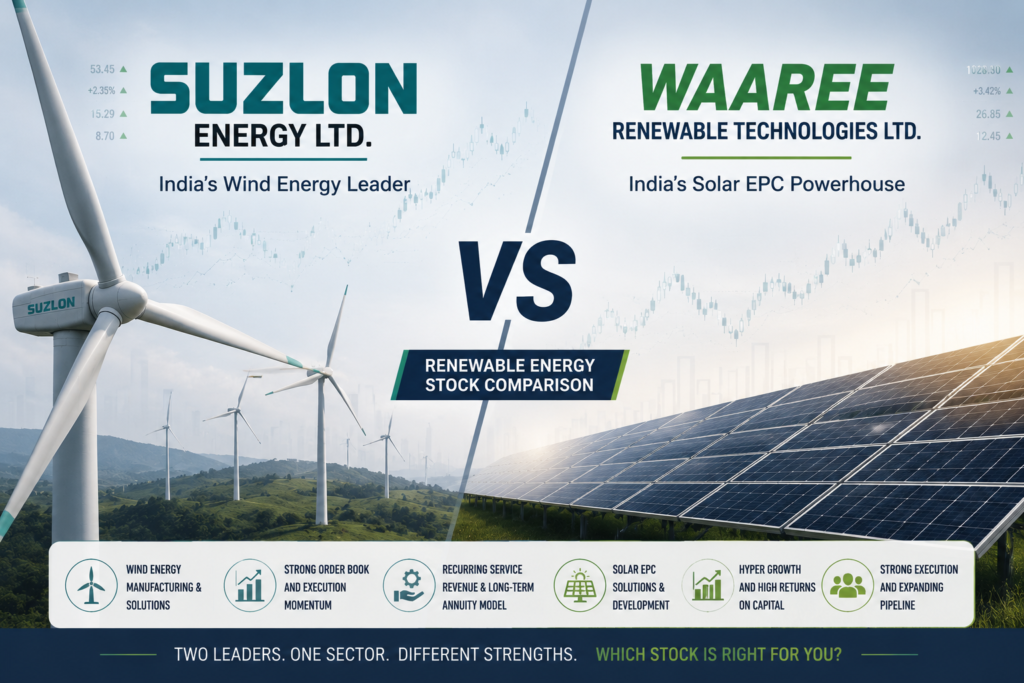
TL;DR (Executive Summary)
- Suzlon Energy wins on business durability, valuation comfort, and risk-adjusted returns.
- Waaree Renewable wins on pure growth potential.
- Suzlon is evolving into a renewable infrastructure platform with recurring service revenues.
- Waaree Renewable is an execution-driven solar EPC growth story that must continuously win new projects.
- If I had to choose only one stock today, I would choose Suzlon Energy.
One Nearly Went Bankrupt. The Other Is Growing at Warp Speed.
One stock spent years fighting for survival.
The other is delivering return ratios that most listed companies can only dream about.
One is rebuilding itself into a renewable infrastructure powerhouse.
The other is riding India’s solar boom with extraordinary execution.
Both have generated enormous wealth.
Both are among the most discussed renewable stocks in India.
But here’s the uncomfortable truth:
Most investors comparing Suzlon and Waaree Renewable are comparing the wrong things.
This is not a battle between two renewable stocks.
It is a battle between two completely different business models.
And understanding that difference may determine which stock creates more wealth over the next decade.
Quick Snapshot
| Metric | Suzlon Energy | Waaree Renewable |
| Current Price | ₹53.5 | ₹1,028 |
| Market Cap | ₹72,719 Cr | ₹10,728 Cr |
| PE Ratio | 22.5 | 22.4 |
| PEG Ratio | 0.12 | 0.21 |
| ROE | 41.4% | 68.9% |
| ROCE | 32.5% | 83.6% |
| Debt-to-Equity | 0.05 | 0.16 |
| Dividend Yield | Negligible | Negligible |
| FY20 Revenue | ₹2,973 Cr | ₹6 Cr |
| FY26 Revenue | ₹15,029 Cr | ₹3,331 Cr |
| FY26 Profit | ₹2,752 Cr | ₹641 Cr |
The Core Thesis
This Is Not Growth vs Growth
It Is:
The Phoenix vs The Speedster
Suzlon Energy = The Phoenix
A company that survived a near-death experience, repaired its balance sheet, rebuilt investor trust, and is now benefiting from India’s renewable infrastructure cycle.
Waaree Renewable = The Speedster
A company growing at breathtaking speed, delivering exceptional returns on capital, and benefiting from India’s solar expansion.
The key question isn’t:
Which company is growing faster?
The real question is: Which business model is more likely to create sustainable shareholder wealth over the next decade?
Layer 1: Valuation Comparison
Same PE. Very Different Expectations.
At first glance, both companies look similarly valued.
| Metric | Suzlon | Waaree |
| PE Ratio | 22.5 | 22.4 |
| PEG Ratio | 0.12 | 0.21 |
Many investors stop their analysis here.
That is a mistake.
The market is not pricing two identical businesses.
It is pricing two completely different futures.
The Suzlon Skepticism Discount
Despite its turnaround, Suzlon is still carrying baggage from its past.
Investors remember:
- Debt problems
- Governance concerns
- Operational struggles
- Restructuring years
As a result, the market may still be partially valuing Suzlon based on what it used to be rather than what it has become.
This creates what I call:
The Skepticism Discount
When a company’s fundamentals improve faster than its reputation, valuation opportunities emerge.
The Waaree Perfection Premium
Waaree faces the opposite situation.
Investors see:
- Hypergrowth
- 80%+ ROCE
- Massive solar opportunity
- Strong execution
And many assume this trajectory will continue indefinitely.
That assumption can be dangerous.
Because when a stock is priced for perfection, even a small disappointment can trigger a large correction.
What Investors Are Missing
The biggest valuation risk is not paying a high PE.
The biggest valuation risk is paying a reasonable PE for earnings that may not be as durable as they appear.
Valuation Winner: Suzlon Energy
Layer 2: Growth Comparison
This Round Goes to Waaree
There is no point pretending otherwise.
Waaree’s growth has been extraordinary.
Waaree Renewable
Revenue:
₹6 Cr → ₹3,331 Cr
Profit:
₹1 Cr → ₹641 Cr
This is one of the fastest growth stories in India’s renewable sector.
Suzlon Energy
Revenue:
₹2,973 Cr → ₹15,029 Cr
Profit:
Loss → ₹2,752 Cr
This is one of the most impressive corporate turnarounds in Indian market history.
Which Company Can Grow Faster?
The answer is clear.
Waaree Renewable
Why?
Because:
- Smaller base
- Solar sector expansion
- New growth verticals
- Larger runway for percentage growth
But investors should remember:
Fastest growth does not automatically create the best investment outcome.
The stock market rewards growth.
But it rewards sustainable growth even more.
Growth Winner: Waaree Renewable
Layer 3: Business Model & Moat
This Is The Most Important Section In This Entire Comparison
Because this is where the two businesses become fundamentally different.
Suzlon’s Hidden Advantage: The Annuity Engine
Most investors think Suzlon simply sells wind turbines.
That is incomplete.
Every turbine installed creates future service opportunities.
Maintenance.
Monitoring.
Operations support.
Performance optimization.
Over time, Suzlon’s growing installed base can become an increasingly valuable recurring revenue platform.
Think of it as:
An Annuity Engine
Each turbine sold today can potentially generate service revenues for years.
The customer relationship doesn’t end after installation.
In many ways, it begins there.
Waaree Renewable’s Challenge: The Treadmill Business
Waaree’s EPC business operates differently.
Projects get completed.
Revenue gets recognized.
Then the cycle restarts.
To maintain growth:
- New contracts must be won
- New projects must start
- New bids must be secured
The treadmill never stops.
If project wins slow down, growth slows down.
That does not make Waaree a bad business.
But it does make it a less naturally recurring business.
The Key Insight
Investors often focus on revenue growth.
Smart investors focus on revenue durability.
And revenue durability generally deserves a premium.
Moat Winner: Suzlon Energy
Layer 4: Risk Comparison
Both Stocks Have Risks
The question is:
Which risks are easier to manage?
Suzlon Risks
Structural Risks
- Renewable policy dependence
- Wind industry cyclicality
- Platform concentration around S144
- Execution complexity
Cyclical Risks
- Land acquisition delays
- Transmission bottlenecks
- Order conversion timing
Waaree Risks
Structural Risks
- Policy dependency
- Margin sustainability concerns
- Capital allocation into IPP and BESS
- Project concentration risk
Cyclical Risks
- EPC execution delays
- Solar module pricing volatility
- Revenue lumpiness
What Investors Are Missing
Many investors look at Waaree’s ROCE and assume risk is low.
The opposite may be true.
Exceptionally high returns often attract competition.
The real question is not:
Can Waaree maintain growth?
The real question is:
Can Waaree maintain these economics?
That question remains unanswered.
Risk Winner: Suzlon Energy
Layer 5: Management & Capital Allocation
Suzlon Management
Management deserves significant credit.
The company has:
- Repaired the balance sheet
- Reduced debt dramatically
- Improved execution
- Expanded manufacturing capability
The turnaround is no longer theoretical.
It is visible in the numbers.
Waaree Management
Management has executed exceptionally well.
Few companies scale this rapidly without operational excellence.
However, the next chapter becomes more challenging.
Moving into:
- Battery Energy Storage Systems (BESS)
- Independent Power Production (IPP)
- Hydrogen opportunities
requires a different level of capital allocation discipline.
Investors should monitor this transition carefully.
Management Winner: Slight Edge to Suzlon
The One-Chart Test
| Question | Suzlon | Waaree |
| Can growth surprise positively? | ✅ High | ⚠ Moderate |
| Can margins disappoint? | ⚠ Moderate | 🚨 High |
| Is valuation forgiving? | ✅ Yes | ⚠ Less |
| Is revenue recurring? | ✅ Partial | ❌ Limited |
| Is sentiment already bullish? | ⚠ Moderate | 🚨 Very High |
The Most Important Insight
If a stock requires perfection to justify its valuation, risk becomes invisible.
If a stock only requires continued execution to justify its valuation, opportunity remains.
That distinction matters a lot.
Final Verdict
🏆 Winner for Growth: Waaree Renewable
🛡️ Winner for Stability: Suzlon Energy
🏆 Winner for Business Quality: Suzlon Energy
🏆 Winner for Valuation: Suzlon Energy
🏆 Winner for Risk-Adjusted Returns: Suzlon Energy
💰 Winner for Income: Neither
If I Could Buy Only One
If someone forced me to allocate fresh money into only one of these businesses today, I would choose Suzlon Energy.
Not because it is growing faster.
Waaree probably wins that battle.
I would choose Suzlon because investing is not about finding the fastest horse.
It is about finding the best balance between growth, durability, and expectations.
Waaree is priced for continued excellence.
Suzlon is still fighting its past.
And in the stock market, some of the biggest opportunities emerge when a company’s future improves faster than its reputation.
That is why Suzlon gets my vote.
Key Factors To Monitor
Suzlon
- Order book growth
- OMS contribution
- Free cash flow conversion
- Working capital discipline
- S144 platform execution
Waaree Renewable
- Margin sustainability
- EPC order book quality
- Debt trajectory
- BESS investments
- Cash flow transparency
Frequently Asked Questions
Which stock is better for long-term investment?
For most investors, Suzlon currently offers a better combination of valuation comfort, business durability, and renewable sector exposure.
Which stock has higher growth potential?
Waaree Renewable has higher growth potential due to its smaller base and exposure to India’s rapidly expanding solar ecosystem.
Which stock is safer?
Suzlon appears relatively safer because of its stronger balance-sheet position, installed-base advantage, and recurring service opportunities.
Is Waaree Renewable overvalued?
Not necessarily. However, the stock’s future returns will depend heavily on maintaining current margins and execution quality.
Why do many investors prefer Suzlon?
Investors increasingly view Suzlon as a turnaround story evolving into a renewable infrastructure platform rather than simply a wind turbine manufacturer.
Can both stocks outperform over the next decade?
Yes. India’s renewable sector remains one of the strongest long-term themes in the country. However, the path and risk profile of each stock are very different.
Final Thought
This is not a choice between a good company and a bad company.
It is a choice between two very different ways of creating shareholder value.
One relies on building a recurring renewable ecosystem.
The other relies on relentless execution.
One is the Phoenix.
One is the Speedster.
The winner over the next decade may not be the company that grows the fastest.
It may be the company whose business model proves the most durable.
Disclaimer
The analysis provided on this blog, including the “5-Layer Framework,” is for educational and informational purposes only. I am not a SEBI-registered investment advisor. Stock market investing involves significant risk, and past performance is not indicative of future results. The views expressed here are my personal opinions based on my research and study of financial literature. This is not a buy or sell recommendation. Please conduct your own due diligence or consult a qualified, SEBI-registered financial advisor before making any investment decisions. The author may or may not hold positions in the stocks discussed.
About the Author

Nilendu Chatterjee is the founder of Equity Blueprint, a platform focused on helping retail investors approach the stock market with clarity, structure, and discipline. With over a decade of experience in the industrial sector and a strong passion for equity research, he brings a practical, ground-level perspective to fundamental analysis.
Through a framework-driven approach, Nilendu breaks down complex businesses into simple, decision-oriented insights—bridging the gap between professional-grade research and everyday investing. His work is centered on one goal: enabling long-term wealth creation by replacing speculation with structured thinking.