Ticker: NSE: TCS
Sector: Information Technology Services & Business Process Management
Category: Large Cap
Framework: Equity Blueprint 5-Layer Fundamental Analysis Framework
Analysis Period: FY2018–FY2026, with Q1 FY2027 update
Latest quarter considered: Q1 FY2027, ended June 30, 2026
Introduction
For years, Tata Consultancy Services was one of those rare companies where investors faced an unusual problem: the business was so consistently good that the stock often looked expensive.
That equation has changed.
TCS remains one of India’s strongest corporate franchises, with enormous scale, global enterprise relationships, high profitability, strong cash generation and minimal financial leverage. But its valuation has compressed sharply as the growth rate of traditional IT services has slowed and investors have become increasingly uncertain about how artificial intelligence will reshape the industry’s economics.
That creates a much more interesting investment question.
Is the market pricing TCS as a slowing legacy IT company when it should be valued as a high-quality technology company entering a new AI-led cycle?
Or is the lower valuation simply compensation for a structurally slower-growth business?
The answer matters because TCS does not need to become a high-growth company for the stock to work from here. It needs to maintain its exceptional economics while generating enough incremental growth to justify a reasonable valuation.
FY2026 provides both reasons for optimism and reasons for caution. Revenue reached ₹2,67,021 crore, while operating profit was ₹66,838 crore and operating margin improved to 25%. Over the five years through FY2026, revenue compounded at 10.2%. Yet constant-currency revenue declined 2.4% in FY2026, demonstrating that the underlying growth environment remains challenging.
Then came Q1 FY2027.
Revenue rose 13.9% in reported INR terms to ₹72,275 crore, TCV reached $9.5 billion, annualised AI revenue reached $2.6 billion and operating margin was 24%.
The numbers suggest that the business may be approaching an inflection point.
But one quarter does not establish a new cycle.
That is why this TCS fundamental analysis focuses not simply on whether the company is good, but on valuation, growth durability, management execution, competitive advantage and the risks that could permanently change the economics of the business.
TL;DR — TCS in 60 Seconds
TCS remains one of India’s highest-quality businesses.
Its competitive position is supported by global scale, deep enterprise relationships, delivery capabilities, high profitability and a strong balance sheet. FY2026 operating margin reached 25%, while the company’s five-year revenue CAGR was 10.2%.
The weakness is growth.
FY2026 constant-currency revenue declined 2.4%, and the broader IT-services industry is undergoing a fundamental transition as clients demand greater productivity from AI and increasingly link technology spending to measurable business outcomes.
The valuation is now considerably more interesting than it was historically. TCS trades at roughly the mid-teens PE range, while its long-term historical valuation has been materially higher.
The AI opportunity is becoming tangible. Annualised AI revenue reached $2.6 billion in Q1 FY2027, up 13.6% sequentially, while quarterly TCV stood at $9.5 billion.
The risk is that AI could also reduce the labour intensity of traditional IT services, forcing TCS to generate new revenue faster than automation erodes existing revenue pools.
Equity Blueprint Verdict: Structural Buy — but with growth confirmation required.
The stock is interesting because the valuation has already adjusted for weaker growth. The investment thesis becomes substantially stronger if constant-currency growth accelerates, AI revenue continues scaling and margins remain resilient.
Quick Snapshot: TCS
| Metric | TCS |
| Current Price* | ~₹2,300 |
| Market Capitalisation* | ~₹8.3 lakh crore |
| PE* | ~15–17× |
| 10-Year Median PE* | ~26.9× |
| PEG* | ~2.1× |
| PB* | ~7× |
| Dividend Yield* | ~4.7–4.8% |
| Debt-to-Equity* | ~0.1× |
| FY2026 Revenue | ₹2,67,021 crore |
| FY2026 Operating Profit | ₹66,838 crore |
| FY2026 Operating Margin | 25.0% |
| FY2026 Net Income | ₹52,820 crore |
| FY2022–FY2026 Revenue CAGR | 10.2% |
| Q1 FY2027 Revenue | ₹72,275 crore |
| Q1 FY2027 Revenue Growth | 13.9% YoY |
| Q1 FY2027 TCV | $9.5 billion |
| Annualised AI Revenue | $2.6 billion |
| Q1 FY2027 Operating Margin | 24.0% |
*Market valuation figures can change daily; the analytical conclusion should therefore be read in the context of the valuation range rather than a single market price.
Abbreviations Used in This Article
| Abbreviation | Full Form |
| TCV | Total Contract Value |
| PE | Price-to-Earnings Ratio |
| PEG | Price/Earnings-to-Growth Ratio |
| PB | Price-to-Book Ratio |
| ROE | Return on Equity |
| ROCE | Return on Capital Employed |
| EBIT | Earnings Before Interest and Tax |
| EBITDA | Earnings Before Interest, Tax, Depreciation and Amortisation |
| PAT | Profit After Tax |
| FCF | Free Cash Flow |
| D/E | Debt-to-Equity Ratio |
| AI | Artificial Intelligence |
| BPM | Business Process Management |
| BFSI | Banking, Financial Services and Insurance |
| CC | Constant Currency |
| CAGR | Compound Annual Growth Rate |
| FY | Financial Year |
Industry Landscape
Industry Overview
India’s IT-services industry has evolved from a cost-arbitrage outsourcing model into a global technology transformation industry.
The first major wave was driven by India’s ability to provide large numbers of technically skilled professionals at substantially lower costs than developed-market alternatives.
That advantage created enormous global delivery businesses.
The industry has since moved progressively higher in the value chain.
Application development gave way to digital transformation. Digital transformation expanded into cloud migration, cybersecurity, data modernisation and enterprise platforms. The latest transition is toward generative AI, agentic AI and AI-enabled business transformation.
This matters for investors because the economics of the industry are changing along with the technology.
Historically, revenue was closely linked to the number of people deployed.
Increasingly, clients want technology companies to deliver outcomes, productivity and business transformation rather than simply provide additional engineers.
Recent industry developments show this shift clearly. Indian IT companies are increasingly moving toward outcome-based contracts as clients demand more productivity for their technology budgets. At the same time, smaller firms have been able to compete more effectively in AI-led projects because of their speed and flexibility.
Industry Size and Growth
The global IT-services market is enormous and remains highly fragmented.
TCS’s FY2022 annual report cited global technology spending of approximately $1.7 trillion in 2021, with global IT services at more than $899 billion and BPM at roughly $211 billion. The same report noted that even the largest global IT-services provider held only a mid-single-digit market share, while TCS had approximately 2.3% of the global IT-services market at that time.
This fragmentation is important for investors.
TCS does not need to take business away from one dominant competitor to grow. The addressable market itself continues to expand as enterprises spend more on cloud, cybersecurity, AI, data modernisation and digital transformation.
The industry’s long-term growth drivers are therefore broader than India’s GDP.
A bank in Europe modernising its core systems, a manufacturer deploying AI across factories, a retailer rebuilding its digital commerce platform or an insurer moving legacy applications to the cloud can all become sources of IT-services demand.
Industry Value Chain — Where Does TCS Actually Make Money?
The IT-services value chain is different from the conventional manufacturing value chain.
Instead of raw materials moving through factories, value moves primarily through human capital, intellectual property, technology platforms, infrastructure and customer relationships.
A simplified value chain looks like this:
Talent → Consulting → Architecture → Software Engineering → Integration → Implementation → Operations → Maintenance → Transformation → End Customer
TCS participates across almost every meaningful stage.
It provides consulting and transformation services, develops and modernises applications, migrates enterprises to cloud platforms, operates technology infrastructure, provides cybersecurity, builds industry-specific solutions and manages long-term technology operations.
Its business model is therefore broader than “software outsourcing.”
The company’s core function is helping organisations use technology to improve operations, efficiency and customer experience. Revenue sources include consulting, software development, cloud, AI, cybersecurity, engineering services and BPM.
This breadth matters because it increases the potential share of wallet TCS can capture from a large enterprise client.
A bank might initially hire TCS for application maintenance.
That relationship can eventually expand into cloud migration, core-banking modernisation, cybersecurity, data engineering, AI, consulting and business-process transformation.
That is one reason long-term client relationships are economically valuable.
Key Industry Growth Drivers
The first structural driver is the increasing technology intensity of businesses.
Banks, manufacturers, retailers, insurers and healthcare companies increasingly depend on digital infrastructure.
The second is cloud migration.
Large enterprises continue modernising legacy systems and moving workloads into hybrid and public-cloud environments.
The third is cybersecurity.
As digital dependence increases, cybersecurity becomes an operating necessity rather than a discretionary technology expense.
The fourth is AI.
Generative AI and agentic systems are creating new categories of enterprise technology expenditure.
The fifth is India’s growing role in global technology delivery and Global Capability Centres.
These factors provide the industry with a strong structural demand base even when discretionary spending temporarily weakens.
Industry Risks
The industry is not risk-free.
The first risk is economic cyclicality.
When global enterprises face recession fears, they often postpone discretionary technology transformation projects, even though they continue spending on mission-critical infrastructure.
This was visible in TCS’s recent results. Management repeatedly described delayed decision-making, cost optimisation, vendor consolidation and macroeconomic uncertainty as important demand factors.
Manufacturing, for example, experienced softness linked to macro and industry-specific pressures in automotive and aerospace during FY2025.
The second risk is technological disruption.
AI can create additional demand for technology services, but it can also automate parts of the traditional software-development process.
The crucial investor question is therefore not whether AI is good or bad for TCS.
It is:
Will the additional revenue opportunity created by AI exceed the traditional labour-based revenue that AI eventually displaces?
That remains a key long-term variable.
Industry Structure
The industry is highly organised at the top end.
Large companies such as TCS, Infosys, HCLTech, Wipro and Tech Mahindra dominate large global transformation contracts, while smaller firms compete in specialised technologies, industries and regional markets.
Competition is intense, but it is not purely price-based.
Large enterprises care about:
- delivery reliability,
- cybersecurity,
- domain expertise,
- global presence,
- regulatory compliance,
- talent availability,
- technology partnerships,
- implementation capability and
- the supplier’s ability to remain relevant for many years.
This creates meaningful advantages for incumbents.
Once a global bank has embedded a technology-services provider deeply into its operations, changing providers can become expensive and operationally risky.
That switching friction is one of the industry’s most important economic characteristics.
Industry Outlook: 3–5 Years
The structural outlook remains positive, but the growth mix will change.
Cloud, cybersecurity, AI, data modernisation and digital engineering should remain important sources of spending.
Traditional labour-intensive services will increasingly face automation and productivity pressure.
This suggests that the strongest companies will not necessarily be those with the largest employee bases.
They will be the companies that can combine:
Scale + AI Capability + Productivity + Domain Expertise + Customer Trust
TCS enters this transition from a position of considerable strength.
Industry Positioning — Where Does TCS Stand?
TCS is clearly an industry leader, not a challenger, niche player or turnaround candidate.
Its FY2026 profile included more than 580,000 consultants, operations across 56 countries and 194 delivery centres, with consolidated revenue of approximately $30 billion.
But scale alone does not explain its leadership.
The more important competitive loop is:
Brand → Client Trust → Large Contracts → Cash Flow → Talent Investment → Delivery Capability → Customer Satisfaction → Larger Contracts
That loop has been built over decades.
And that brings us to the actual TCS investment case.
Layer 1 — Valuation Discipline
Is TCS Cheap or Is the Market Simply Pricing in Slower Growth?
TCS is currently trading at approximately 15.5× earnings, compared with a 10-year median PE of 26.9×.
That is a substantial historical discount.
At first glance, this looks like an obvious opportunity.
But valuation cannot be analysed in isolation.
A company deserves a lower PE when its future growth expectations are lower.
And TCS’s recent growth trajectory has clearly moderated.
Therefore, the correct question is not:
“Is 15.5× cheaper than 26.9×?”
It obviously is.
The correct question is:
“Is TCS’s future growth strong enough for 15.5× earnings to be attractive?”
That is a much harder question.
PE: Attractive Relative to History
A PE of 15.5× for a company with approximately 51.8% ROE and 63% ROCE is difficult to dismiss as expensive.
The market is clearly assigning a lower valuation multiple than it historically gave TCS.
That could provide valuation support if earnings growth accelerates.
However, historical multiples should never be treated as a guaranteed fair value.
TCS previously commanded a higher multiple partly because investors expected stronger growth.
If the growth environment has permanently changed, the historical median PE should not automatically be treated as a target.
PEG: The Warning Hidden Behind the Low PE
The PEG ratio is approximately 2.07.
This produces an important contradiction.
TCS looks cheap compared with its historical PE, but it does not look exceptionally cheap when its current earnings growth is considered.
This tells us that the market is not blindly undervaluing TCS.
It is assigning a discount partly because growth has slowed.
That makes the valuation thesis dependent on future growth recovery.
Debt-to-Equity: No Structural Balance-Sheet Problem
TCS’s D/E ratio is approximately 0.11.
This is extremely conservative.
More importantly, the company does not require large amounts of debt to operate its business.
Its capital-light model allows it to generate substantial cash while maintaining a strong balance sheet.
This distinction is important when evaluating valuation.
A low PE can sometimes indicate a value trap because the market is anticipating financial stress.
There is little evidence of that type of problem at TCS.
ROE and ROCE
TCS’s return ratios remain exceptional.
High returns on capital are particularly valuable in an IT-services company because the business is relatively asset-light.
A company that can generate very high returns without requiring substantial incremental capital has a natural compounding advantage.
The challenge is maintaining those returns as AI changes the business model.
If AI investment requires substantially more capital while revenue growth does not accelerate, future incremental returns could fall.
That is why investors should monitor not only today’s ROCE, but also the return generated on new capital deployed into the AI strategy.
Liquidity: Strong
The current ratio and quick ratio are both around 1.67.
The company’s financial position therefore provides considerable protection against short-term liquidity pressure.
But liquidity is not the main reason to own TCS.
The much more important point is that the company generates substantial operating cash flow while requiring relatively modest amounts of capital to sustain its core business.
Valuation Verdict
TCS does not appear expensive on historical PE.
But it also cannot be called an obvious deep-value opportunity simply because the PE has fallen.
The market appears to be saying:
“I will pay less for TCS because its growth has slowed—but I still recognise the exceptional quality of the underlying business.”
That assessment is reasonable.
Layer 1 Verdict: Attractive valuation relative to history, but not a classic deep-value setup because current growth expectations remain the key constraint.
Layer 2 – Growth Consistency: Is TCS Still a Growth Company?
This is where the TCS analysis becomes much more nuanced.
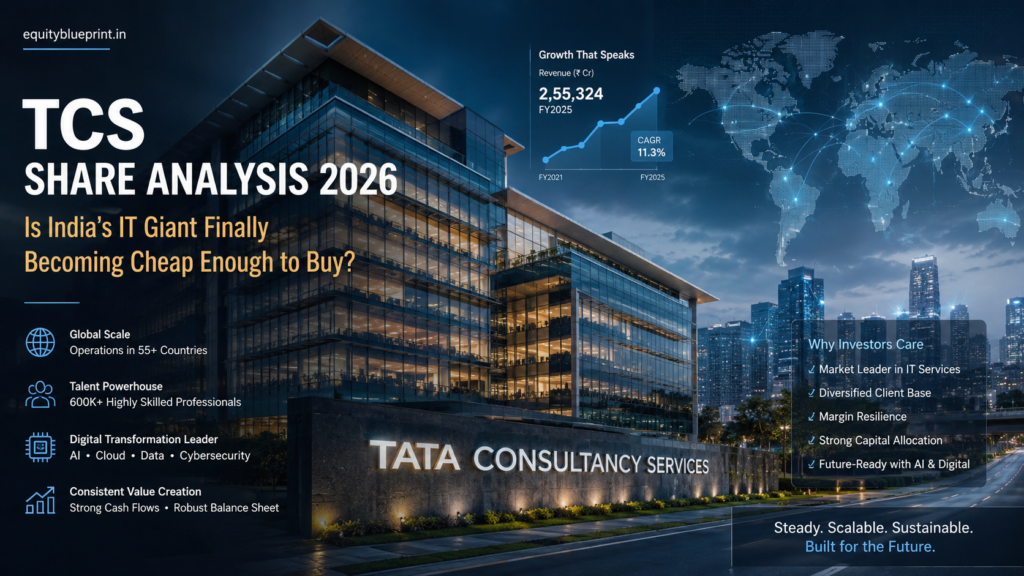
Over the five financial years from FY2021 to FY2025, revenue increased from ₹164,177 crore to ₹255,324 crore, representing a 10.2% CAGR according to the company’s annual report.
The progression was:
FY2021: ₹164,177 crore
FY2022: ₹191,754 crore
FY2023: ₹225,458 crore
FY2024: ₹240,893 crore
FY2025: ₹255,324 crore
FY2026: ₹267,021 crore
That history demonstrates that TCS has unquestionably compounded revenue over the long term.
But the trajectory matters more than the average.
The company moved from exceptionally strong growth during FY2021–FY2023 into a much slower environment.
FY2025 revenue growth was 6.0%, while FY2026 growth fell to 4.6%.
More revealingly, FY2026 constant-currency growth declined 2.4%. The reported 4.6% growth benefited from a 7% positive currency impact.
This is an important warning.
TCS did not suddenly become a weak company.
Instead, the global enterprise technology spending environment became more cautious.
Clients prioritised cost optimisation, vendor consolidation, technology modernisation, legacy transformation and cloud/data modernisation, while geopolitical and macroeconomic uncertainty delayed some decisions.
That means the recent slowdown has a meaningful cyclical component.
But investors should not dismiss it entirely as temporary.
AI creates a second question:
Could the technology-services industry itself be undergoing a structural productivity reset?
If AI allows one engineer to perform work previously done by several engineers, the revenue model of labour-intensive services could change.
TCS’s response is to move toward AI-led transformation rather than simply defend traditional outsourcing.
The latest quarter provides evidence that this strategy is beginning to generate measurable demand.
Q1 FY2027 revenue grew 13.9% year-on-year in rupee terms, while AI-services annualised revenue reached $2.6 billion.
However, one quarter does not establish a new multi-year trend.
The correct conclusion is therefore:
TCS’s long-term growth record is excellent, but its current organic growth trajectory remains unproven.
Is Growth Debt-Fuelled?
No.
This is one of the strongest aspects of the TCS story.
The company has historically generated substantial operating cash flow while maintaining a very conservative balance sheet. FY2026 ROE remained above 50%, while the company continued returning substantial cash to shareholders.
Therefore, the slowdown is not being hidden by aggressive leverage.
That makes the recent growth weakness much easier to interpret.
AI: Growth Engine or Revenue Disruptor?
This is arguably the most important question in the entire TCS investment thesis.
Imagine a software project historically requiring 100 engineers.
If AI tools eventually allow the same output to be produced by 50 engineers, TCS could face pressure on traditional revenue even though the client becomes more productive.
But the same client might subsequently use AI to transform additional business processes, modernise more systems and build entirely new digital products.
That creates additional technology spending.
TCS therefore needs the second effect to outweigh the first.
The early evidence is encouraging.
Annualised AI-services revenue reached $2.6 billion in Q1 FY2027, up 13.6% sequentially.
That is no longer a purely conceptual opportunity.
It is becoming a measurable revenue stream.
But it is still too early to declare victory.
The critical question is whether AI revenue can grow rapidly enough over several years to materially change the company’s consolidated growth rate.
Layer 2 Verdict
TCS passes the quality-of-growth test but not the high-growth test at present.
The next major value-creation phase depends on whether AI, cloud, cybersecurity, platform modernisation and enterprise transformation can push growth back toward a structurally higher level.
Layer 2 Verdict: High-quality structural business, but current growth requires confirmation rather than assumption.
Layer 3 – Management Execution: Can TCS Turn AI Ambition Into Earnings?
Management credibility is particularly important at TCS because the company is attempting to transform an enormous organisation without damaging the economics that made it successful.
The stated ambition is aggressive:
Become the world’s largest AI-led technology-services company.
That is not merely a marketing statement anymore.
TCS has begun building infrastructure, partnerships, talent capabilities and acquisitions around that objective.
Its FY2026 strategy spans the full AI stack—from infrastructure and tools to data, models and applications.
The company has partnered with OpenAI, Google Cloud, AMD, NVIDIA, ServiceNow and other ecosystem players. It also created HyperVault to participate in AI data-centre infrastructure and acquired ListEngage and Coastal Cloud to strengthen Salesforce capabilities.
This represents a significant change from the traditional IT-services playbook.
TCS is attempting to become an orchestrator across the AI ecosystem rather than simply an implementation vendor.
That could be strategically valuable.
But strategy must ultimately show up in financial performance.
And there are encouraging early signals.
In Q1 FY2027, annualised AI-services revenue reached $2.6 billion, up 13.6% sequentially. TCV was $9.5 billion, including an $800 million SKF mega-deal and other AI-led transformation contracts.
The company is also investing heavily in AI talent. Earlier management commentary indicated close to 160,000 associates with higher-order AI skills and more than 10,000 sales and delivery leaders trained through AI-focused programmes.
These are tangible actions.
But there is an important counterpoint.
TCS’s Q1 FY2027 operating margin declined to 24% from the previous quarter, with annual wage increments alone affecting margins by approximately 170 basis points. Management deliberately chose to continue investing in AI capabilities, talent, partnerships, platforms and go-to-market capacity rather than optimise margins in isolation.
This is strategically sensible.
But investors must eventually see returns on that investment.
That creates the central management test for the next three years:
Can TCS transform today’s AI investment into higher revenue growth and stronger productivity without permanently sacrificing its industry-leading margins?
So far, management execution remains credible.
The company has repeatedly demonstrated an ability to navigate technology cycles—from mainframes to cloud to AI—and its FY2026 performance showed that it could expand margins even while reinvesting in new capabilities.
Capital Allocation
TCS has historically been extremely shareholder-friendly.
FY2026 shareholder payouts were substantial, while the company continued investing through a “Build, Partner, Acquire” framework.
The new investment phase does create one area worth monitoring.
HyperVault and AI infrastructure involve materially different capital requirements from traditional IT services.
TCS has therefore begun moving into an adjacent business model that is more infrastructure-intensive.
That does not automatically make the strategy bad.
But it does mean investors should evaluate whether these investments generate attractive returns rather than simply expanding the company’s strategic footprint.
Layer 3 Verdict: Excellent execution history with credible AI transition; the next test is converting strategic investment into incremental economic returns.
Layer 4 — Risk Identification
TCS’s risks are not primarily financial.
They are strategic and cyclical.
1. Global IT Spending Risk
TCS generates a large proportion of its revenue internationally.
North America is particularly important, while BFSI is one of its largest industry verticals.
A prolonged slowdown in US or European technology spending could therefore suppress growth.
This is a cyclical risk, not necessarily a structural threat.
2. AI Disruption Risk
This is the most important structural risk.
AI could reduce the labour intensity of software development, application maintenance and certain business processes.
If TCS cannot monetise the new AI opportunity quickly enough, its traditional revenue pools could face pressure.
This is why AI is simultaneously the company’s biggest opportunity and one of its biggest risks.
3. Margin Risk
TCS has historically operated with excellent margins.
But wage inflation, reskilling, AI investments, acquisitions and new infrastructure can create pressure.
Investors should therefore watch whether productivity improvements eventually offset these investments.
4. Talent Risk
Technology changes rapidly.
Skills that were valuable five years ago may become less valuable over the next five years.
TCS must therefore continually retrain a massive workforce.
This creates both cost and execution risk.
5. Competitive Risk
TCS competes against Indian IT majors, global consulting companies, technology platforms and specialised AI companies.
Competition is unlikely to disappear.
The company’s defence is scale, trust, delivery capability and deep customer relationships.
6. Currency Risk
The difference between reported growth and constant-currency growth during FY2026 demonstrates why currency matters.
Reported revenue grew 4.6%, while constant-currency growth was negative 2.4%.
Investors should therefore focus on underlying business growth rather than relying exclusively on rupee-denominated growth.
7. Capital Allocation Risk
The expansion into AI infrastructure introduces a new variable.
The traditional TCS model is highly capital efficient.
Investors should ensure that new capital-intensive initiatives generate returns commensurate with the company’s historically high standards.
TCS Risk Heat Map
| Risk | Severity | Nature |
| Global IT spending slowdown | Medium | Cyclical |
| AI disruption | High | Structural |
| Margin pressure | Medium | Structural/Cyclical |
| Talent transition | Medium | Structural |
| Competitive intensity | Medium | Structural |
| Currency volatility | Low–Medium | Cyclical |
| AI infrastructure investment | Medium | Strategic |
| Balance-sheet stress | Low | Financial |
The most important conclusion is that TCS does not have a conventional financial-distress risk profile.
Its principal risks concern the future economics of technology services.
Peer Perspective: Why TCS Deserves a Premium
A stock does not exist in isolation.
TCS competes with companies such as Infosys, HCLTech, Wipro and Tech Mahindra, but the investment decision should not be reduced to asking which company has the lowest PE.
The more useful comparison is economic quality.
TCS combines:
Scale + Profitability + Cash Generation + Balance-Sheet Strength + Client Relationships + Global Reach
That combination is difficult to replicate.
A competitor may occasionally grow faster.
Another may trade at a lower multiple.
Another may benefit from a specific industry cycle.
But TCS’s investment case comes from the combination of quality and resilience.
That is why a premium valuation can historically be justified.
The interesting development today is that this premium has compressed considerably.
The stock therefore does not need to become the fastest-growing company in the sector to generate attractive returns.
It needs to demonstrate that its superior business quality remains intact while growth normalises.
What Should Investors Monitor Every Quarter?
Rather than reacting to TCS’s share price, investors should monitor the variables that actually influence intrinsic value.
The first is constant-currency revenue growth.
Reported rupee growth can be distorted by exchange rates. The underlying business should therefore be evaluated through constant-currency performance.
The second is TCV and deal quality.
A strong TCV is encouraging, but investors should examine whether contracts are converting into revenue and whether they generate acceptable margins.
The third is AI-services revenue.
This is perhaps the single most important new KPI for the next phase of TCS.
Q1 FY2027 annualised AI-services revenue stood at $2.6 billion.
The fourth is operating margin.
The key question is not whether margins fluctuate by 50–100 basis points.
The question is whether AI-driven productivity eventually offsets the cost of reskilling, wage inflation and new capability investments.
The fifth is cash conversion.
TCS remains attractive because accounting profits translate into cash.
Q1 FY2027 cash conversion remained strong at 93% of net income.
Finally, investors should monitor capital allocation around acquisitions and AI infrastructure.
If TCS begins deploying increasingly large amounts of capital, return on invested capital becomes even more important.
Layer 4 Verdict
TCS’s risk profile is fundamentally different from a weak or financially stressed company.
The balance sheet is strong.
Liquidity is comfortable.
Cash generation is excellent.
The major uncertainty lies elsewhere.
Can TCS remain economically relevant as AI changes the technology-services value chain?
So far, management is responding proactively.
But investors should not treat management’s AI narrative as proof of future earnings.
The proof will come through:
AI revenue → client wins → revenue growth → productivity → margins → cash flow → shareholder returns.
Until that chain becomes visible over several years, AI should be treated as a promising growth engine—not yet as a guaranteed one.
Equity Blueprint Key Takeaway
TCS is not a turnaround story.
It is not a distressed-value opportunity.
It is a high-quality compounder whose growth engine is currently being rebuilt for a new technology cycle.
That distinction matters.
The biggest risk for TCS shareholders is unlikely to be bankruptcy, excessive debt or permanent financial deterioration.
The more realistic risk is multiple compression caused by prolonged low growth.
If revenue growth remains around 4–6% for years, the market may continue valuing TCS below its historical PE range.
If AI-led transformation, cloud modernisation and productivity improvements push growth meaningfully higher, today’s valuation could eventually prove attractive.
That leads us to the final question.
Layer 5 – Decision Discipline: Should You Allocate Capital to TCS Today?
After examining the industry, valuation, growth, management execution and risks, we can now bring the five layers together.
Layer 1 — Valuation
TCS trades at 15.5× PE in the supplied valuation snapshot versus a 10-year median of 26.9×. That is a substantial historical discount.
However, its PEG of 2.07 suggests the stock is not exceptionally cheap relative to its current growth rate.
Verdict: Attractive historical valuation, but growth-adjusted valuation is less compelling.
Layer 2 — Growth
The five-year revenue CAGR through FY2025 was 10.2%, but growth subsequently moderated. FY2026 reported revenue growth was 4.6%, while constant-currency growth declined 2.4%.
Q1 FY2027 provides an encouraging recovery signal, with 13.9% year-on-year rupee revenue growth.
Verdict: Long-term growth record is excellent; current acceleration requires confirmation.
Layer 3 — Management
TCS management has demonstrated an unusually strong ability to adapt across technology cycles.
The current AI strategy is backed by talent investments, partnerships, acquisitions, platforms and infrastructure rather than presentations alone.
Verdict: Excellent management execution with a credible strategic transition.
Layer 4 — Risk
The major risks are AI disruption, macroeconomic demand weakness, margin pressure, talent transformation and the capital intensity of new AI infrastructure initiatives.
None currently represents a balance-sheet threat.
Verdict: Moderate strategic risk, low financial risk.
Final Verdict: Structural Buy — But Growth Confirmation Is Essential
🟢 Equity Blueprint Verdict: STRUCTURAL BUY
TCS passes the capital-deployment test.
But it does not pass it because the company is simply “cheap.”
It passes because the combination of:
exceptional profitability + strong cash generation + very low leverage + industry leadership + long-term client relationships + technological adaptability + improving AI monetisation + historically attractive valuation
creates a favourable risk-reward profile for a long-term investor.
The caveat is important.
TCS should not be bought under the assumption that its historical 10–15% growth rate will automatically return.
The investment thesis now depends on a new equation:
Traditional IT resilience + AI-led revenue growth + productivity gains + disciplined capital allocation = next phase of TCS compounding.
If that equation works, the current valuation could provide meaningful upside.
If it fails and growth remains structurally stuck at mid-single digits, the stock may remain a high-quality but relatively slow compounder.
That is why the current valuation is interesting.
The market appears to have already lowered its expectations.
The investor does not need TCS to become a spectacularly fast-growing company.
It needs the business to demonstrate that the AI transition can restore sustainable growth without destroying its extraordinary profitability and cash economics.
That is a much more achievable investment thesis.
Equity Blueprint Monitoring Checklist
The next several quarterly results should be evaluated through the following lens:
| Metric | What Investors Want to See |
| Constant-Currency Growth | Sustained acceleration |
| TCV | Strong and improving quality |
| AI Revenue | Rapid growth |
| EBIT Margin | Stability or eventual expansion |
| Cash Conversion | Remains strong |
| ROE/ROCE | Remains structurally high |
| Attrition | Controlled |
| Large Deals | Increasing conversion into revenue |
| Client Concentration | No material deterioration |
| Capital Allocation | High returns on incremental capital |
The most important metric is not any single quarter’s EPS.
It is the relationship between growth, margins and cash generation.
Does TCS Have a Durable Competitive Moat?
TCS’s moat does not come from a patented software product.
It comes from a combination of scale, brand, talent, customer relationships, execution capability, financial strength and accumulated institutional knowledge.
Scale matters because TCS can spread investments in AI, cybersecurity, research and training across a huge client base.
Customer relationships matter because enterprise technology contracts can last for many years.
Talent matters because sophisticated technology transformation still requires human judgement, domain expertise and implementation capability.
Brand matters because a Fortune 500 company choosing a technology partner is not making a simple price comparison.
And financial strength matters because TCS can invest through downturns.
The company had more than 580,000 consultants across 56 countries and 194 delivery centres by FY2026, giving it enormous delivery scale.
Its historical ability to navigate technology transitions is perhaps the strongest moat of all.
The annual report describes relationships that have endured across technology cycles from mainframes to AI.
The moat is therefore not:
“TCS knows today’s technology.”
It is:
“TCS has repeatedly demonstrated an ability to learn tomorrow’s technology before yesterday’s technology becomes obsolete.”
That is a much more durable competitive advantage.
Equity Blueprint Growth Scorecard
| Growth Parameter | Assessment |
| Historical Revenue Growth | ⭐⭐⭐⭐⭐ Excellent |
| Historical Profit Growth | ⭐⭐⭐⭐⭐ Excellent |
| Recent Revenue Growth | ⭐⭐⭐☆☆ Moderate |
| AI Growth Potential | ⭐⭐⭐⭐⭐ Strong |
| Revenue Visibility | ⭐⭐⭐⭐☆ Strong |
| Cash Generation | ⭐⭐⭐⭐⭐ Excellent |
| Capital Efficiency | ⭐⭐⭐⭐⭐ Excellent historically |
| Growth Sustainability | ⭐⭐⭐⭐☆ Promising but unproven |
| Balance-Sheet Strength | ⭐⭐⭐⭐⭐ Excellent |
| Competitive Position | ⭐⭐⭐⭐⭐ Industry-leading |
These are qualitative assessments based on the company’s documented financial and operating characteristics, not predictions.
Equity Blueprint Final Takeaway
TCS remains one of India’s most impressive businesses.
Its balance sheet is strong.
Its cash generation is exceptional.
Its return ratios are outstanding.
Its competitive position is difficult to replicate.
Its management has repeatedly demonstrated the ability to adapt.
And importantly, the valuation is no longer demanding by TCS’s own historical standards.
But the next chapter is different from the last.
The old TCS investment thesis was relatively straightforward:
India’s IT-services industry grows → TCS gains market share → revenue compounds → margins remain strong → cash is returned to shareholders.
The new thesis is more complicated:
Enterprise AI adoption accelerates → TCS captures higher-value transformation work → AI productivity offsets labour intensity → revenue growth improves → margins remain resilient → cash generation compounds.
That transition is underway.
Q1 FY2027 is encouraging: revenue growth accelerated to 13.9% year-on-year in rupee terms, TCV reached $9.5 billion and annualised AI-services revenue reached $2.6 billion.
But one quarter is not a decade.
Therefore, disciplined investors should not buy TCS because “AI will change everything.”
They should buy it because TCS has the financial strength, client relationships, talent base and execution capability to potentially be one of the companies that monetises that change.
At the supplied valuation, the risk-reward profile is favourable enough to classify TCS as a Structural Buy for investors with a long-term horizon.
The key condition is simple:
The business must now prove that AI can restore sustainable growth without compromising the economic quality that made TCS a great business in the first place.
Frequently Asked Questions
Is TCS a good long-term investment?
TCS remains one of India’s highest-quality large-cap businesses because of its profitability, balance-sheet strength, cash generation, global scale and customer relationships. The key variable for future returns is growth. If AI and digital transformation restore stronger growth without materially damaging margins, the long-term investment case becomes considerably stronger.
Is TCS undervalued?
TCS currently trades at approximately 15.5× PE compared with its 10-year median of 26.9×. That makes it inexpensive relative to its historical valuation. However, its PEG of approximately 2.07 means investors should not assume that the stock is deeply undervalued simply because its PE has declined.
Is TCS a debt-free company?
TCS operates with extremely low financial leverage. Its D/E ratio is approximately 0.11, making balance-sheet risk relatively insignificant compared with the strategic risks associated with growth and technological disruption.
What is the biggest opportunity for TCS?
AI-led enterprise transformation is arguably the biggest long-term opportunity. TCS already had annualized AI-services revenue of $2.6 billion in Q1 FY2027, providing evidence that AI is beginning to become a meaningful business rather than merely a strategic theme.
What is the biggest risk for TCS?
The most important structural risk is AI itself. AI could create substantial new technology spending, but it could also reduce the amount of human labour required for traditional IT services. TCS must ensure that the revenue created by new AI-led services exceeds the revenue eventually displaced by automation.
Why has TCS’s growth slowed?
The slowdown has been influenced by weaker global technology spending, customer cost optimization, delayed discretionary projects and broader macroeconomic uncertainty. FY2026 constant-currency revenue growth was negative 2.4%, although reported rupee revenue increased 4.6% because of currency effects.
What should investors monitor in the next quarterly results?
Constant-currency growth, TCV, AI-services revenue, operating margin, cash conversion, large-deal conversion, attrition, ROE/ROCE and capital allocation should receive greater attention than short-term share-price movements.
Is TCS a Structural Buy or a Tactical Buy?
TCS fits the Structural Buy category because the investment thesis is based on long-term business quality, competitive advantages, cash generation and the potential for an AI-led growth cycle. It is not dependent on predicting short-term share-price movements.
Related Analysis:
Indian IT Services & BPM Industry Analysis (2026): The Complete Investor Handbookhttps://equityblueprint.in/indian-it-services-industry-analysis/
Infosys Stock Analysis 2026: Is the AI Opportunity Finally Worth the Valuation?Infosys Stock Analysis 2026: Is the AI Opportunity Finally Worth the Valuation?
Disclaimer
The analysis provided on this blog, including the “5-Layer Framework,” is for educational and informational purposes only. I am not a SEBI-registered investment advisor. Stock market investing involves significant risk, and past performance is not indicative of future results. The views expressed here are my personal opinions based on my research and study of financial literature. This is not a buy or sell recommendation. Please conduct your own due diligence or consult a qualified, SEBI-registered financial advisor before making any investment decisions. The author may or may not hold positions in the stocks discussed.
About the Author

Nilendu Chatterjee is the founder of Equity Blueprint, a platform focused on helping retail investors approach the stock market with clarity, structure, and discipline. With over a decade of experience in the industrial sector and a strong passion for equity research, he brings a practical, ground-level perspective to fundamental analysis.
Through a framework-driven approach, Nilendu breaks down complex businesses into simple, decision-oriented insights—bridging the gap between professional-grade research and everyday investing. His work is centered on one goal: enabling long-term wealth creation by replacing speculation with structured thinking.