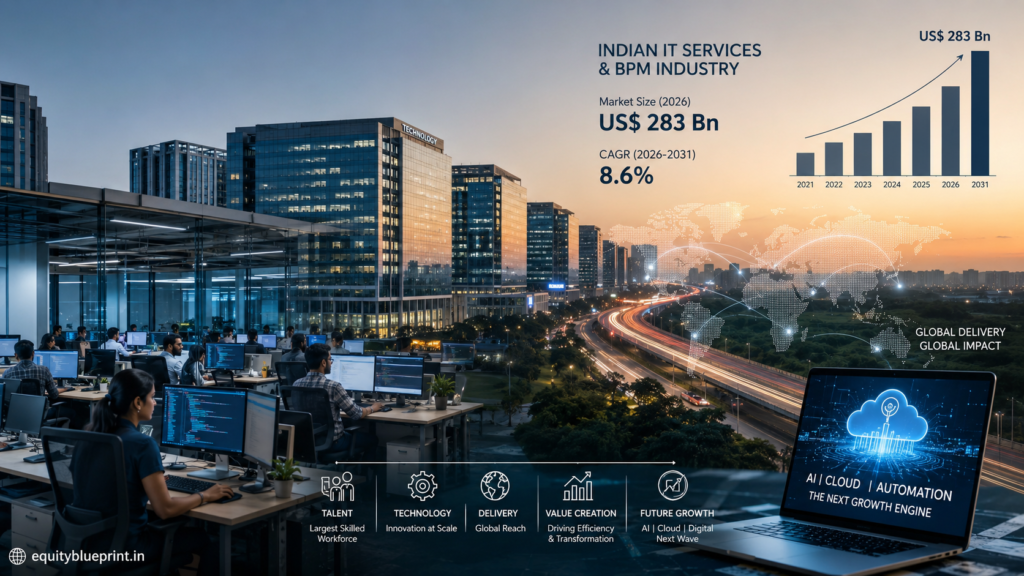
Industry Snapshot
A 60-second overview before diving deep
| Category | Summary |
| Industry | Indian IT Services & Business Process Management (BPM) |
| Industry Size | US$315.4 Billion |
| Contribution to India’s GDP | Approximately 10% |
| Major Revenue Source | Global technology services exports |
| Industry Type | Asset-light, knowledge-intensive services |
| Largest Growth Driver | Enterprise AI and Digital Transformation |
| Key Technologies | AI, Cloud Computing, Cybersecurity, Data Analytics |
| Capital Intensity | Low |
| Primary Competitive Advantage | Skilled talent, execution capability and client trust |
| Largest Listed Company | Tata Consultancy Services (TCS) |
Source: IBEF IT & BPM Industry Report (February 2026) and TCS Integrated Annual Report FY2025–26.
Table of Contents
- The Big Picture
- Industry at a Glance
- How the Industry Works
- Industry Structure
- Major Listed Players
- Growth Drivers
- Industry Risks
- Key Industry Metrics Every Investor Should Track
- How to Value IT Stocks
- Five-Year Industry Outlook
- Equity Blueprint Investor Checklist
- Key Takeaways
- Frequently Asked Questions
- Sources
Indian IT Services & BPM Industry Analysis
Why Understanding This Industry Matters More Than Ever
Imagine waking up tomorrow morning and discovering that every digital service you use has stopped working.
Your UPI payment fails.
Your banking app refuses to open.
Your company’s cloud software goes offline.
Flights cannot be booked.
Hospitals cannot access patient records.
Online shopping platforms stop processing orders.
Within hours, businesses around the world begin losing millions of pounds every minute—not because factories have shut down, but because the digital infrastructure powering modern commerce has disappeared.
This thought experiment highlights an important reality:
The modern economy no longer runs only on roads, factories and power plants. It also runs on software, cloud infrastructure, enterprise technology and digital services.
Behind much of this digital ecosystem are technology companies that design, build, integrate, secure and maintain the software systems businesses rely on every day.
India has become one of the world’s most important technology partners in this transformation.
Over the past three decades, the country has evolved from being primarily an outsourcing destination into a global leader in enterprise technology services, supporting organisations across banking, healthcare, manufacturing, retail, telecommunications, governments and many other industries. According to the IBEF report, the Indian IT & BPM industry reached approximately US$315.4 billion, contributes around 10% of India’s GDP, and generates a substantial share of its revenue through exports of technology services.
For investors, this makes the industry impossible to ignore.
Unlike many traditional sectors, the IT Services & BPM industry is relatively asset-light. Its competitive strength comes less from factories and machinery and more from skilled professionals, intellectual property, client relationships and the ability to solve increasingly complex business problems.
As technologies such as Artificial Intelligence (AI), cloud computing and cybersecurity become integral to enterprise operations, the strategic importance of the industry continues to expand. TCS’s FY2025–26 Integrated Annual Report describes this shift as a move from “Infrastructure to Intelligence”, reflecting the growing integration of AI into enterprise technology stacks.
This article has been designed to help you understand the industry from first principles.
Rather than focusing on stock recommendations, it explains how the industry works, how companies create value, what drives long-term growth, where the major risks lie, and which metrics investors should monitor when analysing IT businesses.
Whether you are a beginner learning about the sector or an experienced investor refining your research process, understanding the economics of the industry is the first step towards making more informed investment decisions.
💡 Institutional Insight
Professional investors rarely begin their research by looking at a company’s share price.
They first seek to understand the industry’s economics:
- How is value created?
- Where are the profit pools?
- What are the entry barriers?
- Who has pricing power?
- Which long-term trends are reshaping the industry?
Only after answering these questions do they move on to analyzing individual companies.
⚠️ Retail Investor Trap
Many investors buy IT stocks simply because they hear terms like “AI”, “Cloud” or “Digital Transformation”.
Buzzwords alone do not create shareholder value. A high-quality IT business is built on strong client relationships, disciplined execution, healthy cash flows, continuous innovation and prudent capital allocation—not on fashionable technology trends alone.
🧠 Equity Blueprint Pro Tip
Before analysing any IT company, ask yourself one simple question:
“What business problem does this company solve for its customers?”
Investors who understand the customer’s problem generally understand the business model far better than those who focus only on quarterly earnings.
1. The Big Picture
The Indian IT Services & BPM industry exists for one simple reason:
Businesses increasingly depend on technology, but most cannot build and manage every digital capability internally.
Instead, they partner with specialised technology companies that provide expertise across consulting, software engineering, cloud migration, cybersecurity, data analytics, enterprise applications, Artificial Intelligence and Business Process Management.
These services help organisations:
- Modernise legacy systems
- Improve operational efficiency
- Enhance customer experiences
- Reduce costs
- Strengthen cybersecurity
- Comply with evolving regulations
- Accelerate innovation
The industry’s role has therefore evolved significantly.
In its early years, India was primarily recognised for cost-efficient software development and outsourcing.
Today, leading companies participate in much higher-value activities, including enterprise consulting, digital engineering, AI implementation and large-scale business transformation programmes. The Equity Blueprint Industry Database and the TCS Integrated Annual Report both emphasise this evolution towards end-to-end enterprise technology partnerships rather than isolated software projects.
Another defining characteristic of the industry is its global orientation.
A significant proportion of revenue comes from serving international enterprise clients across sectors such as:
- Banking and Financial Services
- Healthcare
- Manufacturing
- Retail
- Telecommunications
- Energy
- Public Sector
This global client base has helped establish India as one of the world’s leading exporters of technology services.
Unlike commodity industries, success in IT Services depends less on access to natural resources and more on:
- Highly skilled talent
- Deep domain expertise
- Strong execution capability
- Client trust
- Continuous innovation
- Long-term relationships
These characteristics create meaningful competitive advantages for companies that execute consistently over many years.
2. Industry at a Glance
The following table provides a high-level overview of the industry’s structure.
| Attribute | Details |
| Industry Name | Indian IT Services & Business Process Management (BPM) |
| Industry Size | Approximately US$315.4 Billion |
| Contribution to GDP | Around 10% of India’s GDP |
| Primary Revenue Source | Export-oriented technology services |
| Business Model | Consulting, software development, cloud, AI, cybersecurity, digital transformation and BPM |
| Industry Type | Knowledge-intensive, asset-light services |
| Major Customer Segments | Enterprises, governments and global organisations |
| Key Growth Drivers | Artificial Intelligence, cloud computing, cybersecurity, digital transformation and Global Capability Centres |
| Capital Intensity | Low compared with manufacturing industries |
| Key Competitive Factors | Talent, execution capability, client trust, innovation and scale |
| Leading Listed Companies | TCS, Infosys, HCLTech, Wipro, Tech Mahindra, LTIMindtree, Persistent Systems and Coforge |
Source: IBEF IT & BPM Industry Report.
What Makes This Industry Different?
Compared with sectors such as steel, cement or automobiles, the IT Services industry has several distinctive characteristics:
| Traditional Manufacturing | IT Services & BPM |
| Produces physical goods | Delivers knowledge-based digital services |
| Heavy investment in factories and machinery | Primary investment is in skilled people and technology capabilities |
| Revenue depends on production capacity | Revenue depends on expertise, client relationships and execution |
| Raw materials are physical commodities | Primary input is human capital |
| Expansion often requires significant capital expenditure | Growth is supported by talent, intellectual property and digital infrastructure |
These differences explain why IT companies often generate attractive returns on capital despite owning relatively few physical assets.
3. How the Industry Works
Understanding the industry’s size tells us how important it is.
Understanding the value chain tells us how it makes money.
This is one of the most important sections for investors because it explains how revenue flows through the industry, where companies create the most value and why some IT businesses consistently earn superior profitability.
Unlike manufacturing industries, where raw materials are transformed into physical products, the IT Services & BPM industry transforms knowledge, talent, technology and intellectual property into business outcomes.
The Equity Blueprint Industry Database and the TCS Integrated Annual Report show that India’s leading IT companies participate across almost the entire enterprise technology lifecycle—from strategic consulting and enterprise AI to cloud engineering, cybersecurity, application development and long-term managed services.
The IT Services Value Chain
Every technology project follows a broad sequence of value creation.
| Stage | What Happens |
|---|---|
| 1. Talent & Knowledge | Recruit, train and upskill technology professionals. |
| 2. Technology Infrastructure | Build the technical foundation using cloud, software and security platforms. |
| 3. Business Consulting | Understand the client’s business challenges and define project objectives. |
| 4. Solution Design | Design the overall technology architecture and implementation plan. |
| 5. Software Development | Develop or customise applications and digital solutions. |
| 6. System Integration | Connect the new solution with existing systems and databases. |
| 7. Implementation & Deployment | Test, launch and deploy the solution across the organisation. |
| 8. Managed Services & Support | Provide ongoing maintenance, monitoring and optimisation. |
| 9. Business Value Creation | Deliver higher efficiency, lower costs, better security and improved customer experience. |
Unlike industries such as steel, cement or automobiles, the primary input is not iron ore, coal or machinery.
The most valuable raw materials are:
- Skilled engineers
- Business consultants
- Data scientists
- AI specialists
- Cybersecurity professionals
- Domain expertise
- Intellectual property
This is why leading IT companies invest billions every year in employee training and capability development rather than large manufacturing facilities.
Stage 1 — Talent Creation
Every successful IT project starts with people.
India’s universities, engineering colleges and professional training institutions continuously produce software engineers, programmers, cloud architects, cybersecurity specialists, AI engineers and business consultants.
Companies then invest heavily in:
- Technical training
- Leadership development
- Domain expertise
- Cloud certifications
- AI capability building
- Continuous learning
Unlike many industries where machines determine productivity, human capability is the primary driver of value creation.
TCS identifies continuous learning and workforce capability development as one of the foundations of its long-term business model because technological change requires employees to constantly acquire new skills.
🧠 Equity Blueprint Pro Tip
When analysing an IT company, never view employee expenses as merely a “cost”.
In many cases, they represent an investment in the company’s future competitive advantage.
Stage 2 — Technology Infrastructure
Even the most talented engineers require modern technology platforms.
Today’s enterprise applications rely on:
- Cloud computing
- Data centres
- Networking infrastructure
- Enterprise software platforms
- AI computing infrastructure
- Developer tools
Technology companies such as Amazon Web Services, Microsoft Azure and Google Cloud provide the underlying infrastructure on which enterprise applications are built.
IT services companies generally do not compete with these cloud providers.
Instead, they help businesses:
- Design cloud architectures
- Migrate legacy systems
- Integrate applications
- Optimise cloud costs
- Manage cloud environments
This relationship creates a highly complementary ecosystem rather than direct competition.
Stage 3 — Business Consulting
Technology projects rarely begin with writing software.
They begin with understanding the client’s business problem.
Consultants work closely with management to answer questions such as:
- What operational challenge needs solving?
- Which business processes should change?
- Which technologies are most appropriate?
- What implementation risks exist?
- What return on investment is expected?
At this stage, technology companies function more like business advisors than software developers.
Because consulting requires deep expertise and strategic insight, it generally commands higher billing rates than routine programming work.
🧠 Equity Blueprint Pro Tip
The highest-value IT companies are increasingly judged not by how many programmers they employ, but by how deeply they influence client strategy.
Consulting-led relationships often create opportunities for years of follow-on work across cloud migration, cybersecurity, AI implementation and managed services.
Stage 4 — Solution Design & Architecture
Once the client’s objectives are understood, technology architects design the overall solution.
This involves deciding:
- Which cloud platform should be used?
- How should applications communicate?
- How should sensitive data be protected?
- Which systems need replacing?
- Which systems can be modernised?
A well-designed architecture reduces future maintenance costs while improving scalability and security.
Although clients rarely see this work, it is one of the most technically demanding phases of the project.
Stage 5 — Software Development
This is the stage most people associate with the IT industry.
Engineers begin developing:
- Enterprise applications
- Mobile applications
- Web platforms
- APIs
- AI-enabled software
- Data analytics solutions
However, modern software development represents only one component of a much larger enterprise transformation programme.
Today’s IT companies increasingly combine software engineering with:
- AI integration
- Cloud-native development
- Automation
- Data engineering
- Cybersecurity
This evolution reflects the industry’s transition towards comprehensive digital transformation services.
Stage 6 — System Integration
Large enterprises rarely use a single software platform.
A multinational manufacturer might simultaneously operate:
- SAP for enterprise resource planning
- Salesforce for customer relationship management
- Oracle databases
- Microsoft Azure cloud
- Legacy internal applications
These systems must communicate seamlessly.
Connecting them into one integrated ecosystem is known as System Integration.
Poor integration can create:
- Data inconsistencies
- Operational delays
- Security vulnerabilities
- Higher maintenance costs
Stage 7 — Implementation & Deployment
After development and testing, the solution is deployed throughout the organisation.
Typical activities include:
- Data migration
- User training
- Security validation
- Performance testing
- Go-live support
- Operational monitoring
Large enterprise implementations often continue for months—or even years—depending on their complexity.
Successful implementation strengthens customer trust and frequently leads to additional business opportunities.
Stage 8 — Managed Services & Continuous Improvement
Contrary to popular belief, most technology projects do not end once software is deployed.
Enterprise systems require continuous:
- Monitoring
- Software updates
- Performance optimisation
- Security patches
- Regulatory compliance
- Technical support
- Feature enhancements
These long-term managed service contracts create recurring revenue and strengthen client relationships.
The Industry Database identifies managed services as one of the industry’s most attractive business segments because they provide stable, recurring income while deepening customer engagement.
Real-World Case Study
How a European Bank Modernizes Its Technology
The uploaded source documents explain the services provided by IT companies but do not include a single end-to-end commercial project example. The following scenario is therefore an illustrative example designed to demonstrate how value typically flows through a large enterprise transformation project. It is not drawn from a specific project in the uploaded documents.
Imagine a large European bank wants to modernise decades-old legacy systems.
Its objectives are to:
- Improve customer experience
- Increase cybersecurity
- Reduce operating costs
- Enable AI-powered banking services
Rather than attempting this internally, the bank appoints a global IT partner.
Step 1 — Business Assessment
Consultants analyze:
- Existing technology
- Business processes
- Customer journeys
- Security gaps
- Regulatory requirements
Step 2 — Technology Design
Architects develop a roadmap covering:
- Cloud migration
- AI integration
- Cybersecurity
- Application modernisation
- Data migration
Step 3 — Implementation
Thousands of engineers begin:
- Writing software
- Migrating databases
- Integrating applications
- Testing systems
- Training employees
Step 4 — Long-Term Partnership
After deployment, the IT company continues providing:
- Technical support
- Security monitoring
- Software upgrades
- AI improvements
- Cloud optimisation
The project evolves from a one-time implementation into a long-term strategic relationship.
⚠️ Retail Investor Trap
Many investors assume IT companies simply “write software”.
In reality, software development is often only one part of a much broader engagement that may include consulting, cloud migration, cybersecurity, integration and multi-year managed services.
Companies participating across this entire lifecycle typically build deeper customer relationships than firms focused solely on coding.
Where Is the Industry’s Highest Value Created?
Not every stage of the value chain contributes equally to profitability.
Generally, value increases as services become more specialised.
| Activity | Typical Value Creation | Reason |
| Talent Development | High | Skilled professionals underpin execution and innovation. |
| Business Consulting | Very High | Strategic advice strengthens client relationships and supports premium pricing. |
| Enterprise AI Solutions | Very High | Specialised expertise with strong long-term demand. |
| Digital Transformation | Very High | Large, multi-year programmes with broad service opportunities. |
| Cloud Migration | High | Generates implementation work and recurring managed services. |
| Cybersecurity | High | Mission-critical services with resilient demand. |
| Managed Services | High | Recurring revenue and long-term customer retention. |
| Routine Staff Augmentation | Moderate | Greater competition and more limited pricing power. |
This assessment reflects the service mix described in the Industry Database rather than quantitative profitability by service line.
🧠 Equity Blueprint Pro Tip
When comparing two IT companies, ask:
“Where does each company create most of its revenue?”
A business generating more revenue from consulting, AI, cybersecurity and managed services may have a different long-term profile from one focused mainly on staff augmentation or routine application maintenance.
From Outsourcing to Enterprise Transformation
One of the clearest themes across the uploaded documents is that India’s IT industry is evolving.
Historically, many companies built their businesses around cost-efficient software development and outsourcing.
Today, leading firms are increasingly positioned as strategic enterprise partners that help clients:
- Reimagine business processes
- Adopt Artificial Intelligence
- Modernise cloud infrastructure
- Strengthen cybersecurity
- Build data-driven organisations
- Improve long-term operational resilience
TCS describes this transition as moving from “Infrastructure to Intelligence”, highlighting how enterprise technology is becoming increasingly integrated around AI-enabled business outcomes.
4. Industry Structure
Understanding how the IT Services & BPM industry creates value is only half the story.
The next question every investor should ask is:
Who controls this industry, how intense is the competition, and why do some companies consistently outperform others?
The answers determine whether companies can sustain high profitability, defend market share and generate attractive returns over long periods.
Unlike many traditional industries, the Indian IT Services & BPM industry is knowledge-intensive rather than asset-intensive. Companies compete primarily on execution capability, client trust, technical expertise and innovation instead of ownership of physical assets.
According to the Equity Blueprint Industry Database and the TCS Integrated Annual Report, India’s leading IT companies increasingly position themselves as strategic technology partners, offering consulting, cloud engineering, AI solutions, cybersecurity and managed services to enterprises worldwide.
Industry Structure at a Glance
| Characteristic | Description |
| Market Structure | Moderately concentrated |
| Competition | High |
| Entry Barriers | Moderate to High |
| Capital Requirement | Low physical capital, high human capital |
| Main Competitive Advantage | Talent, client trust and execution capability |
| Industry Nature | Global, export-oriented, knowledge-intensive |
| Switching Cost | Moderate to High for enterprise clients |
| Pricing Power | Stronger in consulting, AI and cybersecurity than commodity services |
🧠 Equity Blueprint Pro Tip
Professional investors rarely ask:
“Which company is the cheapest?”
They ask:
“Which company possesses the strongest competitive advantages that competitors will struggle to replicate over the next decade?”
Understanding industry structure helps answer that question.
Organized vs Unorganized Market
One of the defining characteristics of the Indian IT Services industry is that the organised sector dominates the market.
Unlike industries such as retail or construction—where thousands of small businesses compete—large enterprise technology projects are generally handled by established companies with global delivery capabilities.
Organized Sector
The organized sector consists of professionally managed companies with:
- Listed or regulated corporate structures
- Audited financial statements
- Global delivery capabilities
- International client relationships
- Established governance frameworks
- Large engineering workforces
Typical participants include:
- Tata Consultancy Services (TCS)
- Infosys
- HCLTech
- Wipro
- Tech Mahindra
- LTIMindtree
- Persistent Systems
- Coforge
These companies collectively execute technology projects for banks, manufacturers, retailers, governments, healthcare providers and multinational corporations around the world.
Unorganized Sector
The unorganised segment primarily consists of:
- Small software firms
- Local technology consultants
- Freelance developers
- Boutique digital agencies
- Early-stage technology start-ups
These businesses generally focus on:
- Small and medium enterprises
- Website development
- Mobile applications
- Local software implementation
- Staff augmentation
Although some eventually grow into successful listed companies, they usually lack:
- Global delivery networks
- Brand recognition
- Large enterprise relationships
- Financial scale
- Experience managing complex multi-country projects
As a result, they rarely compete directly with Tier-1 IT companies for the largest global transformation programmes.
Market Structure
The Indian IT Services industry is best described as a moderately concentrated competitive market.
No single company controls the industry.
Instead, several large firms compete across similar service categories while differentiating themselves through execution quality, domain expertise and client relationships.
The market can broadly be divided into three segments.
| Segment | Characteristics | Representative Companies |
| Tier-1 Global Leaders | Broad service portfolio, global delivery network, diversified clients | TCS, Infosys, HCLTech, Wipro |
| Tier-2 Growth Specialists | Strong capabilities in selected technologies or industries | LTIMindtree, Persistent Systems, Coforge |
| Smaller Technology Firms | Regional, niche or specialised technology services | Numerous private companies |
This classification reflects the industry’s competitive landscape rather than a formal regulatory categorization. It is consistent with the relative positioning described in the Industry Database.
The Competitive Landscape
Competition exists across almost every technology service category.
However, companies do not all compete in the same way.
Large companies generally compete using:
- Global scale
- Brand reputation
- Long-standing enterprise relationships
- Broad service portfolios
- Financial strength
- Large consulting teams
- AI and cloud capabilities
Smaller firms often compete through:
- Specialised expertise
- Faster execution
- Lower pricing
- Industry-specific knowledge
- Agile decision-making
This creates a layered industry where both large and specialised companies can coexist successfully.
What Creates Competitive Advantage?
Many first-time investors assume that technology companies succeed simply because they employ good programmers.
In reality, software development alone rarely creates a durable competitive advantage.
Long-term leadership depends on a combination of factors that competitors cannot easily replicate.
1. Client Trust
Enterprise technology projects are often mission-critical.
A failed banking system, airline reservation platform or hospital management system can disrupt entire organisations.
As a result, companies usually prefer working with partners that have:
- Proven execution capability
- Strong governance
- Reliable delivery
- Long operating history
TCS highlights long-term customer relationships as one of its core strengths, with many partnerships spanning multiple technology generations.
2. Skilled Human Capital
The industry’s primary productive asset is its workforce.
Companies invest continuously in:
- Technical certifications
- AI capabilities
- Leadership programmes
- Cloud expertise
- Cybersecurity skills
The ability to attract, retain and develop talented professionals directly influences long-term competitiveness.
3. Global Delivery Network
Leading IT companies operate delivery centres across multiple countries.
This enables them to:
- Support global clients
- Offer round-the-clock services
- Access diverse talent pools
- Improve operational resilience
TCS’s global operating model illustrates how worldwide delivery capabilities have become an important competitive differentiator.
4. Breadth of Services
Enterprise customers increasingly prefer strategic partners capable of managing multiple aspects of their technology landscape.
A company offering:
- Consulting
- AI
- Cloud
- Cybersecurity
- Data analytics
- Application development
- Infrastructure management
- Managed services
is often better positioned than a company specialising in only one area.
5. Continuous Innovation
Technology evolves rapidly.
Companies that continuously invest in:
- Enterprise AI
- Automation
- Cloud-native engineering
- Digital platforms
- Proprietary tools
are generally better positioned to maintain long-term relevance.
🧠 Equity Blueprint Pro Tip
Technology changes quickly.
Competitive advantage comes not from mastering today’s technology, but from building an organisation that can continuously adapt to tomorrow’s technology.
Entry Barriers
At first glance, starting a software company appears relatively easy.
Building a globally trusted IT services company is far more difficult.
The industry’s major entry barriers include:
| Barrier | Why It Matters |
| Client trust | Large enterprises rarely outsource critical systems to unknown providers. |
| Skilled workforce | Recruiting and retaining thousands of experienced professionals requires significant investment. |
| Brand reputation | Reputation strongly influences enterprise purchasing decisions. |
| Global delivery capability | Multinational clients expect worldwide support. |
| Domain expertise | Industry knowledge develops over many years. |
| Execution capability | Successfully delivering complex transformation programmes requires proven experience. |
| Financial strength | Large projects often require significant upfront investment before revenue is recognised. |
⚠️ Retail Investor Trap
Many investors believe the biggest risk to large IT companies comes from new start-ups.
In reality, while start-ups can become innovative competitors in niche areas, replacing a trusted enterprise technology partner is a complex decision involving operational, regulatory and security considerations.
Scale alone does not guarantee success—but client trust creates meaningful competitive protection.
Pricing Power
Pricing power varies considerably across service categories.
Strong Pricing Power
- Business consulting
- Enterprise AI
- Cybersecurity
- Industry-specific solutions
- Complex cloud transformation
Clients generally prioritize expertise and execution quality over price for these services.
Moderate Pricing Power
- Application development
- Cloud migration
- Engineering services
- System integration
These remain attractive businesses but involve greater competitive intensity.
Lower Pricing Power
- Staff augmentation
- Routine application maintenance
- Commodity outsourcing
These services often compete more heavily on cost.
Porter’s Five Forces Analysis
Porter’s Five Forces provides a structured framework for assessing industry attractiveness.
| Force | Intensity | Investor Interpretation |
| Threat of New Entrants | Moderate | Starting a software company is relatively easy, but building global credibility requires years of investment and execution. |
| Bargaining Power of Suppliers | Moderate to High | Skilled professionals are the industry’s most important input, making talent acquisition strategically important. |
| Bargaining Power of Buyers | High | Large enterprise customers negotiate significant contracts and typically evaluate multiple vendors. |
| Threat of Substitutes | Moderate | AI and automation may replace certain routine activities while simultaneously creating demand for new technology services. |
| Competitive Rivalry | High | Competition is intense, but differentiation increasingly depends on expertise, client trust and service quality rather than price alone. |
Major Listed Players
The Indian IT Services industry includes several globally recognised companies.
Although many operate within the same sector, their strategic positioning differs.
| Company | Primary Focus | Competitive Strength |
| TCS | End-to-end IT services, consulting, AI, cloud and managed services | Scale, execution capability, diversified client base |
| Infosys | Digital transformation, consulting and cloud | Strong consulting and enterprise transformation |
| HCLTech | Engineering, infrastructure and enterprise technology | Engineering capabilities and infrastructure expertise |
| Wipro | Consulting, cloud and cybersecurity | Diversified global delivery model |
| Tech Mahindra | Telecom and enterprise technology | Telecommunications expertise |
| LTIMindtree | Digital engineering and cloud | Agile execution and digital transformation |
| Persistent Systems | Product engineering and AI | Innovation-led engineering services |
| Coforge | Industry-focused digital services | Vertical specialisation and agile delivery |
The table summarizes strategic positioning based on the themes discussed in the Industry Database and TCS Annual Report rather than ranking these companies by investment quality.
Comparative Business Models
Not all IT companies generate revenue in the same way.
Broadly, they can be viewed across a spectrum:
| Business Model | Characteristics |
| Broad Enterprise Transformation | End-to-end consulting, cloud, AI, cybersecurity and managed services |
| Digital Engineering Specialists | Product engineering, cloud-native development and software modernisation |
| Vertical Specialists | Focus on industries such as telecom, banking or healthcare |
| Niche Technology Providers | Targeted expertise in selected technologies or customer segments |
Understanding where a company operates within this spectrum often provides better insight than simply comparing revenue or earnings.
6. Growth Drivers
Every industry grows because of certain long-term forces.
Some industries expand because populations increase.
Others grow because rising incomes boost consumer demand.
The Indian IT Services & BPM industry is different.
Its growth is primarily driven by technology adoption. Every time businesses adopt new technologies to become more efficient, secure or competitive, they create new opportunities for IT service providers.
Over the past two decades, the industry has evolved through multiple waves of technological change—from Y2K remediation and enterprise software implementation to cloud computing, digital transformation and now Enterprise AI.
According to the IBEF IT & BPM Industry Report, the Equity Blueprint Industry Database and TCS’s FY2025–26 Integrated Annual Report, the next phase of growth will increasingly be driven by Artificial Intelligence (AI), cloud computing, cybersecurity, Global Capability Centres (GCCs) and enterprise-wide digital transformation.
These are not temporary trends.
They represent structural changes in how organisations operate.
Growth Drivers at a Glance
| Growth Driver | Importance | Long-Term Impact |
| Artificial Intelligence | ⭐⭐⭐⭐⭐ | Enterprise-wide transformation |
| Cloud Computing | ⭐⭐⭐⭐⭐ | Modernisation of IT infrastructure |
| Digital Transformation | ⭐⭐⭐⭐⭐ | Multi-year technology investments |
| Cybersecurity | ⭐⭐⭐⭐☆ | Increasing enterprise security spending |
| Global Capability Centres (GCCs) | ⭐⭐⭐⭐☆ | Expanding India’s technology ecosystem |
| Government Digital Initiatives | ⭐⭐⭐⭐☆ | Stronger digital infrastructure |
| Data Analytics | ⭐⭐⭐⭐☆ | Better business decision-making |
| Automation | ⭐⭐⭐⭐☆ | Productivity improvements |
| Sustainability Technology | ⭐⭐⭐☆☆ | Emerging opportunity |
| Global IT Spending | ⭐⭐⭐⭐⭐ | Expanding addressable market |
1. Artificial Intelligence (AI)
Why It Matters
Artificial Intelligence is no longer a futuristic concept.
It is becoming an essential business tool across almost every major industry.
Banks use AI for fraud detection.
Hospitals use AI to assist diagnosis.
Manufacturers use AI for predictive maintenance.
Retailers use AI for personalised recommendations.
Governments increasingly use AI to improve public services.
However, implementing AI across a large organisation is far more complex than purchasing AI software.
Companies require assistance with:
- AI strategy
- Data preparation
- Cloud infrastructure
- System integration
- Model deployment
- Security
- Governance
- Employee training
This creates substantial opportunities for IT services companies.
TCS’s FY2025–26 Annual Report identifies Enterprise AI as its most important long-term strategic opportunity and describes an integrated approach that combines infrastructure, trusted data, AI models and enterprise applications.
Similarly, the IBEF report highlights significant public and private investments supporting India’s AI ecosystem, including the IndiaAI Mission.
💡 Institutional Insight
Professional investors increasingly distinguish between companies that use AI internally and companies that generate revenue by helping customers implement AI.
The second group is generally better positioned to benefit directly from rising enterprise AI spending.
Why Investors Should Care
AI is unlikely to eliminate demand for IT services.
Instead, it is expected to shift demand towards higher-value consulting, implementation and managed services.
2. Cloud Computing
Cloud computing has fundamentally changed how businesses consume technology.
Instead of purchasing expensive servers and maintaining their own data centres, organisations increasingly rent computing resources from cloud providers.
Major platforms include:
- Amazon Web Services
- Microsoft Azure
- Google Cloud
However, moving an enterprise from legacy infrastructure to the cloud is rarely straightforward.
Businesses often require help with:
- Migration planning
- Application modernisation
- Security
- Cost optimisation
- Performance monitoring
- Cloud management
These services create long-term opportunities for IT companies.
The IBEF report highlights continued investment in cloud infrastructure and growing demand for cloud professionals across India.
Case Study
Moving a Manufacturing Company to the Cloud
The uploaded documents explain the importance of cloud migration but do not describe an individual client project.
The following example is therefore illustrative and is intended only to explain how cloud transformation projects typically create value.
Imagine a manufacturing company operating ageing on-premises servers.
Its objectives are to:
- Improve scalability
- Reduce infrastructure costs
- Strengthen cybersecurity
- Enable AI-powered analytics
Instead of purchasing new servers, the company works with an IT services partner.
The project includes:
- Assessing existing systems
- Designing a cloud migration strategy
- Migrating applications
- Training employees
- Monitoring performance
- Providing ongoing managed services
What begins as a migration project often develops into a long-term customer relationship.
3. Digital Transformation
Digital transformation means redesigning business processes using modern technology.
Examples include:
| Traditional Business | Digital Business |
| Branch banking | Mobile banking |
| Paper records | Electronic records |
| Manual manufacturing | Smart factories |
| Physical retail | Omnichannel commerce |
| Manual customer support | AI-enabled customer service |
Unlike a single software installation, digital transformation usually affects multiple parts of an organisation simultaneously.
It often combines:
- Consulting
- Software engineering
- Cloud computing
- Cybersecurity
- AI
- Data analytics
- Process redesign
This makes digital transformation one of the industry’s largest long-term revenue opportunities.
⚠️ Retail Investor Trap
Many investors think digital transformation simply means “building a mobile app”.
In reality, it often involves redesigning an organisation’s technology, workflows, security, data architecture and customer experience over several years.
4. Cybersecurity
As businesses become more digital, cybersecurity becomes increasingly important.
Modern threats include:
- Ransomware
- Data breaches
- Identity theft
- Financial fraud
- Nation-state cyber attacks
Protecting enterprise systems requires ongoing investment.
IT companies therefore provide services such as:
- Threat detection
- Identity management
- Security monitoring
- Compliance
- Incident response
- Cloud security
Unlike many discretionary technology projects, cybersecurity spending often remains essential regardless of broader economic conditions.
5. Global Capability Centres (GCCs)
Global Capability Centres are dedicated technology and business operation centres established by multinational corporations.
Rather than outsourcing every function, many global companies build specialised centres in India to support:
- Software engineering
- Artificial Intelligence
- Data analytics
- Finance
- Human Resources
- Product development
- Digital operations
According to the IBEF report, India’s GCC ecosystem is expected to expand significantly by 2030, supported by AI adoption and increasing hiring across Tier-II and Tier-III cities.
Why GCCs Matter
Growing GCC activity strengthens India’s technology ecosystem by:
- Creating skilled employment
- Supporting innovation
- Increasing knowledge transfer
- Expanding demand for specialised services
6. Government Digital Initiatives
Government policy continues to accelerate technology adoption.
The IBEF report highlights several initiatives supporting digital infrastructure, including:
- Digital India
- IndiaAI Mission
- Public investment in AI infrastructure
- National cloud initiatives
- Digital public infrastructure
These initiatives improve the environment in which technology companies operate.
7. Data Analytics
Every digital interaction creates data.
Organisations increasingly rely on analytics to improve:
- Customer experience
- Marketing
- Supply chains
- Pricing
- Inventory management
- Risk management
Turning raw data into useful business insights requires advanced software, AI and analytical expertise.
This creates another important source of demand for IT companies.
8. Enterprise Automation
Businesses increasingly automate repetitive processes.
Examples include:
- Invoice processing
- Customer onboarding
- Claims management
- Procurement
- Human resources administration
Automation reduces:
- Costs
- Errors
- Processing time
while improving operational efficiency.
IT companies generate revenue by designing, implementing and maintaining these automation systems.
9. Sustainability Technology
Environmental sustainability is becoming an increasingly important consideration for many organisations.
Technology now supports:
- Energy optimisation
- Smart buildings
- Digital twins
- Carbon reporting
- Sustainable supply chains
Although still an emerging area, sustainability-related technology spending represents another long-term opportunity.
10. Global Technology Spending
Ultimately, the industry’s growth depends on enterprise technology investment.
The Business Case for the IT Industry projects the global IT market to expand significantly over the coming decade, supported by increasing adoption of AI, cloud computing and cybersecurity technologies.
As organisations continue modernising their operations, Indian IT companies remain well positioned to participate in this expanding market.
🧠 Equity Blueprint Pro Tip
When analysing an IT company, ask:
“Which long-term technology trend contributes most to this company’s revenue?”
Companies aligned with multiple structural growth drivers—such as AI, cloud, cybersecurity and digital transformation—may have more diversified growth opportunities than those dependent on a single service line.
Growth Driver Summary
| Growth Driver | Primary Revenue Opportunity |
| Artificial Intelligence | AI consulting and implementation |
| Cloud Computing | Migration and managed services |
| Digital Transformation | Multi-year enterprise projects |
| Cybersecurity | Recurring security services |
| GCC Expansion | Higher demand for specialised expertise |
| Government Initiatives | Digital infrastructure development |
| Data Analytics | Enterprise intelligence solutions |
| Automation | Productivity and workflow optimisation |
| Sustainability | Green technology solutions |
| Global IT Spending | Larger addressable market |
7. Industry Risks
Every attractive industry also faces meaningful risks.
Understanding these risks helps investors distinguish between:
- temporary challenges,
- structural threats, and
- manageable business risks.
The IT Services & BPM industry is resilient in many respects, but it remains exposed to global economic conditions, technological disruption, talent availability and changing customer priorities.
Professional investors evaluate risks with the same discipline they apply to growth opportunities.
Industry Risk Dashboard
| Risk | Impact | Probability | What Investors Should Monitor |
| Global Economic Slowdown | High | Medium | Enterprise technology budgets |
| AI Disruption | High | Medium | AI strategy and service evolution |
| Talent Shortages | High | High | Attrition and hiring trends |
| Pricing Pressure | Medium | High | Operating margins |
| Cybersecurity Incidents | High | Medium | Security capabilities and governance |
| Regulatory Changes | Medium | Medium | Compliance and data privacy developments |
| Currency Movements | Medium | High | Foreign exchange exposure |
| Geopolitical Events | Medium | Medium | Geographic revenue diversification |
| Client Concentration | Medium | Medium | Dependence on major customers |
| Technology Obsolescence | High | Medium | Investment in innovation |
1. Global Economic Slowdown
A significant proportion of India’s IT services revenue comes from international enterprise clients.
During economic slowdowns, businesses may:
- postpone discretionary technology projects,
- reduce consulting budgets,
- delay digital transformation,
- renegotiate contracts.
Mission-critical spending often continues, but overall growth may moderate.
2. Artificial Intelligence Disruption
Artificial Intelligence creates both opportunities and challenges.
Routine activities such as:
- software testing,
- documentation,
- basic coding,
- customer support
may become increasingly automated.
However, the same technology creates demand for:
- AI implementation,
- AI governance,
- enterprise integration,
- AI-enabled business transformation.
TCS frames AI as a strategic opportunity rather than simply a cost-saving technology.
🧠 Equity Blueprint Pro Tip
Investors should not ask:
“Will AI reduce IT jobs?”
A more useful question is:
“Which companies are successfully repositioning themselves to capture AI-related revenue?”
3. Talent Availability
The industry’s most valuable asset is its workforce.
Competition for specialists in:
- AI
- Cloud
- Cybersecurity
- Data Science
can increase salary costs and reduce profitability if productivity improvements do not keep pace.
Investors should monitor:
- Employee attrition
- Hiring
- Training
- Reskilling programmes
4. Pricing Pressure
Certain technology services remain highly competitive.
Routine outsourcing and staff augmentation often experience greater pricing pressure than consulting or AI implementation.
Companies moving towards higher-value services generally have stronger pricing power.
5. Cybersecurity Incidents
IT companies manage sensitive enterprise systems.
A significant cyber incident could:
- damage reputation,
- disrupt operations,
- reduce customer confidence,
- increase regulatory scrutiny.
Continuous investment in security therefore remains essential.
6. Regulatory & Data Privacy Changes
Governments continue introducing new rules covering:
- AI governance,
- data privacy,
- cross-border data transfers,
- cybersecurity.
Although compliance may increase costs, it can also create new consulting opportunities.
7. Currency Fluctuations
Many Indian IT companies earn substantial revenue in foreign currencies while incurring significant employee costs in Indian Rupees.
Exchange-rate movements can therefore influence reported financial performance.
8. Geopolitical Events
Global political developments may influence:
- outsourcing decisions,
- trade relationships,
- enterprise technology spending,
- customer confidence.
Diversified geographic exposure helps reduce dependence on individual markets.
9. Client Concentration
Heavy dependence on a small number of customers increases business risk.
Investors should examine:
- customer diversification,
- industry diversification,
- geographic diversification,
- contract renewals.
10. Technology Obsolescence
Technology evolves rapidly.
Companies that fail to invest in:
- AI,
- cloud,
- cybersecurity,
- digital engineering,
may gradually lose competitiveness.
Continuous innovation is therefore essential.
⚠️ Retail Investor Trap
A company can report strong quarterly earnings while quietly falling behind in technology capability.
Investors should monitor whether management is investing for the next technology cycle—not merely reporting profits from the current one.
Which Risks Matter Most?
| Risk | Long-Term Importance |
| AI Transition | ⭐⭐⭐⭐⭐ |
| Talent Availability | ⭐⭐⭐⭐⭐ |
| Global Technology Spending | ⭐⭐⭐⭐⭐ |
| Cybersecurity | ⭐⭐⭐⭐☆ |
| Pricing Pressure | ⭐⭐⭐⭐☆ |
| Regulatory Changes | ⭐⭐⭐☆☆ |
| Currency Movements | ⭐⭐⭐☆☆ |
| Geopolitical Events | ⭐⭐⭐☆☆ |
8. Key Industry Metrics Every Investor Should Track
After understanding how the industry works, who competes, and what drives long-term growth, the next step is learning how to evaluate individual companies.
Many retail investors focus almost exclusively on revenue growth or quarterly earnings.
Professional investors go much deeper.
They ask questions such as:
- Is the company winning better-quality business?
- Are profits improving because of operational efficiency or simply because revenue has increased?
- Is growth sustainable?
- Is the company generating real cash?
- Is management allocating capital effectively?
The answers lie in a combination of financial ratios, operating metrics and business quality indicators.
Rather than analysing dozens of numbers, investors should focus on the metrics that best explain how an IT services company creates long-term shareholder value.
The Five Pillars of IT Company Analysis
For long-term investors, most important metrics fall into five broad categories.
| Pillar | Purpose |
| Growth | Is the business expanding sustainably? |
| Profitability | Is management converting revenue into profits efficiently? |
| Cash Generation | Does accounting profit translate into real cash? |
| Capital Efficiency | Is capital being used productively? |
| Business Quality | Is the competitive position becoming stronger or weaker? |
1. Revenue Growth
Revenue is the starting point of every business analysis.
Consistent revenue growth indicates that customers continue purchasing the company’s services.
For IT companies, revenue growth may come from:
- Winning new clients
- Expanding existing customer relationships
- Cross-selling additional services
- Acquisitions
- Growth in enterprise technology spending
However, revenue should never be analysed in isolation.
Investors should ask:
- Is growth broad-based?
- Which service lines are growing fastest?
- Is growth driven by consulting, AI and cloud, or by lower-value commodity services?
The Industry Database highlights the industry’s increasing focus on AI, cloud, cybersecurity and digital transformation as key long-term growth areas.
🧠 Equity Blueprint Pro Tip
Professional investors rarely ask:
“Did revenue increase this quarter?”
They ask:
“Where did the growth come from, and is it likely to continue?”
2. EBIT Margin (Operating Margin)
Revenue alone does not determine business quality.
A company that grows rapidly while sacrificing profitability may ultimately destroy shareholder value.
Operating Margin (EBIT Margin) measures how much operating profit remains after operating expenses.
Formula
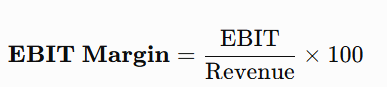
Higher operating margins generally indicate:
- Better operational efficiency
- Stronger pricing power
- Better execution
- More valuable service offerings
Companies moving towards consulting, AI and enterprise transformation often seek to improve margins through a richer service mix.
Why It Matters
Imagine two companies each generate £1 billion in revenue.
Company A earns an EBIT margin of 12%.
Company B earns 22%.
Even though revenue is identical, Company B converts far more of each pound of revenue into operating profit.
That provides greater flexibility to invest in:
- AI
- Research
- Employee development
- Acquisitions
- Shareholder returns
3. Net Profit Margin
Operating profit eventually becomes net profit after:
- Interest
- Taxes
- Other income and expenses
Formula

Stable or improving margins generally indicate disciplined cost management.
However, investors should always compare margin trends over several years rather than focusing on a single reporting period.
4. Free Cash Flow (FCF)
One of the biggest mistakes investors make is assuming accounting profit equals cash generation.
It does not.
Free Cash Flow measures how much cash remains after necessary business investment.
Formula

Because IT companies are relatively asset-light, many mature businesses have the potential to generate substantial free cash flow.
Strong cash generation supports:
- Dividends
- Share buybacks
- Acquisitions
- AI investment
- Balance-sheet strength
🧠 Equity Blueprint Pro Tip
Revenue pays the bills.
Profit attracts investors.
Cash creates long-term shareholder value.
5. Return on Capital Employed (ROCE)
ROCE measures how efficiently management generates operating profit from the capital invested in the business.
Formula

For asset-light industries such as IT Services, consistently healthy ROCE often indicates:
- Efficient operations
- Strong capital allocation
- Sustainable competitive advantages
However, ROCE should always be analysed over multiple years rather than in isolation.
6. Return on Equity (ROE)
ROE measures the return generated for shareholders.
Formula

High ROE may indicate:
- Efficient capital allocation
- Strong profitability
- Durable business quality
But investors should also examine whether unusually high ROE results from excessive financial leverage rather than operational strength.
7. Client Concentration
Financial statements alone cannot reveal every business risk.
One important qualitative metric is customer diversification.
Questions investors should ask include:
- Does one customer contribute a significant share of revenue?
- Are customers spread across industries?
- Is geographic exposure diversified?
- Are relationships long-term?
Diversification generally improves business resilience.
8. Deal Wins
Large enterprise contracts provide insight into future revenue potential.
The TCS Integrated Annual Report discusses the importance of long-term customer relationships and transformation engagements, although it should not be interpreted as guaranteeing future financial performance.
Investors should therefore monitor:
- Large transformation contracts
- Multi-year managed service agreements
- Consulting engagements
- Digital transformation programmes
These often indicate future revenue visibility.
9. Employee Metrics
People are the industry’s primary productive asset.
Important indicators include:
- Employee attrition
- Hiring trends
- Workforce utilisation
- Learning and reskilling initiatives
The TCS report places significant emphasis on continuous learning and capability development as part of its long-term strategy.
High attrition may increase:
- Recruitment costs
- Training expenses
- Project execution risk
10. Service Mix
Not all revenue carries the same strategic value.
Investors should understand how much revenue comes from:
- Consulting
- Artificial Intelligence
- Cloud services
- Cybersecurity
- Digital engineering
- Managed services
- Traditional application maintenance
A richer mix of higher-value services may strengthen long-term competitiveness, although the uploaded sources do not provide benchmark percentages for an ideal service mix.
Institutional Benchmark Framework
Important Note
The uploaded source documents describe the industry’s business model and strategic direction but do not publish numerical benchmark ranges (for example, “ideal EBIT margin” or “ideal ROCE”) applicable across the Indian IT Services industry.
Rather than invent unsupported thresholds, the framework below focuses on qualitative interpretation, which is consistent with the available sources.
| Metric | Why It Matters | What Investors Should Look For |
| Revenue Growth | Indicates business expansion | Consistent, diversified growth over multiple years |
| EBIT Margin | Measures operating efficiency | Stable or improving margins rather than volatile swings |
| Net Profit Margin | Measures overall profitability | Sustainable profitability with disciplined cost control |
| Free Cash Flow | Measures cash generation | Positive and growing cash generation over time |
| ROCE | Measures capital efficiency | Consistently efficient use of capital |
| ROE | Measures shareholder returns | Sustainable returns supported by operational performance |
| Client Diversification | Reduces concentration risk | Balanced customer portfolio across industries and geographies |
| Service Mix | Indicates business quality | Increasing contribution from higher-value technology services |
| Talent Development | Supports future competitiveness | Continuous investment in skills and capability building |
⚠️ Retail Investor Trap
Never buy an IT stock because one ratio looks attractive.
A company can have:
- high ROE but slowing growth,
- strong revenue but weak cash flow,
- healthy margins but declining competitiveness.
Always evaluate the complete picture rather than relying on a single metric.
9. How to Value IT Stocks
A great business is not always a great investment.
Even exceptional companies can become poor investments if purchased at unrealistic valuations.
Professional investors therefore analyse both business quality and valuation before making investment decisions.
Common Valuation Ratios
1. Price-to-Earnings (P/E)
Formula
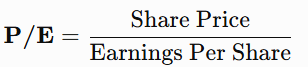
P/E indicates how much investors are willing to pay for each unit of earnings.
A higher P/E may reflect expectations of stronger future growth, but it can also imply elevated market expectations.
2. EV/EBITDA
Enterprise Value (EV) includes both equity and debt, making it useful when comparing companies with different capital structures.
Formula

It is commonly used when comparing mature companies because it focuses on operating performance before financing decisions.
3. PEG Ratio
The PEG Ratio combines valuation with expected growth.
Formula

Rather than asking whether a stock is expensive, PEG asks whether the valuation appears reasonable relative to expected growth.
4. Price-to-Free Cash Flow (P/FCF)
Companies ultimately create value through cash generation.
P/FCF compares market valuation with the company’s ability to generate free cash flow.
For mature, cash-generative IT businesses, this can provide an additional perspective alongside earnings-based measures.
🧠 Equity Blueprint Pro Tip
Professional investors rarely rely on a single valuation multiple.
Instead, they combine:
- Business quality,
- Growth prospects,
- Cash generation,
- Capital efficiency, and
- Valuation
before reaching an investment conclusion.
Valuation Is Context-Dependent
Valuation should be interpreted in context, considering:
- Growth outlook
- Profitability
- Cash generation
- Competitive position
- Capital allocation
- Market expectations
A high-quality company can justify a higher valuation if it continues to strengthen its competitive position and deliver sustainable growth. Conversely, even a lower valuation may not represent value if the underlying business fundamentals are deteriorating.
10. Five-Year Industry Outlook (2026–2031)
Every investor eventually reaches the same question:
“Where is this industry likely to be five years from now?”
While no one can predict the future with certainty, investors can analyse long-term structural trends that are already reshaping an industry.
The four primary source documents used for this handbook consistently point in the same direction.
The Indian IT Services & BPM industry is expected to remain one of India’s strongest structural growth industries over the coming years, supported by:
- Artificial Intelligence (AI)
- Cloud computing
- Cybersecurity
- Digital transformation
- Global Capability Centres (GCCs)
However, the nature of growth is expected to change.
The next phase is likely to become more technology-led than labour-led, with greater emphasis on AI-enabled transformation, consulting and high-value digital services rather than traditional outsourcing alone.
Industry Outlook in One Sentence
The Indian IT Services & BPM industry is expected to remain one of India’s strongest long-term growth industries, but future success will increasingly depend on technology leadership, innovation and business transformation rather than simply adding more people.
How the Industry Is Changing
The industry’s growth model is evolving.
| Earlier Growth Model | Future Growth Model |
| Labour outsourcing | AI-enabled transformation |
| Software development | Business transformation |
| Cost reduction | Productivity improvement |
| Staff augmentation | Strategic consulting |
| Legacy maintenance | Intelligent automation |
This transition is consistently reflected across the Industry Database and the TCS Annual Report, which describe AI as becoming embedded across enterprise operations rather than remaining a standalone technology.
1. Artificial Intelligence Will Become the Largest Growth Engine
Artificial Intelligence is expected to influence almost every enterprise technology decision over the coming decade.
Businesses are increasingly asking:
- How can AI improve productivity?
- How can AI automate repetitive work?
- How can AI improve customer experience?
- How can AI support decision-making?
- How can AI reduce operating costs?
As a result, demand is expected to increase for:
- AI consulting
- AI implementation
- AI governance
- AI platform integration
- AI security
- AI-enabled enterprise transformation
The Industry Database concludes that AI is likely to become the industry’s largest structural growth engine.
TCS’s FY2025–26 Annual Report also describes its strategy of leading across the AI stack—from infrastructure and cloud to data, models and enterprise applications—while helping customers scale AI safely across their organisations.
🧠 Equity Blueprint Pro Tip
The biggest opportunity is not AI replacing IT services.
It is AI changing the type of work clients are willing to pay for.
Companies that help enterprises adopt AI responsibly and at scale may benefit more than those relying primarily on traditional outsourcing.
2. Cloud Adoption Still Has Significant Runway
Cloud adoption has progressed rapidly, but the transformation is far from complete.
According to the Industry Database, many organisations have begun migrating to the cloud, yet a substantial number of transformation programmes remain ongoing. These projects typically include:
- Infrastructure migration
- Security redesign
- Application modernisation
- Data integration
- Ongoing cloud management
Because these programmes often take several years to complete, cloud computing is expected to remain a durable source of demand for IT services.
3. Cybersecurity Will Become Even More Critical
Every new digital system creates additional security challenges.
The Business Case for the IT Industry highlights escalating ransomware, phishing and AI-powered cyberattacks, alongside increasing regulatory requirements around data protection.
Consequently, demand is expected to increase for:
- Identity management
- Threat detection
- Security monitoring
- Compliance
- Digital risk management
Cybersecurity is gradually shifting from a discretionary technology investment to a business necessity.
4. Global Capability Centres (GCCs) Will Continue Expanding
One of the strongest structural themes identified in the source documents is the expansion of Global Capability Centres.
India continues to strengthen its position because of:
- Large engineering talent pool
- Mature technology ecosystem
- Competitive operating costs
- Digital infrastructure
The IBEF report highlights continued growth in India’s GCC ecosystem, including increasing AI-focused capability centres and investments supporting advanced technology development.
This trend supports long-term demand for:
- Software engineering
- AI specialists
- Data scientists
- Enterprise architects
- Consulting professionals
5. Technology Spending Should Continue Expanding
The industry’s long-term prospects ultimately depend on enterprise technology spending.
The Business Case for the IT Industry notes that worldwide IT spending is expected to continue growing, supported by investments in automation, cloud technologies and AI, even as organisations seek greater operational efficiency.
Similarly, the IBEF report shows continued growth in India’s IT export revenues, reflecting sustained international demand for technology services.
Future Opportunities
The following themes consistently emerge across the source documents.
| Structural Opportunity | Why It Matters |
| Artificial Intelligence | Creates a new enterprise technology investment cycle |
| Cloud Computing | Supports multi-year transformation projects |
| Cybersecurity | Mission-critical enterprise capability |
| Digital Transformation | Modernises entire business operations |
| GCC Expansion | Strengthens India’s global technology position |
| Data Engineering | Supports AI and advanced analytics |
| Enterprise Consulting | Moves companies higher up the value chain |
| Intelligent Automation | Improves productivity across industries |
Industry Outlook Scorecard
| Factor | Outlook |
| Long-Term Demand | ⭐⭐⭐⭐⭐ |
| Technology Innovation | ⭐⭐⭐⭐⭐ |
| Export Opportunity | ⭐⭐⭐⭐⭐ |
| AI Adoption | ⭐⭐⭐⭐⭐ |
| Cloud Growth | ⭐⭐⭐⭐⭐ |
| Cybersecurity Demand | ⭐⭐⭐⭐☆ |
| Talent Availability | ⭐⭐⭐⭐☆ |
| Competitive Intensity | ⭐⭐⭐⭐☆ |
This scorecard is an editorial synthesis of the themes consistently supported across the uploaded sources. It is intended as a qualitative assessment rather than a quantitative forecast.
Scenario Analysis
No industry follows a perfectly predictable path.
Thinking in scenarios helps investors prepare for different outcomes instead of relying on a single forecast.
Bull Case
Growth accelerates if:
- AI adoption expands rapidly.
- Cloud migration continues strongly.
- Global IT spending remains healthy.
- GCC investments increase further.
- Indian companies strengthen their leadership in enterprise transformation.
Base Case
The industry continues growing steadily through:
- Ongoing digital transformation
- Enterprise AI adoption
- Cybersecurity investment
- Cloud modernisation
- Stable export demand
This aligns most closely with the direction suggested by the uploaded sources.
Bear Case
Growth could weaken if:
- Global economic conditions deteriorate significantly.
- Enterprises postpone discretionary technology spending.
- Geopolitical tensions disrupt business confidence.
- Companies fail to adapt to AI-led transformation.
The TCS Annual Report specifically identifies macroeconomic uncertainty, geopolitical developments and disruptive technologies as important risks that require active management.
⚠️ Retail Investor Trap
Many investors assume the industry will grow simply because technology spending grows.
The source documents suggest a more nuanced conclusion:
The industry is expected to grow, but the companies creating the greatest long-term value are likely to be those that continuously adapt to changing technologies rather than relying on legacy business models.
🧠 Equity Blueprint Pro Tip
When analysing an IT company, ask:
“Is management preparing for the next technology cycle, or simply maximising today’s earnings?”
Long-term leaders often invest in new capabilities before those investments become immediately visible in financial results.
11. Equity Blueprint Investor Checklist
Before investing in any IT Services company, work through the following questions.
Rather than focusing on short-term share price movements, this checklist encourages investors to evaluate the underlying quality of the business.
Equity Blueprint Business Quality Framework
| Question | Why It Matters |
| Does the company have long-term client relationships? | Indicates revenue stability and customer trust. |
| Is it investing in AI, cloud and cybersecurity? | Shows readiness for future technology cycles. |
| Does it generate strong free cash flow? | Supports reinvestment, acquisitions and shareholder returns. |
| Is revenue diversified across industries and geographies? | Reduces concentration risk. |
| Does it consistently develop and retain talent? | Protects execution quality. |
| Does it possess pricing power? | Supports sustainable profitability. |
| Can it win large transformation projects? | Reflects competitive capability. |
| Is management investing for the next technology cycle rather than only the next quarter? | Indicates long-term strategic thinking. |
This framework is adapted from the Equity Blueprint Industry Database and is intended as a qualitative checklist rather than a scoring model.
Five Questions Every Investor Should Ask
Before making an investment decision, ask yourself:
1. Is the company adapting to future technologies?
Companies investing in AI, cloud computing and cybersecurity are generally better positioned for the industry’s next phase of growth.
2. Does the company possess durable competitive advantages?
Look for:
- Trusted customer relationships
- Strong execution capability
- Skilled workforce
- Financial strength
- Pricing power
3. Can the company maintain profitability while investing for the future?
The strongest businesses balance:
- Current earnings
- Innovation
- Talent development
- Long-term competitiveness
4. Is management preparing for the next technology cycle?
The Industry Database emphasises that long-term leaders usually invest before major technological shifts become obvious.
5. Does the investment thesis rely on business quality rather than market excitement?
Technology trends change quickly.
Strong businesses are built on:
- Execution
- Customer trust
- Innovation
- Capital discipline
rather than short-lived market enthusiasm.
🧠 Equity Blueprint Pro Tip
Professional investors rarely ask,
“Which IT stock will double next year?”
They ask,
“Which company is most likely to remain relevant through multiple technology cycles?”
That mindset shifts attention from short-term forecasts to long-term business quality.
12. Key Takeaways
After exploring the Indian IT Services & BPM industry from multiple perspectives, one conclusion becomes clear:
The Indian IT industry is no longer simply an outsourcing industry—it has evolved into a global enterprise technology transformation ecosystem.
Three decades ago, India’s primary competitive advantage was delivering software development at lower costs.
Today, the industry’s competitive position increasingly depends on:
- Enterprise consulting
- Artificial Intelligence
- Cloud engineering
- Cybersecurity
- Digital transformation
- Industry-specific technology expertise
- Long-term customer relationships
The source documents consistently highlight this shift from labour-intensive services to technology-enabled business transformation.
For investors, this changes how the industry should be analysed.
Instead of asking,
“Which company is growing fastest?”
A better question is:
“Which company is building the strongest competitive position for the next technology cycle?”
Companies that consistently invest in:
- AI capabilities
- Cloud expertise
- Talent development
- Innovation
- Customer relationships
- Financial discipline
are generally better positioned to benefit from long-term structural growth.
Equity Blueprint Industry Summary
| Topic | Key Takeaway |
| Industry Nature | Knowledge-intensive, export-oriented technology services |
| Business Model | End-to-end enterprise technology transformation |
| Largest Growth Drivers | AI, Cloud, Cybersecurity, Digital Transformation and GCC expansion |
| Biggest Competitive Advantages | Talent, client trust, execution capability and innovation |
| Largest Risks | Global economic slowdown, AI disruption, talent shortages and technology change |
| Most Important Investor Metrics | Revenue Growth, EBIT Margin, Free Cash Flow, ROCE, ROE and Business Quality |
| Valuation Approach | Combine business quality with valuation rather than relying on a single ratio |
| Long-Term Outlook | Positive, but increasingly technology-led rather than labour-led |
🧠 Equity Blueprint Pro Tip
The biggest winners over the next decade may not necessarily be the companies that hire the most engineers.
They are more likely to be the companies that:
- solve increasingly complex business problems,
- integrate AI effectively,
- deepen long-term customer relationships,
- and continuously reinvent themselves as technology evolves.
⚠️ Retail Investor Trap
Avoid assuming that every company within a strong industry is automatically a strong investment.
A favourable industry creates opportunities, but long-term shareholder returns still depend on:
- execution,
- capital allocation,
- innovation,
- customer relationships,
- and management quality.
Industry strength and company quality are related—but they are not the same thing.
🧠 Equity Blueprint Pro Tip
Study the industry first.
Study the company second.
Study the valuation last.
Most investment mistakes occur when investors reverse this order.
13. Frequently Asked Questions (FAQ)
1. What is the Indian IT Services & BPM industry?
The Indian IT Services & BPM industry provides technology-enabled services such as software development, consulting, cloud computing, cybersecurity, Artificial Intelligence, data analytics and business process management to organisations across the world. It has evolved into one of India’s largest export-oriented service industries.
2. Why is India a global leader in IT services?
According to the source documents, India’s competitive advantages include:
- A large engineering talent pool
- Strong technology ecosystem
- Mature global delivery capabilities
- Competitive operating costs
- Long-standing relationships with global enterprises
These factors have helped establish India as a preferred destination for enterprise technology services.
3. What is Business Process Management (BPM)?
Business Process Management (BPM) refers to managing and improving business processes such as customer support, finance, human resources, procurement and other operational functions using technology and specialised expertise.
4. What is driving future growth in the industry?
The primary source documents consistently identify:
- Artificial Intelligence
- Cloud computing
- Cybersecurity
- Digital transformation
- Global Capability Centres (GCCs)
as the industry’s major structural growth drivers.
5. Will Artificial Intelligence replace IT companies?
AI will not replace the IT services industry.
Instead, AI is changing the nature of enterprise technology work by creating demand for:
- AI consulting
- AI implementation
- AI governance
- Enterprise AI integration
- Intelligent automation
Companies with stronger AI capabilities are expected to benefit more from this transition.
6. What are Global Capability Centres (GCCs)?
A Global Capability Centre is a technology and business operations centre established by a multinational company in another country.
India has become one of the world’s leading GCC destinations because of its skilled workforce, digital infrastructure and mature technology ecosystem.
7. Which financial ratios are most useful when analysing IT companies?
The most useful metrics generally include:
- Revenue Growth
- EBIT Margin
- Net Profit Margin
- Free Cash Flow
- ROCE
- ROE
However, investors should analyse these metrics alongside business quality, customer relationships, service mix and competitive positioning rather than relying on financial ratios alone.
8. Why is Free Cash Flow important for IT companies?
Free Cash Flow measures the cash available after necessary business investment.
For relatively asset-light businesses such as IT services companies, sustainable cash generation can support:
- Innovation
- Talent development
- Dividends
- Share buybacks
- Acquisitions
9. Is the Indian IT industry cyclical?
The uploaded documents indicate that long-term demand remains supported by structural technology adoption.
However, short-term growth may fluctuate because enterprise technology spending is influenced by:
- Global economic conditions
- Corporate investment cycles
- Geopolitical developments
- Customer confidence
10. What is the biggest long-term risk for the industry?
Rather than identifying a single dominant risk, the source documents consistently highlight several important risks, including:
- Rapid technological change
- AI disruption
- Global economic uncertainty
- Talent shortages
- Cybersecurity challenges
11. How should beginners analyse an IT company?
A practical sequence is:
- Understand the industry.
- Understand the business model.
- Analyse growth drivers and risks.
- Review financial performance.
- Assess business quality.
- Evaluate valuation.
This approach reduces the risk of focusing only on short-term market movements.
12. Should investors focus only on large IT companies?
The uploaded documents do not recommend investing only in large companies.
Instead, they emphasise evaluating each business based on:
- Competitive advantages
- Technology capabilities
- Customer relationships
- Innovation
- Long-term adaptability
Final Conclusion
The Indian IT Services & BPM industry stands at an important point in its evolution.
Its success is no longer defined only by cost-efficient software development. Instead, it is increasingly driven by the ability to help enterprises navigate complex technological change through Artificial Intelligence, cloud computing, cybersecurity, digital engineering and strategic consulting.
For long-term investors, this means the focus should move beyond quarterly earnings and headline valuations.
The most durable businesses are likely to be those that:
- build deep customer relationships,
- attract and develop exceptional talent,
- generate strong cash flows,
- allocate capital wisely,
- and continuously adapt to new technology cycles.
Understanding the industry’s economics before analysing individual companies provides a stronger foundation for investment decisions.
Whether you are evaluating an established market leader or an emerging specialist, remember this principle:
Great investing begins with understanding the business—not the share price.
Related Analysis:
TCS Share Analysis 2026: Is India’s IT Giant Finally Becoming Cheap Enough to Buy?TCS Share Analysis 2026: Is India’s IT Giant Finally Becoming Cheap Enough to Buy?
Disclaimer
This article is intended solely for educational and informational purposes.
It does not constitute investment advice, financial advice, tax advice or a recommendation to buy, sell or hold any security.
Although every effort has been made to ensure the information is accurate and based on the cited source documents, industries evolve continuously. Investors should consult the latest annual reports, investor presentations, regulatory filings and other official disclosures before making investment decisions.
Past performance does not guarantee future results, and all investments involve risk.
About the Author

Nilendu Chatterjee is the founder of Equity Blueprint, a platform focused on helping retail investors approach the stock market with clarity, structure, and discipline. With over a decade of experience in the industrial sector and a strong passion for equity research, he brings a practical, ground-level perspective to fundamental analysis.
Through a framework-driven approach, Nilendu breaks down complex businesses into simple, decision-oriented insights—bridging the gap between professional-grade research and everyday investing. His work is centered on one goal: enabling long-term wealth creation by replacing speculation with structured thinking.