Stock: Infosys Limited
Ticker: NSE: INFY | NYSE: INFY
Sector: Information Technology / IT Services
Framework: Equity Blueprint 5-Layer Fundamental Analysis
Analysis Period: FY2018–FY2026, with emphasis on FY2026 and Q1 FY2027
Latest Quarter Analysed: Q1 FY2027, quarter ended June 30, 2026
Introduction: Is Infosys Cheap Because the Market Is Worried About Its Future?
Infosys is facing an unusual investment situation.
The company remains one of India’s highest-quality technology-services businesses. It has enormous global enterprise relationships, a large skilled workforce, a strong balance sheet, substantial free cash flow, high return ratios and decades of credibility in global technology delivery.
Yet the stock is no longer commanding the valuation premium investors became accustomed to during earlier periods of strong IT-services growth.
On September 10, 2026, Infosys was trading around ₹1,036 per share, substantially below its 52-week high of ₹1,728. The stock had also fallen sharply during the preceding sessions, reflecting a broader reassessment of Indian IT valuations and concerns surrounding the future economics of traditional technology services.
At first glance, this appears to create a classic value-investing opportunity.
But there is a more important question.
Is Infosys becoming cheaper because the market has temporarily misunderstood a high-quality company, or because investors are correctly recognising that artificial intelligence could permanently change the economics of traditional IT services?
That is the central question of this Infosys fundamental analysis.
The answer is not straightforward.
Infosys has demonstrated that AI is already moving from presentation material into actual enterprise deployments. Its FY2026 annual report states that AI-led programmes were deployed across 90% of its top 200 clients. The company also generated more than US$20 billion of revenue in FY2026, produced US$3.7 billion of free cash flow and returned more than US$4 billion to shareholders through dividends and buybacks.
At the same time, the industry’s economics are changing. NASSCOM describes the current transition as a movement from scale-led growth toward value, innovation, enterprise AI and outcome-based models. It also expects technology spending to remain relatively restrained in FY27 even as AI budgets gradually rise.
Therefore, the Infosys investment thesis cannot simply be:
“AI is growing, therefore Infosys will grow.”
The more appropriate question is:
Can Infosys convert its AI capabilities, enterprise relationships and balance-sheet strength into enough incremental growth to compensate for the productivity and automation pressures AI itself creates?
That is what the five-layer analysis below attempts to determine.
TL;DR — Infosys in 60 Seconds
Infosys remains a financially strong, highly profitable and strategically important Indian IT-services company. Its FY2026 revenue reached ₹1,78,650 crore, while net profit attributable to shareholders reached ₹29,440 crore. Revenue increased 9.6% in reported rupee terms and 3.1% in constant currency, while return on equity reached 31.6%. Free cash flow was ₹33,097 crore, equivalent to 112.3% of net profit.
The balance sheet is another major strength. Infosys ended FY2026 with ₹43,075 crore of consolidated cash and investments, while debt remained low. The company’s financial model therefore does not depend on leverage to produce growth or shareholder returns.
The problem is not financial quality. The problem is growth visibility.
Q1 FY2027 showed encouraging signs. Revenue reached ₹48,211 crore, up 14.0% year-on-year in rupee terms, while operating margin was 21.1%. Large-deal TCV was US$3.6 billion, with 61% classified as net new, and AI revenue represented 8.2% of total revenue.
However, management’s FY2027 constant-currency revenue-growth guidance remains only 1.5%–3.0%. That is important because reported rupee growth can be affected by currency movements, while constant-currency growth provides a cleaner view of underlying demand.
Valuation has become substantially more interesting. The supplied peer dataset places Infosys at approximately 14.2× PE, 1.81× PEG, 0.10× debt-to-equity, 31.9% ROE and 40% ROCE. Independent valuation data also shows the company’s EV/EBITDA multiple has fallen dramatically from the elevated levels seen earlier in the decade.
The central investment tension is therefore clear.
Infosys appears financially inexpensive for its quality, but it is inexpensive because the market is demanding evidence that growth can return.
Equity Blueprint Verdict: Tactical Accumulation / Conditional Structural Buy
Infosys passes the quality, balance-sheet, profitability and management-execution tests. It does not yet receive an unconditional Structural Buy because the industry is undergoing a fundamental technological transition and FY2027 growth guidance remains modest.
The investment case becomes materially stronger if constant-currency growth accelerates, AI revenue continues scaling, large deals convert into revenue and operating margins remain around the 20%–22% range.
Quick Snapshot: Infosys
| Metric | Infosys |
| Current share price* | ~₹1,040 |
| Approx. market capitalisation* | ~₹4.2 lakh crore |
| FY2026 EPS | ₹71.58 |
| Approx. PE on FY2026 EPS | ~14.5× |
| Peer-dataset PE | 14.2× |
| Peer-dataset PEG | 1.81× |
| Debt-to-Equity | ~0.10× |
| FY2026 Revenue | ₹1,78,650 crore |
| FY2026 Net Profit | ₹29,440 crore |
| FY2026 Operating Margin | 20.3% reported / 21.0% adjusted |
| FY2026 ROE | 31.6% |
| FY2026 Free Cash Flow | ₹33,097 crore |
| FY2026 Cash & Investments | ₹43,075 crore |
| FY2026 Large Deal TCV | US$14.9 billion |
| Q1 FY2027 Revenue | ₹48,211 crore |
| Q1 FY2027 Revenue Growth | 14.0% YoY |
| Q1 FY2027 Operating Margin | 21.1% |
| Q1 FY2027 AI Revenue | 8.2% of revenue |
| Q1 FY2027 Large Deal TCV | US$3.6 billion |
| FY2027 Revenue Guidance | 1.5%–3.0% CC |
| FY2027 Operating Margin Guidance | 20%–22% |
*Share price and market capitalisation are market-dependent and can change daily. The valuation conclusion should therefore be interpreted as a range rather than as a single-price recommendation. The September 10, 2026 share price was approximately ₹1,036.
Abbreviations Used in This Article
| Abbreviation | Full Form |
| AI | Artificial Intelligence |
| CC | Constant Currency |
| CAGR | Compound Annual Growth Rate |
| D/E | Debt-to-Equity |
| EBITDA | Earnings Before Interest, Tax, Depreciation and Amortisation |
| EBIT | Earnings Before Interest and Tax |
| EPS | Earnings Per Share |
| FCF | Free Cash Flow |
| PE | Price-to-Earnings |
| PEG | Price/Earnings-to-Growth |
| PAT | Profit After Tax |
| ROE | Return on Equity |
| ROCE | Return on Capital Employed |
| TCV | Total Contract Value |
Industry Landscape
Industry Overview
Infosys operates within India’s technology-services industry, an industry that has evolved considerably beyond its original outsourcing model.
The first major economic advantage of Indian IT services was labour arbitrage. Indian technology companies could provide large pools of technically skilled employees to global corporations at a substantially lower cost than comparable developed-market labour.
That model created enormous companies.
But the industry gradually moved up the value chain.
Application development expanded into digital transformation. Digital transformation expanded into cloud migration, cybersecurity, data modernisation and enterprise platforms. Today, artificial intelligence, generative AI and agentic AI are becoming increasingly important components of enterprise technology spending.
This transition matters enormously for Infosys investors.
The historical IT-services model was heavily correlated with the number of employees deployed on client projects. More engineers generally meant greater delivery capacity and therefore more revenue.
AI introduces a different economic relationship.
If an engineer supported by AI can accomplish the work previously performed by several engineers, the customer may receive greater value without proportionally increasing its technology-services budget.
That creates both an opportunity and a threat.
The opportunity is that technology spending can expand into entirely new areas such as AI strategy, AI engineering, data modernisation, cloud transformation, cybersecurity and intelligent automation.
The threat is that productivity improvements could compress the amount of human labour required for traditional services.
This is why the current IT-services cycle is different from previous digital-transformation cycles.
NASSCOM’s 2026 strategic review describes the Indian technology industry’s transition from scale-led growth toward value and innovation. It highlights enterprise AI, outcome-based delivery models, domain-centric platforms, strategic partnerships and AI-native capabilities as important elements of the next phase.
Industry Size and Growth
India’s technology industry has become one of the country’s most important export-oriented economic sectors.
NASSCOM estimated Indian technology-industry revenue, including hardware, at approximately US$282.6 billion in FY2025, with IT services contributing around US$137.1 billion, BPM US$54.6 billion, ER&D US$55.7 billion, software products US$16.1 billion and hardware US$19.2 billion.
The industry was estimated to cross approximately US$315 billion by FY2026.
More importantly, the industry employs millions of people and remains heavily integrated with global enterprise technology spending.
The export orientation is particularly important for Infosys. Approximately 97% of Infosys revenue in FY2026 came from exports, meaning its economic performance is fundamentally linked to technology budgets and business conditions in North America, Europe and other international markets.
This creates an unusual business model.
Infosys is an Indian company, but its demand environment is predominantly global.
Indian GDP growth is therefore not enough to determine Infosys’s revenue trajectory.
The company is much more sensitive to US corporate technology budgets, European economic conditions, BFSI spending, manufacturing investment, enterprise cloud adoption, cybersecurity requirements and the willingness of multinational corporations to undertake transformation programmes.
Major Industry Segments
The Indian technology-services ecosystem can broadly be divided into IT services, BPM, engineering research and development, software products and hardware.
Within IT services, the major demand pools include application development and maintenance, cloud, data and analytics, cybersecurity, consulting, digital transformation, enterprise platforms and increasingly AI.
The industry is also experiencing convergence.
A technology-services provider is no longer competing only with another IT-services provider.
It may compete with a global consulting company, a software company, a hyperscaler, a specialist AI company, a global capability centre or an internal client technology team.
This widening competitive field is one of the most important structural changes investors must understand.
India’s Position in the Global Technology Economy
India’s importance comes from more than labour cost.
The country possesses a very large technology talent pool, extensive experience in global delivery, mature IT infrastructure, established relationships with multinational corporations and a large ecosystem of technology-services companies.
NASSCOM estimates direct technology-sector employment at approximately 6 million in FY2026.
India therefore remains strategically important to global corporations seeking technology talent and cost-effective transformation capabilities.
But the competitive advantage is evolving.
The next decade will increasingly depend on whether India can transition from being primarily the world’s technology execution centre to becoming a larger centre of AI innovation, product development, engineering and business transformation.
For Infosys, this transition represents an opportunity to move further up the value chain.
Industry Value Chain
The technology-services value chain begins with client business requirements.
A global corporation identifies a business problem such as modernising its technology infrastructure, reducing operating costs, improving customer experience, migrating workloads to the cloud, strengthening cybersecurity or deploying artificial intelligence.
The next layer involves consulting and transformation design.
Technology providers then provide architecture, software engineering, data services, cloud implementation, cybersecurity, systems integration and operational support.
The final layer increasingly involves ongoing optimisation and outcome management.
Historically, much of this value chain was delivered through people-intensive services.
AI is changing that.
The emerging value chain increasingly includes proprietary platforms, reusable IP, AI agents, automation tools, data assets and domain-specific solutions.
Infosys operates across a broad portion of this value chain.
Its activities span consulting, application services, cloud, data, AI, engineering, cybersecurity, enterprise platforms and business-process services.
Its AI strategy is organised around areas including strategy and engineering, data, process, legacy modernisation, physical AI and trust.
That breadth is strategically valuable because large enterprises generally do not want to purchase AI in isolation.
AI often requires changes to data architecture, legacy systems, workflows, cybersecurity, governance and employee processes.
A company capable of integrating all these layers can potentially capture a larger share of the transformation budget.
Key Industry Growth Drivers
Enterprise AI Adoption
Artificial intelligence is becoming the largest structural change affecting technology services.
NASSCOM’s 2026 review describes the shift from AI experimentation toward industrialisation and enterprise-scale adoption. It also highlights agentic systems as a major development because AI is moving from assisting employees toward executing business processes.
For Infosys, this is potentially a major growth opportunity.
The company already reports AI-led programmes across 90% of its top 200 clients, indicating that AI is not confined to a small specialist customer base.
Cloud and Data Modernization
AI requires clean data, scalable infrastructure and modern application architecture.
Many large enterprises still operate legacy systems that were built decades ago.
This creates a second-order opportunity for Infosys.
Even when AI becomes more automated, companies may require more spending on data modernisation, cloud migration and legacy-system transformation before they can deploy AI effectively.
Cybersecurity
The more digitally connected an enterprise becomes, the greater the importance of cybersecurity.
AI itself also creates new security and governance requirements.
Cybersecurity therefore remains a relatively durable technology-services demand pool.
Enterprise Productivity
Corporations are under constant pressure to reduce costs while maintaining growth.
Technology spending that directly produces measurable productivity gains is more likely to survive periods of macroeconomic uncertainty.
This favours providers capable of demonstrating measurable economic outcomes rather than merely selling additional manpower.
Government and Digital Infrastructure
Government digitalisation, digital public infrastructure, cybersecurity requirements, data localisation and broader technology adoption support the development of India’s technology ecosystem.
For Infosys, however, government policy is a secondary driver compared with global enterprise spending because the overwhelming majority of its revenue comes from international markets.
Industry Risks
The first major risk is cyclical.
Technology spending can be postponed when corporate confidence weakens. Large transformation projects can be delayed, resized or renegotiated.
The second risk is structural.
AI can reduce the labour intensity of traditional technology services.
The third risk is competitive.
Global consulting firms, hyperscalers, software companies, AI-native firms and GCCs are all competing for portions of the same enterprise technology budget.
The fourth risk is geopolitical.
Changes in immigration policy, trade policy, data regulation and cross-border technology restrictions can influence delivery economics.
The fifth risk is currency-related.
Because Infosys generates the overwhelming majority of its revenue outside India while a meaningful portion of its cost base is in India, currency movements can influence reported revenue and margins.
Industry Structure
The Indian IT-services industry is highly organised and globally competitive.
Large companies such as Infosys, TCS, HCLTech, Wipro and Tech Mahindra possess enormous delivery networks, global sales organisations and long-standing enterprise relationships.
At the same time, the industry remains fragmented enough for specialist firms to grow rapidly in selected niches.
The emergence of GCCs adds another layer.
Large multinational corporations increasingly build their own technology centres in India, allowing them to capture some of the cost and talent advantages traditionally offered by external IT-services companies.
This creates a structural question for the entire sector:
How much technology work will remain outsourced when clients can build increasingly sophisticated internal technology organisations in India?
The answer is unlikely to be binary.
Enterprises will continue to outsource complex transformation programmes, but the mix of outsourced work may shift toward higher-value consulting, engineering, AI, cybersecurity and outcome-based engagements.
Industry Outlook: The Next 3–5 Years
The medium-term outlook for Indian technology services appears structurally positive but operationally difficult.
NASSCOM expects technology spending to remain relatively range-bound at approximately 5%–7% year-on-year in FY27, while AI budgets gradually increase. It also expects the industry to move further toward outcome-based models and AI-driven productivity.
The implication is important.
The next three to five years may not resemble the high-growth technology cycles of the past.
Revenue growth could remain moderate even while the economic value created by technology increases.
That distinction is crucial for investors.
A company could produce more value for its customers while generating less revenue per unit of human labour.
Therefore, the winners will not necessarily be the companies with the largest employee bases.
They will increasingly be the companies capable of converting technology capability into measurable business outcomes.
Industry Positioning: Where Does Infosys Stand?
Infosys should be classified as an industry leader, not a challenger, turnaround candidate or cyclical participant.
It possesses global scale, a large enterprise client base, a strong balance sheet, high profitability, substantial cash generation and established technology capabilities.
However, being an industry leader does not automatically mean the stock is attractive at every price.
The investment question is whether Infosys can remain a leader while the economics of the industry change.
That distinction becomes central to the five-layer analysis.
Equity Blueprint 5-Layer Fundamental Analysis
Layer 1 — Valuation Discipline
Is Infosys Actually Cheap?
At approximately ₹1,036 per share, Infosys trades at roughly 14.2× FY2026 reported EPS of ₹71.58.
At these valuation levels, Infosys trades at approximately 14.2× PE, below TCS at 15.3× and HCL Technologies at 19.2×, while remaining above Wipro at 12.9× and well below Tech Mahindra at 28.9×. That immediately tells us something important.
Infosys is not trading at a premium to every major Indian IT peer.
Its valuation has become much more reasonable.
But PE alone does not establish cheapness.
A low PE can indicate undervaluation, or it can indicate that the market expects earnings growth to slow.
For Infosys, both explanations may be partially true.
PEG Ratio
Infosys trades at a PEG ratio of approximately 1.81×, indicating that its valuation is relatively moderate when measured against its expected earnings-growth profile. That is not an exceptionally low PEG.
It indicates that the market is still assigning a meaningful premium to the company’s earnings quality relative to its expected growth.
This is logical.
Infosys is not a distressed business.
It has high returns, substantial cash generation and low leverage.
The market therefore should not value it like a structurally weak company merely because revenue growth has slowed.
At the same time, a PEG above 1 indicates that investors should demand evidence of sustainable earnings growth before assuming that the current multiple will expand.
Debt-to-Equity and Liquidity
This is where Infosys becomes particularly attractive.
Infosys has a debt-to-equity ratio of approximately 0.10×, reflecting a very low level of financial leverage.
The FY2026 balance sheet also shows ₹43,075 crore of consolidated cash and investments.
This changes the interpretation of valuation.
Infosys does not require leverage to maintain its operations.
It can invest in acquisitions, technology, talent and AI while simultaneously returning capital to shareholders.
That financial flexibility is an important component of its competitive moat.
ROE and ROCE
Infosys generates an ROE of approximately 31.9% and an ROCE of around 40%, reflecting strong profitability and efficient use of capital.
Those are strong numbers.
More importantly, they are consistent with the economics of an asset-light technology-services model.
A company that can generate approximately 30%+ returns on equity without depending heavily on debt deserves a higher valuation than a capital-intensive company producing similar earnings growth.
This is why a simple PE comparison can be misleading.
The quality of earnings matters.
The EV/EBITDA Perspective
PE tells us how much investors are paying for accounting earnings.
EV/EBITDA provides a different perspective because it considers enterprise value relative to operating earnings before depreciation and financing effects.
For Infosys, the long-term valuation cycle is particularly revealing.
The historical data shows EV/EBITDA at very elevated levels during the FY2022 period and substantially lower levels in the subsequent years. Independent valuation data currently places Infosys around the high-single-digit EV/EBITDA range, materially below its historical median.
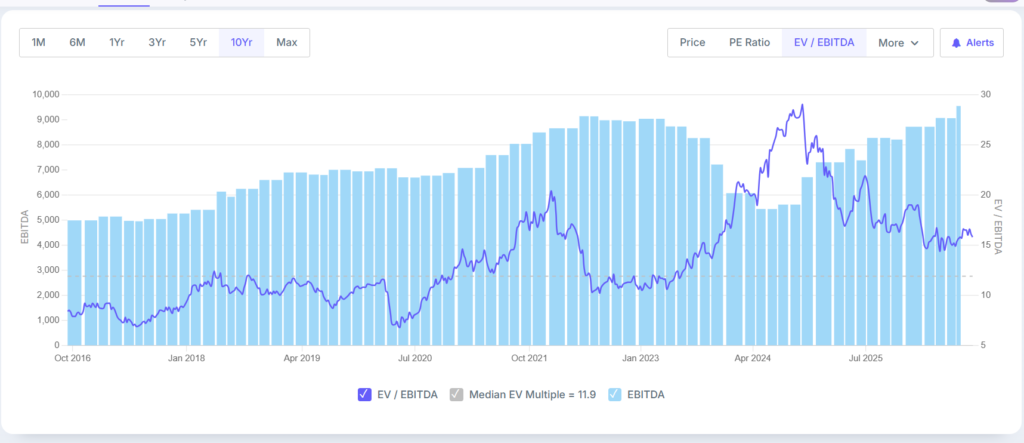
Infosys: 10-Year EV/EBITDA Valuation Cycle, Image Source: screener.in
(Infosys’s EV/EBITDA multiple has compressed substantially from the elevated valuation levels seen earlier in the decade, bringing the stock closer to historically lower valuation territory.)
The chart should be read as a valuation-cycle tool, not as proof that the stock must rise.
A falling multiple can mean two very different things.
The first possibility is that the market has become excessively pessimistic and the stock is being valued below the economic quality of the business.
The second possibility is that the market is correctly anticipating lower structural growth and therefore assigning a permanently lower multiple.
For Infosys, determining which explanation is correct is the central valuation challenge.
The current EV/EBITDA level is clearly more attractive than the multiples seen during the 2021–22 valuation peak. Independent data currently places Infosys’s EV/EBITDA around 8.6× versus a 10-year median near 13.9×.
That represents substantial valuation compression.
But investors should not automatically assume a return to the old median.
If AI reduces the industry’s revenue intensity and long-term growth settles at a lower level, the appropriate valuation multiple could also remain structurally lower.
Therefore, the correct conclusion is not:
“Infosys is trading below its historical multiple, so it must rerate.”
The correct conclusion is:
“The valuation has already absorbed a meaningful amount of pessimism, reducing downside from multiple compression, provided the underlying business does not structurally deteriorate.”
Layer 1 Verdict: Pass
Infosys passes the valuation-quality test.
The company has strong returns, low leverage, substantial liquidity and significant cash generation.
The valuation is no longer excessive relative to its own recent history or selected Indian IT peers.
However, the stock is not a classic deep-value opportunity.
The discount exists because growth expectations have weakened.
Layer 1 conclusion: Attractive valuation for a high-quality business, but rerating requires growth confirmation.
Layer 2 — Growth Consistency
The Five-Year Revenue Story
Infosys generated ₹1,21,641 crore of revenue in FY2022 and ₹1,78,650 crore in FY2026.
That represents substantial absolute growth over the period.
The company’s official investor information reports a five-year revenue CAGR of 12.2% based on FY2026 financials, while five-year net-profit CAGR was 8.8%.
This is a useful starting point.
Infosys is not a stagnant company.
It has compounded revenue and profit over a long period while maintaining high profitability.
But the growth trajectory has not been linear.
FY2025 revenue growth was 6.1%.
FY2026 revenue growth improved to 9.6% in reported rupees, while constant-currency growth was 3.1%. Net profit grew 10.2% in FY2026.
This difference between reported growth and constant-currency growth is critical.
The investor should focus on the underlying business rather than allowing currency movements to create a false impression of accelerating demand.
Growth Quality Matters More Than Revenue Growth Alone
Infosys’s FY2026 operating profit grew 5.3%, slower than revenue growth of 9.6%.
Reported operating margin fell from 21.1% to 20.3%.
That does not mean the business deteriorated.
The FY2026 reported operating margin was affected by a ₹1,289 crore provision related to India’s labour codes. The company’s adjusted operating margin was 21.0%.
Therefore, investors need to distinguish between reported accounting performance and underlying operating performance.
The bigger issue is not FY2026 margin.
It is whether Infosys can grow revenue fast enough to create operating leverage in the future.
Q1 FY2027: Is the Inflection Point Real?
Q1 FY2027 was encouraging.
Revenue reached ₹48,211 crore, up 14% year-on-year in rupee terms. Operating profit reached ₹10,163 crore, while operating margin stood at 21.1%. Net profit increased 12.2% year-on-year.
Constant-currency growth was 2.4% year-on-year and 1.0% sequentially.
That is not spectacular growth.
But it is important because the business is operating in a challenging global technology environment.
Large deal TCV was US$3.6 billion, with 61% net new, and AI revenue reached 8.2% of total revenue.
These numbers provide evidence that the AI strategy is beginning to influence actual commercial activity.
However, one quarter cannot establish a new structural growth cycle.
That is why management’s FY2027 revenue guidance remains important.
Infosys expects constant-currency revenue growth of only 1.5%–3.0% for FY2027.
This is the clearest signal that management itself is not assuming an immediate explosive AI-led revenue acceleration.
AI: Opportunity and Threat at the Same Time
This is arguably the most important analytical issue in the entire Infosys investment thesis.
AI can increase the company’s addressable market.
It can create demand for AI consulting, data transformation, cloud modernisation, AI engineering, cybersecurity and enterprise automation.
But AI can also reduce the number of employees required to perform traditional technology-services work.
Suppose a client previously required 1,000 engineers to maintain and modernise a technology environment.
If AI-enabled productivity eventually allows the same work to be completed with 700 engineers, the client has an economic incentive to reduce its technology-services spending.
For Infosys, the answer must be to move from selling labour capacity toward selling technology outcomes.
This is precisely why the company’s AI strategy matters.
Infosys states that its AI-led programmes are already deployed across 90% of its top 200 clients. Its AI strategy includes strategy and engineering, data, process, legacy modernisation, physical AI and trust.
If these capabilities generate new revenue pools faster than AI reduces traditional service demand, Infosys can emerge stronger.
If automation reduces traditional revenue faster than new AI revenue replaces it, the industry’s long-term revenue pool could compress.
That is the fundamental AI debate.
Is Infosys’s Growth Sustainable?
The historical growth record is strong enough to establish business quality.
It is not strong enough to guarantee future growth.
The current evidence suggests three layers of growth.
The first is the mature traditional IT-services business, where growth is relatively modest.
The second is digital, cloud, data and modernisation, which continue to provide transformation demand.
The third is AI, where the addressable market is expanding but monetisation is still developing.
The long-term investment case depends heavily on the third layer becoming large enough to influence consolidated growth.
Layer 2 Verdict: Conditional Pass
Infosys passes the historical growth-consistency test but does not yet pass the high-confidence future-growth test.
Its five-year financial record demonstrates durable compounding.
Q1 FY2027 provides encouraging evidence.
But FY2027 guidance remains modest.
Layer 2 conclusion: Growth is durable but currently insufficiently strong to justify assuming a rapid structural reacceleration. AI provides the potential catalyst, but confirmation is still required.
Layer 3 — Management Execution
Does Management’s Narrative Match Ground Reality?
Management credibility is particularly important for an IT-services company because much of the future value lies in capabilities that are difficult to measure using current financial statements.
Infosys’s management has spent considerable effort repositioning the company around AI.
The FY2026 annual report describes AI as moving from experimentation toward enterprise-scale adoption and states that the company has been investing in talent, partnerships and portfolio changes to accelerate this transition.
The question is whether this is simply corporate language.
The evidence suggests that at least part of the strategy is translating into commercial activity.
AI revenue represented 8.2% of revenue in Q1 FY2027.
Large deal TCV reached US$3.6 billion during the quarter, with 61% net new.
The company also reported AI-led programmes across 90% of its top 200 clients.
These are more meaningful indicators than the number of AI partnerships announced.
Capital Allocation
Capital allocation is another area where Infosys scores strongly.
FY2026 free cash flow reached ₹33,097 crore, equivalent to 112.3% of net profit. The company completed an ₹18,000 crore buyback at ₹1,800 per share and declared a ₹48 dividend per share.
This demonstrates that the company is capable of converting accounting earnings into cash.
That matters because high-quality capital allocation requires actual cash rather than merely reported profits.
The company also continues to invest in talent.
Its FY2026 annual report states that more than 20,000 college graduates were recruited during the year, while the workforce exceeded 3.28 lakh employees.
That is strategically relevant because AI changes the skill mix required in technology services.
The challenge is no longer simply hiring more engineers.
It is developing engineers who can work effectively with AI systems.
Management’s Most Important Test
The most important test for Salil Parekh and the Infosys leadership team is therefore not whether they can communicate an AI strategy.
It is whether they can demonstrate AI-led incremental economics.
Investors should ask:
Can AI increase revenue per employee?
Can AI create new consulting and transformation budgets?
Can AI improve margins without causing revenue cannibalisation?
Can large AI engagements convert into recurring revenue?
Can Infosys maintain pricing power as productivity improves?
Can the company shift from people-based billing toward outcome-based economics without damaging total revenue?
The answers will determine whether the current AI strategy creates shareholder value.
Layer 3 Verdict: Strong Pass
Management execution currently deserves a positive assessment.
The company has maintained financial discipline, generated strong free cash flow, returned significant capital to shareholders and invested heavily in AI capabilities and talent.
More importantly, the AI strategy is beginning to show up in client adoption, AI revenue and large-deal activity.
The remaining question is economic scale rather than strategic direction.
Layer 3 conclusion: Management credibility is strong, but the ultimate test remains whether AI investment translates into sustained revenue growth and attractive incremental returns.
Layer 4 — Risk Identification
The risks surrounding Infosys need to be separated into cyclical risks and structural risks.
That distinction is essential.
Cyclical Risk: Global IT Spending
Corporate technology budgets can weaken during recessions.
When companies become uncertain about economic conditions, they may postpone transformation programmes.
This can produce slower revenue growth without permanently damaging the business.
This is a cyclical risk.
Structural Risk: AI Cannibalisation
This is more serious.
AI may reduce the amount of labour required to deliver traditional IT services.
If Infosys continues to generate revenue primarily by deploying people, productivity improvements could eventually compress its addressable revenue pool.
The company must therefore monetise AI rather than merely use AI internally.
Structural Risk: GCC Competition
Global capability centres allow multinational corporations to build their own technology teams in India.
This could reduce outsourcing demand in certain categories.
The strongest defence is to provide capabilities that clients cannot easily replicate internally, particularly complex transformation, consulting, AI implementation, cybersecurity and specialised domain expertise.
Competitive Risk
Infosys competes against TCS, HCLTech, Wipro, Tech Mahindra, global consulting firms, hyperscalers, software companies and specialist technology firms.
The peer dataset shows that Infosys is neither the cheapest major IT stock nor the most expensive. Its valuation must therefore be justified by the combination of growth, profitability and balance-sheet quality rather than PE alone.
Currency Risk
Because approximately 97% of Infosys’s revenue comes from exports, currency movements can materially influence reported financial results.
A weaker rupee can increase the rupee value of foreign revenue and potentially support margins.
A stronger rupee can have the opposite effect.
Therefore, reported INR growth should always be separated from constant-currency growth.
Talent Risk
AI is changing the skill requirements of the technology-services industry.
Traditional programming skills remain important, but demand is increasingly shifting toward AI engineering, cloud, data, cybersecurity, domain expertise and technology architecture.
The risk is not simply employee attrition.
The deeper risk is a mismatch between the company’s talent pool and the skills demanded by future clients.
Infosys’s large reskilling effort is therefore strategically important.
Margin Risk
Infosys has historically maintained strong operating margins.
But AI introduces a complicated margin equation.
AI can increase productivity and reduce delivery costs.
At the same time, customers may demand that part of those productivity gains be passed back through lower prices.
The long-term margin outcome therefore depends on whether Infosys can retain enough of the productivity benefit.
Client Concentration and Deal Conversion
Large enterprise clients create strong revenue visibility, but large-deal TCV should never be treated as equivalent to immediate revenue.
A US$3.6 billion TCV number is economically useful only if the contracts are successfully implemented and converted into revenue over time.
Investors should therefore track the relationship between:
TCV → bookings → ramp-up → revenue → cash flow.
This conversion chain is more important than the headline deal number alone.
Infosys Risk Heat Map
| Risk | Severity | Nature | What Investors Should Monitor |
| Weak global IT spending | High | Cyclical | Constant-currency growth |
| AI cannibalisation | Very High | Structural | Revenue mix and AI monetisation |
| GCC expansion | High | Structural | Large-client outsourcing trends |
| Competitive pricing | Medium–High | Structural | Margins and pricing |
| Currency volatility | Medium | Cyclical | CC vs reported growth |
| Talent mismatch | Medium–High | Structural | AI-skilled workforce |
| Margin compression | High | Structural/Cyclical | Operating margin |
| Large-deal conversion | Medium–High | Execution | TCV-to-revenue conversion |
| Regulatory/geopolitical changes | Medium | External | Immigration, trade and data policy |
Layer 4 Verdict: Manageable but Material
Infosys does not face a balance-sheet crisis.
Its major risks are strategic and economic rather than financial.
The most important risk is therefore not debt.
It is whether AI changes the economics of the IT-services industry faster than Infosys can adapt its business model.
That is a much more important risk than a conventional financial-ratio analysis would reveal.
Peer Perspective: Where Does Infosys Actually Stand?
A peer comparison becomes useful only when it answers an economic question: how does Infosys compare with its major competitors on valuation, profitability, financial leverage and overall business quality?
The comparison shows the following:
| Company | PE | PEG | D/E | ROE | ROCE |
| Infosys | 14.2× | 1.81× | 0.10× | 31.9% | 40.0% |
| TCS | 15.3× | 2.04× | 0.11× | 51.8% | 63.0% |
| HCL Technologies | 19.2× | 3.44× | 0.07× | 23.8% | 30.4% |
| Wipro | 12.9× | 2.53× | 0.23× | 15.5% | 17.8% |
| Tech Mahindra | 28.9× | 25.4× | 0.07× | 17.5% | 23.1% |
This table produces a more interesting conclusion than simply saying that Infosys is cheap.
Infosys is valued below TCS on PE despite producing substantially higher ROE and ROCE than most of the other companies in the comparison.
TCS remains superior on the return-ratio metrics shown in the dataset, but Infosys’s combination of valuation, profitability and balance-sheet quality is attractive.
Wipro is cheaper on PE, but its ROE and ROCE are substantially lower.
HCLTech has strong competitive economics but trades at a considerably higher PE and PEG.
Tech Mahindra’s valuation is difficult to justify on the supplied PEG metric.
Therefore, Infosys occupies an interesting middle ground.
It is not the cheapest IT company.
It is not the highest-return company.
But it may offer one of the better combinations of quality + balance-sheet strength + valuation + AI optionality among large Indian IT-services companies.
That combination is important.
What Should Investors Monitor Every Quarter?
The Infosys investment thesis should be treated as a living system rather than a one-time buy-or-sell decision.
The first metric to monitor is constant-currency revenue growth.
If reported INR growth is strong but constant-currency growth remains weak, investors should not interpret currency benefits as genuine acceleration.
The second metric is AI revenue.
AI currently represents 8.2% of Q1 FY2027 revenue. The important question is whether this percentage continues to rise and whether AI growth is incremental rather than merely replacing traditional services.
The third metric is large-deal TCV.
The fourth is net-new TCV.
A high TCV number dominated by renewals or rebadging is less powerful than genuinely incremental contracts.
The fifth metric is operating margin.
Infosys currently guides to a 20%–22% operating-margin range for FY2027. Investors should watch whether AI productivity allows the company to remain within or above that range while revenue growth improves.
The sixth metric is free cash flow.
Revenue growth without cash generation would weaken the investment thesis.
The seventh metric is employee productivity.
Investors should increasingly watch revenue and profit per employee rather than employee additions alone.
The eighth metric is the conversion of AI programmes into commercial revenue.
This is perhaps the most important new metric for the next three years.
Equity Blueprint Key Takeaway
The Infosys story is no longer simply about whether Indian IT services will grow.
It is about whether Infosys can transition from a labour-scaled technology-services company into an AI-enabled, outcome-oriented enterprise transformation company without destroying the economics of its existing business.
The company has many of the ingredients required for that transition.
It has scale.
It has enterprise relationships.
It has cash.
It has strong return ratios.
It has an established global delivery model.
It has a large talent pool.
And it already has meaningful AI adoption among major clients.
The question is whether these advantages translate into faster consolidated growth.
Layer 5 — Decision Discipline
Layer 5 requires combining everything.
The valuation is attractive.
The balance sheet is strong.
The return ratios are high.
The cash generation is excellent.
Management execution is credible.
The industry remains strategically important.
The AI opportunity is real.
But growth remains the missing piece.
FY2026 constant-currency growth was only 3.1%, and FY2027 guidance remains at 1.5%–3.0%.
That means the market is not irrational to demand evidence before assigning Infosys a premium valuation.
At the same time, the stock’s valuation compression has already created a meaningful margin of safety compared with the expensive levels of previous years.
This produces an asymmetric setup.
If growth remains weak, the stock may remain inexpensive for a prolonged period.
If AI-led demand produces sustained acceleration, the combination of earnings growth and valuation rerating could become powerful.
That is precisely the type of situation in which disciplined investors should avoid both extreme optimism and excessive pessimism.
Equity Blueprint Final Verdict
Tactical Accumulation — With Structural Buy Potential
Infosys currently passes the fundamental-quality test.
It passes the balance-sheet test.
It passes the cash-generation test.
It passes the management-execution test.
It passes the competitive-position test.
And, after the recent valuation compression, it increasingly passes the valuation-discipline test.
The area where it does not yet receive a full unconditional pass is growth visibility.
The market is effectively asking Infosys to prove that AI will create a new growth cycle rather than simply make existing IT services more efficient.
That proof has begun, but it is not complete.
Q1 FY2027 provides encouraging evidence: 14% reported revenue growth, 21.1% operating margin, US$3.6 billion of large-deal TCV, 61% net-new TCV and AI revenue equivalent to 8.2% of revenue.
But management’s 1.5%–3.0% FY2027 constant-currency revenue-growth guidance prevents the investment thesis from being classified as an unquestionable structural-growth story.
Therefore, the current classification is:
Equity Blueprint Category: Tactical Accumulation — With Structural Buy Potential
The stock becomes substantially more compelling if three conditions occur simultaneously.
First, constant-currency revenue growth moves sustainably above the current guidance range.
Second, AI revenue continues to grow rapidly enough to become a material consolidated growth driver.
Third, operating margins remain around or above 20% despite the industry’s pricing and productivity pressures.
If those conditions are met, the current valuation could prove unusually attractive in retrospect.
If they are not met, Infosys may remain a high-quality but structurally slower-growing business that deserves a lower valuation multiple than it commanded during previous technology booms.
That is the key distinction investors must understand.
Infosys does not need to become the fastest-growing IT company to create long-term wealth. It needs to demonstrate that its combination of competitive moat, cash generation and AI capability can produce returns that justify today’s valuation.
At approximately 14–15× earnings, the market is no longer pricing Infosys as an unstoppable growth compounder.
It is pricing the company more like a mature, high-quality technology franchise that must prove its next growth cycle.
That makes the stock considerably more interesting.
Equity Blueprint Monitoring Checklist
| Metric | Current Position | What Would Strengthen the Thesis? | What Would Weaken It? |
| Constant-currency growth | 2.4% YoY in Q1 FY27 | Sustained acceleration | Persistent low-single-digit growth |
| AI revenue | 8.2% of Q1 revenue | Rapid share expansion | Slow adoption/low monetisation |
| Large-deal TCV | US$3.6B in Q1 FY27 | Strong net-new wins | Weak bookings/conversion |
| Net-new TCV | 61% | Sustained high share | Renewal-heavy TCV |
| Operating margin | 21.1% | >21% with growth | Persistent <20% |
| FY27 guidance | 1.5%–3.0% CC | Upward revisions | Downward revisions |
| Free cash flow | ₹33,097 crore FY26 | Continued strong conversion | Deteriorating conversion |
| ROE | 31.6% FY26 | Sustained >30% | Material decline |
| Cash & investments | ₹43,075 crore | Continued liquidity | Significant balance-sheet deterioration |
| AI client penetration | 90% of top 200 clients | Deeper monetisation | Adoption without revenue |
| Valuation | ~14–15× earnings | Earnings growth + rerating | Multiple expansion without growth |
Durable Competitive Moat
Infosys’s moat does not come from one proprietary technology.
Its competitive advantage is an ecosystem.
The first component is scale.
Large multinational corporations require technology partners capable of operating across geographies, technologies and regulatory environments.
The second component is client trust.
Enterprise technology transformations involve mission-critical systems. Switching providers can be expensive, disruptive and operationally risky.
The third component is institutional knowledge.
Long-standing client relationships create accumulated knowledge of technology architecture, business processes and organisational requirements.
The fourth component is talent.
Infosys has a workforce exceeding 3.28 lakh employees, providing significant delivery capacity and access to a broad skill base.
The fifth component is financial strength.
A large cash balance and strong free cash flow provide flexibility to invest in acquisitions, platforms, talent and emerging technologies.
The sixth component is the ability to combine multiple technology layers.
AI alone is not enough.
Large enterprises need data, cloud, legacy modernisation, cybersecurity, engineering, governance and change management.
Infosys can potentially capture value across these layers.
This is why the company can remain strategically relevant even if the economics of traditional outsourcing change.
The moat is therefore relationship + scale + talent + delivery capability + financial strength + technological breadth.
The challenge is to convert that moat into renewed growth.
Equity Blueprint Growth Scorecard
| Factor | Assessment | Investor Interpretation |
| Business Quality | Excellent | Strong global franchise |
| Balance Sheet | Excellent | Very low financial risk |
| Cash Generation | Excellent | Strong FCF conversion |
| Profitability | Excellent | High ROE/ROCE |
| Historical Growth | Strong | Long-term compounding intact |
| Current Growth | Moderate | Demand remains subdued |
| AI Opportunity | Very Strong | Potential structural catalyst |
| AI Monetisation | Developing | Evidence emerging |
| Management Execution | Strong | Strategy increasingly visible in results |
| Valuation | Attractive | Significant compression already occurred |
| Competitive Moat | Strong | Scale and relationships matter |
| Structural Risk | High | AI may alter industry economics |
| Cyclical Risk | Medium–High | Global IT spending remains important |
| Overall Investment Case | Positive but conditional | Growth confirmation required |
Equity Blueprint Final Takeaway
Infosys is not an investment case built around a single catalyst.
It is a high-quality technology franchise standing at a technological crossroads.
The traditional Infosys model was built around global delivery scale, engineering talent and long-term enterprise relationships.
The next version of Infosys must be built around AI-enabled productivity, enterprise transformation, proprietary platforms, data, cloud and outcome-based services.
The company has already started making that transition.
The evidence is visible in client adoption, AI revenue, large-deal wins, AI partnerships, talent reskilling and the increasing integration of AI into enterprise transformation programmes.
But the financial statements have not yet demonstrated a dramatic AI-led acceleration in consolidated growth.
That is why the stock is interesting rather than obvious.
The valuation has become substantially more forgiving.
The balance sheet provides downside resilience.
The cash-generation profile remains exceptional.
The competitive moat remains intact.
And the AI opportunity could become much larger than today’s revenue contribution suggests.
But the investor still needs proof.
The proof will come from the numbers.
Not from AI announcements.
Not from partnerships.
Not from management presentations.
Not from industry excitement.
The decisive evidence will be whether Infosys can simultaneously deliver:
higher constant-currency growth + rising AI revenue + strong large-deal conversion + resilient margins + sustained free cash flow.
If those five variables begin moving together, the current valuation could represent the early stage of a meaningful rerating opportunity.
If they do not, the stock may remain trapped in a lower-growth valuation regime despite its excellent business quality.
For long-term investors, that distinction matters enormously.
Infosys is therefore not a blind buy at any price. It is a high-quality business entering an important transition, currently available at a considerably more reasonable valuation than during its previous premium cycle.
That combination makes it worthy of serious long-term research and, for investors comfortable with the AI-transition risk, selective accumulation rather than aggressive chasing.
Data Sources and Analytical Basis
This analysis has been prepared using Infosys’s FY2018–FY2026 annual-report history, quarterly results through Q1 FY2027, investor presentations, earnings-call and management commentary, peer-comparison data, supplemental financial datapoints and the supplied 10-year EV/EBITDA trend chart.
For FY2026, Infosys reported revenue of ₹1,78,650 crore, net profit attributable to owners of ₹29,440 crore, adjusted operating margin of 21.0%, free cash flow of ₹33,097 crore, cash and investments of ₹43,075 crore and large-deal TCV of US$14.9 billion.
For Q1 FY2027, Infosys reported revenue of ₹48,211 crore, operating margin of 21.1%, net profit of ₹7,769 crore, US$3.6 billion of large-deal TCV and AI revenue equivalent to 8.2% of revenue.
Industry-level context has been supplemented with NASSCOM’s 2025–2026 technology-sector research, particularly its analysis of enterprise AI, industry growth, GCC expansion, outcome-based delivery and the changing economics of technology services.
Market-price references in this article reflect September 10, 2026 market data and are inherently subject to change.
Market Data: Real-time price action and corporate announcements provided via the National Stock Exchange of India https://www.nseindia.com/
Financial Metrics: Historical fundamental data, ratios, and peer comparisons sourced from Screener.in https://www.screener.in/
Company Disclosures: Statutory filings, annual reports, and investor presentations sourced directly from the Company’s Investor Relations desk. https://www.infosys.com/
Frequently Asked Questions About Infosys Stock
Is Infosys a good long-term investment?
Infosys has many characteristics associated with a high-quality long-term compounder, including strong profitability, low leverage, substantial cash generation, a global enterprise client base and high return ratios. The primary uncertainty is future growth as AI changes the economics of traditional IT services.
Is Infosys stock undervalued in 2026?
Infosys appears considerably more reasonably valued than during its previous valuation peaks. Its PE is around the mid-teens on recent earnings, while EV/EBITDA has compressed substantially relative to historical levels. However, the stock should not be considered deeply undervalued solely because its multiple is below historical averages. The lower valuation also reflects weaker growth expectations.
What is the biggest risk to Infosys?
The most important structural risk is AI-driven disruption of traditional IT-services economics. AI can create new revenue opportunities but can also reduce the amount of labour required to perform existing services. Infosys must monetise AI faster than automation cannibalises its traditional revenue pools.
What is Infosys’s AI strategy?
Infosys’s AI strategy covers areas including strategy and engineering, data, process transformation, legacy modernisation, physical AI and trust. The company also uses Infosys Topaz and related AI capabilities to support enterprise transformation.
How important is AI revenue for Infosys?
AI revenue represented 8.2% of Infosys revenue in Q1 FY2027. This is already material enough to matter, but the more important question is the rate at which this revenue grows and whether it represents incremental business rather than substitution for traditional services.
Does Infosys have high debt?
No. Infosys has very low leverage. The supplied peer dataset shows debt-to-equity of approximately 0.10×, while the company also maintains substantial cash and investments.
What should investors watch in the next Infosys quarterly result?
The most important variables are constant-currency revenue growth, AI revenue, large-deal TCV, net-new TCV, operating margin, free cash flow, employee productivity, attrition, client growth and management’s revenue guidance.
Can Infosys create long-term wealth?
Potentially, yes. But long-term wealth creation depends on the combination of earnings growth and valuation. Infosys already possesses strong business economics; the crucial question is whether those economics can be preserved while the industry transitions from labour-led delivery toward AI-enabled, outcome-based technology services.
Related Analysis:
Indian IT Services & BPM Industry Analysis (2026): The Complete Investor Handbookhttps://equityblueprint.in/indian-it-services-industry-analysis/
TCS Share Analysis 2026: Is India’s IT Giant Finally Becoming Cheap Enough to Buy?TCS Share Analysis 2026: Is India’s IT Giant Finally Becoming Cheap Enough to Buy?
Educational Disclaimer
This article is intended strictly for educational and informational purposes and represents an analytical framework for understanding Infosys Limited and its business, financial performance, valuation, competitive position and risks.
It is not financial advice, investment advice, a recommendation to buy or sell any security, or a guarantee of future returns.
Stock prices, valuation multiples, financial results, industry conditions and company-specific circumstances can change materially over time. Investors should conduct their own research, consider their individual financial objectives and risk tolerance, and consult a qualified financial adviser where appropriate before making investment decisions.
Past performance is not indicative of future returns.
Equity Blueprint does not accept responsibility for investment decisions made solely on the basis of this article.
About the Author

Nilendu Chatterjee is the founder of Equity Blueprint, a platform focused on helping retail investors approach the stock market with clarity, structure, and discipline. With over a decade of experience in the industrial sector and a strong passion for equity research, he brings a practical, ground-level perspective to fundamental analysis.
Through a framework-driven approach, Nilendu breaks down complex businesses into simple, decision-oriented insights—bridging the gap between professional-grade research and everyday investing. His work is centered on one goal: enabling long-term wealth creation by replacing speculation with structured thinking.