Ticker: NSE: ADANIGREEN vs NSE: JSWENERGY
Sector: Power & Renewable Energy | Independent Power Producers (IPP)
Category: Large Cap Comparison
Framework: Equity Blueprint Comparison Framework
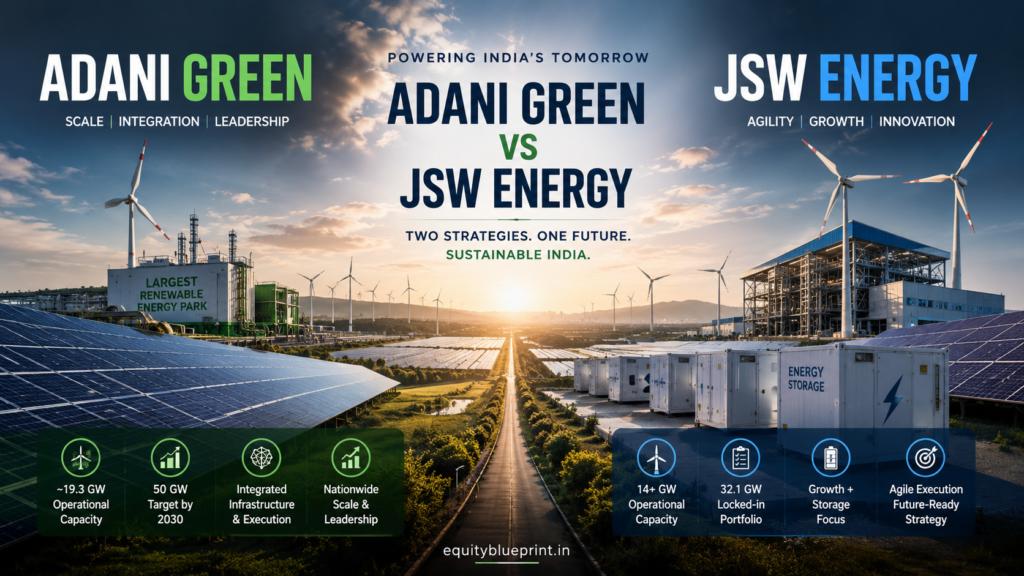
TL;DR (Executive Summary)
If you’re short on time, here’s the investment thesis in under two minutes.
🟢 Why Investors Like Adani Green
- India’s largest listed renewable energy company with nearly 19.3 GW of operational capacity.
- Industry-leading execution backed by the massive Khavda Renewable Energy Park.
- Strong long-term revenue visibility through Power Purchase Agreements (PPAs).
- The clearest pure-play investment on India’s renewable energy transition.
🟢 Why Investors Like JSW Energy
- Rapidly transforming into an integrated energy platform spanning solar, wind, hydro, thermal power, Battery Energy Storage Systems (BESS), Pumped Hydro Storage (PHS), and energy trading.
- Strategy 2030 targets 30 GW generation capacity and 40 GWh energy storage, creating multiple future growth engines.
- Significantly lower valuation despite operating in the same structural growth industry.
- Better balance sheet and a stronger margin of safety.
⚠️ What Could Go Wrong?
- Adani Green’s premium valuation leaves little room for execution mistakes.
- JSW Energy still needs to prove that its ambitious expansion can improve ROE, ROCE and Free Cash Flow.
- Both companies operate in a capital-intensive business where project delays, financing costs and capital allocation decisions can significantly influence shareholder returns.
⚖️ Investor Decision Matrix
| If You Value… | Better Choice |
| Largest Renewable Energy Leader | 🟢 Adani Green |
| Lower Valuation | 🟢 JSW Energy |
| Better Balance Sheet | 🟢 JSW Energy |
| Proven Renewable Execution | 🟢 Adani Green |
| Diversified Business Model | 🟢 JSW Energy |
| Higher Risk-Adjusted Return Potential | 🟢 JSW Energy |
🏆 Equity Blueprint Initial Verdict
This isn’t a comparison between a good company and a bad company.
Nor is it simply a comparison between two renewable energy stocks.
It is a comparison between:
- India’s undisputed renewable energy leader, and
- India’s fastest-transforming integrated energy platform.
If Adani Green continues executing flawlessly, it could remain the country’s dominant renewable energy company for years to come.
But if valuation discipline matters—and if JSW Energy successfully delivers on Strategy 2030—it may generate superior risk-adjusted returns over the next decade.
That distinction forms the foundation of this entire comparison.
Introduction
Imagine you had missed every major wealth-creating trend of the last twenty years.
You didn’t invest when private banks transformed India’s financial system.
You missed the IT boom.
You stayed away from the consumer sector’s long bull market.
Now ask yourself one question.
What could become India’s next decade-defining investment theme?
For many investors, the answer is becoming increasingly obvious.
Renewable energy.
India is preparing for one of the largest energy transitions in the world.
The government’s target of 500 GW of non-fossil fuel capacity by 2030, rising electricity demand, artificial intelligence (AI), data centres, electric vehicles, advanced manufacturing and railway electrification are creating a structural demand cycle that could last for decades.
Unlike cyclical industries that rise and fall with the economy, electricity demand continues to expand as a nation develops.
Every new factory needs power.
Every AI data centre consumes enormous electricity.
Every electric vehicle increases grid demand.
Every air conditioner installed in Indian homes strengthens long-term power consumption.
The question, therefore, is no longer whether India’s electricity market will grow.
The more important question is:
Which companies are best positioned to convert that growth into long-term shareholder wealth?
Among all listed renewable energy companies, two names consistently dominate investor discussions.
Adani Green Energy.
JSW Energy.
At first glance, they appear remarkably similar.
Both are investing aggressively.
Both are expanding renewable capacity.
Both benefit from India’s clean-energy transition.
Both have ambitious long-term roadmaps.
Yet beneath the surface, they represent two very different investment philosophies.
Adani Green is attempting to build the country’s largest renewable energy empire through scale, execution and operational dominance.
JSW Energy is taking a different path.
Rather than focusing solely on renewable generation, it is building an integrated energy platform that combines renewable power with battery storage, pumped hydro, thermal balancing capacity and energy trading.
One company is building more renewable assets.
The other is building the future electricity ecosystem.
That subtle distinction could ultimately determine which stock creates greater long-term wealth.
📌 Why This Comparison Matters
Many investors ask:
“Which stock will give higher returns?”
Professional investors ask a different question.
“Which business can continue creating value even after today’s expectations are already reflected in the share price?”
That is exactly what this comparison aims to answer.
Rather than focusing on recent share price movements or market sentiment, we’ll compare both companies using the Equity Blueprint Framework, evaluating:
- Valuation
- Growth quality
- Business model
- Competitive advantages
- Financial strength
- Management execution
- Capital allocation
- Risk profile
- Long-term wealth creation potential
Our goal is not simply to declare a winner.
Our goal is to help you understand which stock fits your investment style—and why.
📊 Before We Begin…
One important point deserves attention.
This is not a momentum comparison.
It is not a trading guide.
And it is not a prediction of which stock will outperform over the next three months.
Instead, this analysis asks a far more meaningful question:
If you could own only one of these companies for the next ten years, which one would deserve a place in your portfolio?
That’s the question we’ll answer.
Quick Comparison Snapshot (FY2026)
| Parameter | Adani Green | JSW Energy |
| CMP | ₹1,502 | ₹547 |
| Market Capitalisation | ₹2.47 Lakh Crore | ₹1.00 Lakh Crore |
| Business Model | Pure Renewable Energy IPP | Integrated Energy Platform |
| Operational Capacity | ~19.3 GW | 14+ GW |
| 2030 Vision | 50 GW Renewable Capacity | 30 GW Generation + 40 GWh Storage |
| PE Ratio | 135 | 46 |
| PEG Ratio | 7.79 | 2.45 |
| Price-to-Book | 12.81 | 2.96 |
| ROE | 11.4% | 7.51% |
| ROCE | 7.39% | 8.16% |
| Debt-to-Equity | 5.19 | 2.50 |
| Dividend Yield | 0.00% | 0.37% |
| Revenue (FY2026) | ₹12,928 Crore | ₹18,901 Crore |
| Net Profit (FY2026) | ₹10,785 Crore | ₹10,068 Crore |
| 3-Year Free Cash Flow | -₹39,648 Crore | -₹4,880 Crore |
The Core Thesis: This Isn’t a Battle Between Two Stocks
Most comparison articles begin with a simple question.
Which company is better?
That is the wrong question.
A far more useful question is:
Which company offers the highest probability of creating superior long-term wealth at today’s valuation?
The answer isn’t obvious.
Because this isn’t a comparison between a winner and a loser.
It is a comparison between two different ways of participating in India’s energy transition.
Adani Green is betting on one thing:
Scale.
Build more renewable capacity.
Commission projects faster than competitors.
Dominate India’s renewable generation market.
JSW Energy is betting on something broader:
Integration.
Don’t just generate electricity.
Store it.
Balance it.
Trade it.
Deliver reliable power 24×7.
That difference changes the entire investment debate.
One company is building India’s largest renewable generator.
The other is trying to build India’s most complete energy company.
Both strategies are compelling.
Both could create substantial shareholder wealth.
But they won’t reward investors in exactly the same way.
And that’s precisely why this comparison matters.
💡 Equity Blueprint Insight
The biggest investing mistake is assuming that companies operating in the same industry deserve the same valuation.
They don’t.
Markets don’t simply reward growth.
They reward predictable growth, capital discipline, and management execution.
Over the next few sections, we’ll examine which company possesses the stronger combination of those qualities—and whether the market is pricing them correctly.
Understanding the Industry Before Comparing the Companies
Before comparing two businesses, professional investors first compare the industry.
Why?
Because even exceptional management teams struggle to create wealth in structurally declining industries.
Conversely, companies operating within powerful long-term trends often enjoy years of favourable demand.
India’s renewable energy sector firmly belongs to the second category.
Several independent forces are driving this transformation simultaneously:
- 🇮🇳 India’s target of 500 GW non-fossil fuel capacity by 2030
- ⚡ Rapid growth in electricity demand
- 🤖 Artificial Intelligence and data centres
- 🚗 Electric vehicle adoption
- 🏭 Manufacturing expansion
- 🚆 Railway electrification
- 🌱 Corporate decarbonisation
- 🔋 Battery storage deployment
This isn’t simply an ESG story anymore.
It is an infrastructure story.
A national competitiveness story.
And potentially one of the biggest long-term investment opportunities in the Indian equity market.
However, one challenge remains.
Generating renewable electricity is only half the battle.
The future belongs to companies capable of delivering electricity when the sun isn’t shining and the wind isn’t blowing.
That’s exactly where this comparison becomes fascinating.
Because Adani Green and JSW Energy are solving that problem in very different ways.
Layer 1 – Valuation: Are Investors Paying for Growth… or Paying Too Much for Optimism?
Before discussing revenues, profits or ambitious expansion plans, let’s answer a much simpler question.
If both companies stopped growing tomorrow, which stock would leave investors with the larger margin of safety?
That is the essence of valuation.
Contrary to popular belief, the best company does not always become the best investment.
History offers countless examples.
Coca-Cola was a wonderful business in the late 1990s. Yet investors who bought it at excessive valuations waited years for meaningful returns.
The same principle applies today.
Both Adani Green and JSW Energy operate in one of India’s most attractive structural growth industries.
The difference lies in how much of that future growth is already reflected in today’s share price.
📊 Valuation Snapshot
| Metric | Adani Green | JSW Energy |
| PE Ratio | 135 | 46 |
| PEG Ratio | 7.79 | 2.45 |
| Price-to-Book | 12.81 | 2.96 |
| Debt-to-Equity | 5.19 | 2.50 |
| Dividend Yield | Nil | 0.37% |
At first glance, the comparison appears almost unfair.
Across nearly every conventional valuation metric, JSW Energy looks significantly cheaper.
But experienced investors know something important.
Cheap does not automatically mean undervalued.
Expensive does not automatically mean overvalued.
The real question is:
Why is the market willing to pay such a large premium for one company over the other?
Let’s break that down.
PE Ratio: Paying for Leadership
Most retail investors begin their analysis with the PE Ratio.
It’s useful.
But it rarely tells the complete story.
💡 Jargon Buster – What is the PE Ratio?
Imagine buying a small shop.
If the shop earns ₹1 lakh every year and someone asks you to pay ₹20 lakh for it, you’re effectively paying 20 years’ worth of profits.
That’s exactly what the PE Ratio measures.
Higher PE generally means investors expect higher future growth.
With that in mind, consider the numbers again.
| Company | PE Ratio |
| Adani Green | 135 |
| JSW Energy | 46 |
Both companies trade above the industry’s average PE.
But Adani Green stands in a league of its own.
A PE above 130 tells us something profound.
The market isn’t paying for today’s earnings.
It is paying for:
- India’s renewable revolution.
- The successful execution of the Khavda Renewable Energy Park.
- Decades of renewable capacity additions.
- Continued leadership in utility-scale renewable infrastructure.
In short…
Investors are paying for certainty.
JSW Energy, by contrast, trades at a much lower multiple.
Why?
Because investors are still evaluating whether Strategy 2030 will eventually transform the company into India’s next-generation integrated energy platform.
One company has already earned the market’s trust.
The other is still trying to earn it.
📌 Equity Blueprint Insight
Markets don’t reward companies.
They reward expectations. The higher the expectations, the harder they become to exceed.
PEG Ratio: Is Future Growth Already Priced In?
Looking only at the PE Ratio can sometimes be misleading.
Imagine two companies.
Both trade at a PE of 40.
One grows profits by 40%.
The other grows profits by only 10%.
Should both deserve the same valuation?
Probably not. That’s why professional investors often look at the PEG Ratio.
💡 Jargon Buster – PEG Ratio
PEG simply adjusts the PE Ratio for expected earnings growth.
A quick rule of thumb:
- Below 1 → Attractive
- Around 1 → Fairly valued
- Above 2 → Investors are already paying heavily for future growth
Now compare the two companies.
| Company | PEG Ratio |
| Adani Green | 7.79 |
| JSW Energy | 2.45 |
Neither company qualifies as cheap.
But the gap is enormous.
Adani Green’s valuation assumes years of outstanding execution.
JSW Energy also carries high expectations—but considerably less optimism is embedded into its current valuation.
That distinction matters.
Because investing isn’t about identifying companies that will grow.
It’s about identifying companies that can grow more than the market already expects.
Price-to-Book: How Much Premium Does the Market Assign?
Infrastructure businesses require billions of rupees before they generate meaningful profits.
Consequently, Book Value remains a useful supporting metric.
| Company | Price-to-Book |
| Adani Green | 12.81 |
| JSW Energy | 2.96 |
The difference is remarkable.
The market values Adani Green at more than four times the premium assigned to JSW Energy relative to its net assets.
Does that mean Adani Green is irrationally expensive?
Not necessarily.
It simply reflects the market’s confidence in:
- Management execution.
- Asset quality.
- Future profitability.
- Long-term renewable leadership.
But investors should remember one important principle.
The better the story, the higher the expectations.
And the higher the expectations, the smaller the margin for error.
Why Professional Investors Prefer EV/EBITDA
Infrastructure companies often confuse retail investors.
Large depreciation charges.
Heavy borrowing.
Massive capital expenditure.
All of these can distort the PE Ratio.
That is why institutional investors frequently prefer EV/EBITDA.
💡 Jargon Buster – Why EV/EBITDA Matters
Think of buying an apartment building.
Would you only consider the purchase price?
Of course not.
You’d also examine:
- Outstanding loans.
- Cash flows.
- Rental income.
EV/EBITDA works similarly.
Instead of focusing only on shareholders’ earnings, it values the entire business, including debt. That’s why analysts covering infrastructure companies often trust EV/EBITDA more than PE.
Adani Green: Premium Has Gradually Normalized
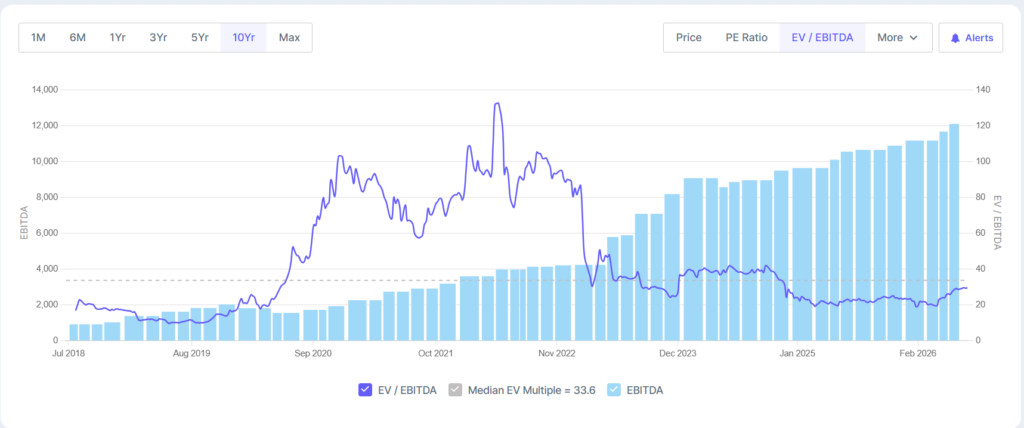
Image Source : https://www.screener.in/
Over the last decade, Adani Green experienced one of the most dramatic valuation expansions in India’s renewable sector.
Investors aggressively re-rated the company as renewable energy moved from a niche theme to a national priority.
Interestingly, despite continued business expansion, EV/EBITDA has gradually moderated.
Why?
Because EBITDA has grown faster than Enterprise Value.
That’s healthy.
It suggests the business has started catching up with its valuation.
JSW Energy: Growth Without Extreme Valuation
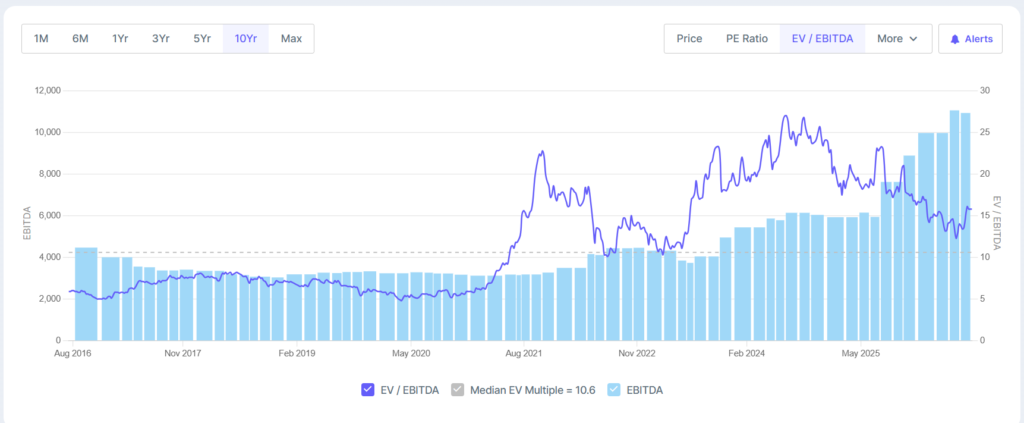
Image Source : https://www.screener.in/
JSW Energy tells a different story.
Its valuation expanded as investors began recognising Strategy 2030 and the company’s transition toward integrated energy solutions.
However, unlike Adani Green, valuation multiples never reached extreme levels.
Today, EV/EBITDA has also moderated.
The difference is that expectations remain considerably more reasonable.
For long-term investors, that’s encouraging.
The Hidden Story Behind Both Charts
Most investors compare today’s valuation.
Few compare how valuation has changed over time.
That is a mistake.
The historical EV/EBITDA trends reveal something important.
Both companies have experienced multiple compression while continuing to improve their underlying businesses.
In simple words…
Future shareholder returns are increasingly likely to come from:
- Higher earnings.
- Better cash generation.
- Improved return on capital.
Not from investors becoming willing to pay even higher multiples.
That represents a much healthier investment environment.
Debt: The Silent Risk Investors Often Ignore
Renewable energy is among the world’s most capital-intensive industries.
Debt is inevitable.
The question isn’t whether companies borrow.
The question is whether those borrowings create more value than they cost.
| Company | Debt-to-Equity |
| Adani Green | 5.19 |
| JSW Energy | 2.50 |
Here, the difference becomes difficult to ignore.
Adani Green has chosen speed.
JSW Energy has chosen relatively greater financial flexibility.
Neither approach is inherently wrong.
But they create different risk profiles.
During periods of falling interest rates, aggressive leverage can significantly boost shareholder returns.
During difficult financing environments, the opposite is equally true.
What Investors Are Getting Wrong
One of the biggest misconceptions surrounding this comparison is remarkably simple.
Many investors believe:
Adani Green is expensive.
JSW Energy is cheap.
Reality is far more nuanced.
Adani Green deserves a premium.
Its execution record is exceptional.
Its operational scale is unmatched.
Its renewable portfolio remains the industry benchmark.
The real question is whether that premium has become too large.
JSW Energy, meanwhile, isn’t inexpensive either.
The market already recognises its long-term potential.
However, compared with Adani Green, investors are paying for future possibility rather than established certainty.
That subtle difference may ultimately decide long-term returns.
📌 Equity Blueprint Insight
Markets often reward certainty.
But history shows that extraordinary wealth is frequently created when possibility gradually becomes certainty.
Today, Adani Green represents certainty.
JSW Energy represents possibility.
Neither approach is inherently superior.
But investors seeking the best risk-adjusted opportunity may find the second proposition more attractive.
Equity Blueprint Valuation Scorecard
| Parameter | Winner |
| PE Ratio | 🟢 JSW Energy |
| PEG Ratio | 🟢 JSW Energy |
| Price-to-Book | 🟢 JSW Energy |
| Financial Flexibility | 🟢 JSW Energy |
| Revenue Visibility | 🟢 Adani Green |
| Market Leadership | 🟢 Adani Green |
| Margin of Safety | 🟢 JSW Energy |
Layer 1 Verdict
Viewed purely through the lens of valuation, JSW Energy emerges as the stronger investment candidate.
Not because it is dramatically undervalued.
And certainly not because Adani Green is a poor business.
Rather, because the balance between price, growth potential and financial flexibility currently appears more favourable.
Adani Green remains an outstanding company.
But outstanding companies do not always translate into outstanding investments when investors pay exceptionally high prices.
JSW Energy still has something every long-term investor values.
Room to positively surprise the market.
Looking Beyond Valuation
Buying a stock at the right price is only half the equation.
A reasonable valuation means very little if the business cannot continue compounding over the next decade.
That naturally brings us to the second pillar of the Equity Blueprint Framework:
Which company has the stronger long-term growth engine—and which is more likely to convert today’s investments into tomorrow’s shareholder wealth?
Layer 2 – Growth Comparison: Which Company Can Create More Wealth Over the Next Decade?
Imagine two companies.
One doubles its revenue every few years but requires enormous debt to keep growing.
The other grows more steadily while improving business quality and creating multiple future growth engines.
Which one would you choose?
There isn’t a universally correct answer.
The answer depends on one simple question:
Is the company merely getting bigger—or is it becoming a stronger business?
Professional investors rarely chase growth alone.
They chase high-quality growth.
That means asking questions like:
- Is revenue growth sustainable?
- Are profits growing faster than sales?
- Is management reinvesting wisely?
- Will today’s investments generate higher cash flows tomorrow?
Those are the questions that truly determine long-term shareholder wealth.
Let’s compare both companies through that lens.
Revenue Growth: Scale vs Transformation
Both companies have expanded rapidly over the last six financial years.
But they have taken very different paths.
| Revenue | FY2020 | FY2026 | Growth |
| Adani Green | ₹2,549 Cr | ₹12,928 Cr | More than 5× |
| JSW Energy | ₹9,138 Cr | ₹18,901 Cr | More than 2× |
At first glance, Adani Green appears to be the clear winner.
Growing revenue more than fivefold in six years is an extraordinary achievement.
But percentages can sometimes be misleading.
Growing from ₹2,500 crore to ₹13,000 crore is impressive.
Growing from ₹9,000 crore to nearly ₹19,000 crore is equally impressive because the base is much larger.
This is why institutional investors rarely celebrate growth percentages alone.
They ask:
How difficult was that growth to achieve?
Adani Green: Growth Through Scale
Adani Green has followed a remarkably focused strategy.
Every year, management has expanded renewable capacity through utility-scale solar and wind projects backed by long-term PPAs.
Revenue growth has been driven primarily by:
- New project commissioning
- Higher renewable generation
- Expansion of operational capacity
- Long-term contracted cash flows
This creates one major advantage.
Revenue becomes highly predictable once projects begin commercial operations.
The business resembles a toll road.
Heavy investment comes first. Stable cash generation follows.
JSW Energy: Growth Through Diversification
JSW Energy tells a very different story.
Rather than relying on one growth engine, management has built several.
Revenue expansion has come from:
- Renewable capacity additions
- Strategic acquisitions
- Thermal optimisation
- Hydroelectric projects
- Energy trading
- Storage investments
Instead of simply becoming a larger renewable company, JSW Energy is becoming a broader energy business.
That distinction matters.
Because diversification can create more opportunities for future earnings growth.
📌 Equity Blueprint Insight
Adani Green has pursued vertical growth.
JSW Energy has pursued horizontal expansion.
One company is becoming bigger.
The other is becoming broader.
Neither strategy is inherently superior.
The question is which one will create more shareholder value over the next decade.
Profit Growth: Revenue Means Nothing Without Earnings
Revenue tells us that customers are buying electricity.
Profit tells us whether shareholders are benefiting.
| Net Profit | FY2020 | FY2026 |
| Adani Green | ₹1,450 Cr | ₹10,785 Cr |
| JSW Energy | ₹2,957 Cr | ₹10,068 Cr |
Again, Adani Green appears stronger.
Its earnings have increased more than sevenfold.
JSW Energy’s profits have more than tripled.
Both numbers are outstanding.
But they also reflect the unique economics of infrastructure businesses.
Once a power plant begins operating, additional revenue often contributes disproportionately to profits because fixed costs have already been incurred.
This phenomenon is known as operating leverage.
💡 Jargon Buster – Operating Leverage
Imagine building a toll bridge.
Constructing the bridge costs thousands of crores.
But once it’s operational, every additional vehicle crossing the bridge generates revenue without requiring another bridge to be built.
Power plants work in a similar way.
After construction is complete, incremental electricity sales often improve profitability much faster than revenue.
That is exactly what both companies are beginning to experience.
However, investors should avoid one common mistake.
Accounting profits alone never tell the complete story.
Infrastructure businesses are heavily influenced by:
- Depreciation
- Interest expenses
- Capital expenditure
- Project financing
That’s why growth must always be analyzed alongside cash flow and capital efficiency.
Operational Growth: Where the Real Story Begins
Financial statements tell us what happened.
Operational metrics explain why it happened.
This is where the comparison becomes far more interesting.
Adani Green
Recent operational achievements include:
- Approximately 19.3 GW operational renewable capacity.
- Around 5 GW commissioned during FY2026.
- Khavda Renewable Energy Park progressing as planned.
- Strong increase in energy sales.
- Continued expansion of hybrid renewable projects.
These achievements reinforce one important point.
Management has consistently converted announced projects into revenue-generating assets.
Execution has become Adani Green’s greatest competitive advantage.
JSW Energy
JSW Energy’s milestones tell a different story.
Instead of simply adding renewable capacity, management has simultaneously expanded across multiple technologies.
Key achievements include:
- More than 14 GW operational generation capacity.
- 32.1 GW locked-in project portfolio.
- Commissioning of the Tidong Hydroelectric Project.
- Continued development of the Salboni Ultra Supercritical Thermal Project.
- Rapid expansion into Battery Energy Storage Systems.
- One of India’s largest Pumped Hydro development pipelines.
The company’s operational complexity has increased dramatically. So has its opportunity set.
Which Growth Model Is More Scalable?
This is where the debate becomes particularly interesting.
Adani Green’s Model
Future growth depends primarily on:
- Renewable capacity additions.
- Faster project commissioning.
- Khavda execution.
- Additional PPAs.
The strategy is simple.
Build.
Commission.
Repeat.
The advantage?
Operational focus.
The challenge?
As the company becomes larger, maintaining very high growth rates naturally becomes more difficult.
JSW Energy’s Model
Future growth is spread across several businesses.
Management is simultaneously investing in:
- Solar.
- Wind.
- Hydro.
- Thermal.
- Battery storage.
- Pumped hydro.
- Energy trading.
This creates multiple earnings engines.
If one segment slows, another can continue driving growth.
However, greater diversification also increases execution complexity.
📌 Equity Blueprint Insight
Scale creates efficiency.
Diversification creates resilience.
Adani Green appears stronger in the first category.
JSW Energy appears stronger in the second.
Strategy 2030: Whose Vision Looks More Compelling?
Every infrastructure company publishes ambitious presentations.
Investors should ignore the headlines and focus on one question.Can management realistically deliver what it promises?
Adani Green
Target:
50 GW renewable capacity by 2030
The strategy is straightforward.
Remain India’s largest renewable energy company.
Future success depends heavily on Khavda and continued execution excellence.
JSW Energy
Target:
- 30 GW generation capacity
- 40 GWh energy storage
Notice the difference.
Management is not simply targeting larger renewable capacity.
It is preparing for the next stage of India’s electricity transition—where storage becomes just as important as generation.
That makes Strategy 2030 far more than an expansion plan.
It represents a complete evolution of the business model.
Cash Flow Quality: The Growth Test That Really Matters
Revenue growth attracts investors.
Profit growth creates excitement.
Cash flow creates wealth.
Interestingly, both companies currently report negative Free Cash Flow.
At first glance, that appears worrying.
In reality, context matters.
Neither company is burning cash because operations are weak.
Both are investing aggressively in long-life infrastructure assets expected to generate returns over decades.
The key question therefore becomes:
Will today’s capital expenditure generate tomorrow’s cash flows?
That is the investment thesis for both businesses.
Which Company Has the Better Long-Term Growth Engine?
Let’s step back.
Adani Green has demonstrated exceptional historical growth.
Few renewable companies globally have expanded this quickly while maintaining execution quality.
JSW Energy, however, may possess something equally valuable.
Optionality.
Its future no longer depends on one business alone.
Instead, it can benefit from:
- Renewable generation.
- Energy storage.
- Grid balancing.
- Hydroelectricity.
- Energy trading.
As India’s electricity market evolves, those additional growth engines could become increasingly valuable.
📌 Equity Blueprint Insight
Markets often reward yesterday’s winners.
Long-term wealth is frequently created by identifying tomorrow’s winners before the market fully recognises them.
Adani Green has already proven what it can become.
JSW Energy is still proving what it could become.
That difference may ultimately shape future returns.
Equity Blueprint Growth Scorecard
| Parameter | Winner |
| Historical Revenue Growth | 🟢 Adani Green |
| Historical Profit Growth | 🟢 Adani Green |
| Operational Scale | 🟢 Adani Green |
| Business Diversification | 🟢 JSW Energy |
| Storage Opportunity | 🟢 JSW Energy |
| Future Optionality | 🟢 JSW Energy |
| Renewable Leadership | 🟢 Adani Green |
| Growth Visibility | ⚖️ Tie |
Layer 2 Verdict
If the next decade is defined purely by renewable capacity additions, Adani Green remains exceptionally well positioned.
Its execution record, scale and operational momentum are difficult to match.
However, if India’s future electricity system increasingly values generation, storage and integrated energy solutions, JSW Energy could emerge as the more complete long-term business.
The market already recognises Adani Green’s leadership.
It is still evaluating JSW Energy’s transformation.
That makes the investment debate less about who has grown faster and more about whose future is being underestimated.
Looking Beyond Growth
Rapid growth alone never creates lasting shareholder wealth.
History is filled with companies that expanded aggressively only to disappoint investors because management allocated capital poorly.
The next pillar of the Equity Blueprint Framework examines exactly that.
Which management team has demonstrated the discipline, execution capability and strategic vision required to convert today’s ambitious expansion plans into sustainable shareholder wealth?
Layer 3 – Business Quality & Management: Which Company Deserves Your Trust?
Financial statements tell us what happened yesterday.
Management determines what happens tomorrow.
This is especially true in the power sector.
Building a 5 GW renewable park is not simply an engineering challenge—it is a capital allocation challenge.
Management must acquire land, secure financing, win Power Purchase Agreements (PPAs), control construction costs, manage suppliers, commission projects on time and generate acceptable returns for decades.
In other words, shareholders are not just investing in solar panels or wind turbines.
They are investing in management’s ability to convert capital into long-term cash flows.
That makes management quality one of the most important competitive advantages in this comparison.
Two Different Leadership Philosophies
Although both companies operate in the same industry, they are building very different businesses.
Adani Green: Build the Biggest Renewable Platform
Adani Green follows a focused strategy.
Its objective is straightforward:
Become India’s dominant renewable energy company.
Almost every major investment supports that mission.
Management has concentrated capital into:
- Utility-scale solar parks
- Wind farms
- Hybrid renewable projects
- Battery storage
- Ultra-large integrated renewable developments like Khavda
The advantage of this approach is clarity.
Every investment strengthens the company’s leadership in renewable generation.
JSW Energy: Build the Future Electricity Platform
JSW Energy’s strategy is broader.
Rather than specialising in one technology, management is preparing for what India’s electricity system could look like ten years from now.
Its portfolio now spans:
- Solar
- Wind
- Hydroelectric power
- Thermal generation
- Battery Energy Storage Systems (BESS)
- Pumped Hydro Storage (PHS)
- Energy trading
Instead of asking,
“How can we build the largest renewable company?”
Management appears to be asking,
“How can we become India’s most complete energy company?” That subtle difference changes the entire investment story.
💡 Equity Blueprint Insight
Adani Green is building capacity.
JSW Energy is building capability.
Capacity creates scale.
Capability creates optionality.
Both create value—but in different ways.
Competitive Moat: Why Can’t Competitors Simply Copy Them?
A great business should be difficult to replicate.
Otherwise, competitors eventually destroy excess profits.
In infrastructure, competitive advantages rarely come from branding.
Instead, they come from:
- Execution
- Financing
- Scale
- Land acquisition
- Regulatory expertise
- Long-term customer relationships
Let’s compare both companies.
Adani Green’s Moat
✅ 1. Scale
With nearly 19.3 GW of operational renewable capacity, Adani Green has built one of India’s largest clean-energy portfolios.
Scale matters because it improves:
- Procurement costs
- Financing access
- Operating efficiency
- Bargaining power with suppliers
Larger platforms often become even stronger over time.
✅ 2. Execution
Many infrastructure companies announce ambitious targets.
Few consistently deliver.
Adani Green has repeatedly demonstrated its ability to commission projects quickly.
That execution capability has become one of its biggest competitive strengths.
✅ 3. Long-Term PPAs
Most renewable projects operate under long-term Power Purchase Agreements.
These contracts provide:
- Stable revenue
- Predictable cash flows
- Lower business volatility
For infrastructure investors, predictable cash generation is an enormous advantage.
✅ 4. Khavda Renewable Energy Park
Khavda is more than a large project.
It is a strategic asset.
If successfully executed, it could reinforce Adani Green’s leadership for years and create significant economies of scale.
JSW Energy’s Moat
✅ 1. Diversification
JSW Energy combines multiple businesses under one platform.
Very few listed companies operate across:
- Renewable generation
- Hydro
- Thermal
- Storage
- Energy trading
This diversification creates strategic flexibility.
✅ 2. Storage Leadership
India’s renewable future depends not only on producing electricity—but also on storing it.
JSW Energy has invested aggressively in:
- Battery Energy Storage Systems
- Pumped Hydro Storage
These technologies could become increasingly valuable as renewable penetration rises.
✅ 3. Strong Parent Ecosystem
Being part of the JSW Group provides access to:
- Capital
- Engineering expertise
- Vendor relationships
- Project execution capabilities
This ecosystem reduces execution risk.
✅ 4. Multiple Earnings Engines
Unlike businesses dependent on one source of growth, JSW Energy benefits from several.
If one segment slows, another may continue driving earnings.
That resilience could become increasingly valuable over time.
Financial Strength: Who Has More Room for Error?
One lesson from investing history is remarkably consistent.
Companies with stronger balance sheets generally survive difficult periods more comfortably.
That doesn’t mean debt is always bad.
Infrastructure businesses naturally borrow to build assets.
The important question is:
Does the company have enough financial flexibility to keep growing even when conditions become difficult?
| Metric | Adani Green | JSW Energy | Advantage |
| Debt-to-Equity | 5.19 | 2.50 | 🟢 JSW Energy |
| Current Ratio | 0.49 | 0.60 | 🟢 JSW Energy |
| Quick Ratio | 0.48 | 0.55 | 🟢 JSW Energy |
| ROE | 11.4% | 7.51% | 🟢 Adani Green |
| ROCE | 7.39% | 8.16% | 🟢 JSW Energy |
The comparison tells an interesting story.
Adani Green currently delivers stronger shareholder returns through a higher ROE.
JSW Energy, however, enters the next investment cycle with greater financial flexibility.
In an industry where expansion requires billions of rupees, that flexibility can become a significant competitive advantage.
📌 Equity Blueprint Insight
Many investors obsess over installed capacity.
Institutional investors often focus on something else:
How efficiently is management converting every rupee of invested capital into future earnings?
That is where long-term wealth is ultimately created.
Layer 4 – Risk Comparison: Every Great Story Has a Weak Spot
Every investment thesis eventually comes down to one question.
What could go wrong?
Ignoring risks doesn’t make them disappear.
Understanding them helps investors avoid permanent capital loss.
Let’s examine the biggest risks facing each company.
Adani Green: Key Risks
🔴 Premium Valuation
The market already expects exceptional execution.
When expectations are this high, even good performance may disappoint if it falls short of perfection.
🔴 High Leverage
Debt has accelerated growth.
But it also reduces flexibility.
Higher borrowing costs or project delays could place additional pressure on returns.
🔴 Project Concentration
Large projects like Khavda create enormous opportunities.
They also concentrate execution risk.
Delays in commissioning, transmission infrastructure or regulatory approvals could temporarily affect growth.
JSW Energy: Key Risks
🟠 Strategy 2030 Execution
The company’s investment thesis depends heavily on management successfully delivering its ambitious roadmap.
Ambition alone is not enough.
Execution will determine shareholder returns.
🟠 Operational Complexity
Managing renewable generation, hydro, thermal, storage and energy trading simultaneously is considerably more challenging than operating a focused business.
Diversification reduces concentration risk—but increases managerial complexity.
🟠 Capital Efficiency
JSW Energy has invested aggressively.
The next challenge is converting those investments into higher ROE, stronger ROCE and sustainable Free Cash Flow.
The market will increasingly expect proof.
Equity Blueprint Risk Matrix
| Risk Category | Adani Green | JSW Energy |
| Valuation Risk | 🔴 High | 🟡 Moderate |
| Debt Risk | 🔴 High | 🟡 Moderate |
| Execution Risk | 🟡 Moderate | 🔴 High |
| Business Diversification | 🟡 Moderate | 🟢 Strong |
| Financial Flexibility | 🟡 Moderate | 🟢 Strong |
| Regulatory Risk | 🟡 Similar | 🟡 Similar |
| Long-Term Industry Outlook | 🟢 Strong | 🟢 Strong |
The Investment Decision: Which Stock Fits Your Personality?
One of the biggest mistakes investors make is searching for the best stock.
In reality, the better question is:
Which stock is better for me?
Your investment style matters just as much as financial analysis.
Choose Adani Green if you…
✅ Prefer proven market leaders.
✅ Believe renewable generation will remain the dominant investment theme.
✅ Are comfortable paying premium valuations for exceptional execution.
✅ Have a long investment horizon and can tolerate higher volatility.
Choose JSW Energy if you…
✅ Prefer better valuation discipline.
✅ Want exposure to multiple future growth engines.
✅ Believe energy storage will become as important as renewable generation.
✅ Value stronger financial flexibility.
✅ Prefer a better balance between risk and reward.
Final Equity Blueprint Verdict
After comparing valuation, growth, business quality, management execution, financial strength and long-term industry positioning, one conclusion becomes clear.
This is not a contest between a strong company and a weak company.
It is a contest between certainty and optionality.
Adani Green represents certainty.
It has already established itself as India’s renewable energy leader.
Its execution record is among the strongest in the industry.
JSW Energy represents optionality.
Management is building a broader, more diversified energy platform that could become increasingly valuable as India’s electricity system evolves.
🏆 Category Winners
| Category | Winner |
| Renewable Leadership | 🟢 Adani Green |
| Business Diversification | 🟢 JSW Energy |
| Valuation | 🟢 JSW Energy |
| Financial Strength | 🟢 JSW Energy |
| Historical Execution | 🟢 Adani Green |
| Future Optionality | 🟢 JSW Energy |
If I Had to Invest Today…
If someone gave me only one choice and asked:
“Which stock would you buy today for the next 10 years?”
My answer would be:
JSW Energy.
Not because Adani Green is an inferior company.
Far from it.
Adani Green remains one of India’s highest-quality renewable energy businesses.
But investing isn’t just about buying great companies.
It’s about buying great companies at prices that still leave room for attractive future returns.
Today, JSW Energy appears to offer a more balanced combination of:
- Growth potential
- Business diversification
- Financial flexibility
- Valuation comfort
- Future optionality
If management successfully executes Strategy 2030, investors may benefit from both earnings growth and a gradual re-rating of the business.
That combination creates a compelling long-term investment proposition.
✅ Your Quarterly Investor Checklist
Rather than watching daily share prices, monitor these indicators every quarter:
- □ Progress on Adani Green’s Khavda Renewable Energy Park.
- □ JSW Energy’s Battery Energy Storage and Pumped Hydro execution.
- □ Changes in Debt-to-Equity.
- □ Improvement in ROE and ROCE.
- □ Free Cash Flow trends.
- □ New Power Purchase Agreements (PPAs).
- □ Project commissioning timelines.
- □ Management commentary on capital allocation.
Action Tip: Set Google Alerts for terms such as “Khavda Renewable Energy Park”, “JSW Energy Battery Storage”, and “JSW Energy Strategy 2030”. Reviewing quarterly updates on these topics will help you judge whether the original investment thesis remains intact.
Frequently Asked Questions (FAQs)
Is Adani Green better than JSW Energy?
Adani Green remains India’s leading renewable energy company with a stronger execution track record and larger renewable portfolio. However, JSW Energy currently offers a more attractive balance of valuation, diversification and financial flexibility. The better choice depends on your investment priorities.
Which stock has better long-term growth potential?
Adani Green has demonstrated stronger historical growth. JSW Energy may offer broader future growth opportunities because of its investments in renewable energy, battery storage, pumped hydro and integrated energy solutions.
Which company has the stronger balance sheet?
JSW Energy currently has lower leverage and better liquidity, providing greater financial flexibility for future expansion.
Which renewable energy stock is safer?
From a financial perspective, JSW Energy appears relatively safer because of its lower debt and diversified business model. Adani Green benefits from long-term contracted revenues but carries higher leverage and valuation risk.
Which stock would the Equity Blueprint Framework choose today?
Based on the current balance of valuation, growth potential, management strategy and risk, the Equity Blueprint Framework gives a slight edge to JSW Energy for long-term investors. However, investors seeking a pure-play renewable energy leader with a proven execution record may still prefer Adani Green.
Final Thought
India’s renewable energy transition is no longer just an environmental story—it is one of the country’s most significant long-term infrastructure and investment opportunities.
Both Adani Green and JSW Energy are positioned to benefit from that transformation. The difference lies in how they intend to create shareholder value.
Whether you choose the focused execution of Adani Green or the diversified ambition of JSW Energy, remember that long-term returns will ultimately depend on one thing:
Management’s ability to convert today’s capital expenditure into tomorrow’s sustainable cash flows.
Related Analysis
Renewable Energy Industry Explained: Growth Drivers, Risks & Future Outlook https://equityblueprint.in/renewable-energy-industry-analysis-india/
Adani Green Energy Share Analysis 2026: Is India’s Renewable Energy Giant Still Worth Buying at a Premium Valuation? https://equityblueprint.in/adani-green-energy-share-analysis-2026-is-indias-renewable-energy-giant-still-worth-buying-at-a-premium-valuation/
JSW Energy Share Analysis 2026: Can India’s Renewable Energy Challenger Create Long-Term Wealth Despite Massive Expansion? https://equityblueprint.in/jsw-energy-share-analysis-2026-can-indias-renewable-energy-challenger-create-long-term-wealth-despite-massive-expansion/
Waaree Renewable Technologies Ltd (NSE: WAAREERTL): Hypergrowth EPC Story or Narrative Premium Ahead of Reality? https://equityblueprint.in/waaree-renewable-technologies-ltd-nse-waareertl-hypergrowth-epc-story-or-narrative-premium-ahead-of-reality/
Suzlon Energy Ltd (NSE: SUZLON): India’s Renewable Revival Story or a Late-Cycle Euphoria Trade? https://equityblueprint.in/suzlon-energy-ltd-nse-suzlon-indias-renewable-revival-story-or-a-late-cycle-euphoria-trade/
Suzlon Energy vs Waaree Renewable Technologies: The Phoenix vs The Speedster — Which Renewable Stock Is Better for the Next Decade? https://equityblueprint.in/suzlon-energy-vs-waaree-renewable-technologies-the-phoenix-vs-the-speedster-which-renewable-stock-is-better-for-the-next-decade/
NTPC Green Energy Share Analysis (FY2026): Is This Renewable Energy Giant Worth Buying at Its Premium Valuation? NTPC Green Energy Share Analysis (FY2026): Is This Renewable Energy Giant Worth Buying at Its Premium Valuation?
Disclaimer
The analysis provided on this blog, including the “5-Layer Framework,” is for educational and informational purposes only. I am not a SEBI-registered investment advisor. Stock market investing involves significant risk, and past performance is not indicative of future results. The views expressed here are my personal opinions based on my research and study of financial literature. This is not a buy or sell recommendation. Please conduct your own due diligence or consult a qualified, SEBI-registered financial advisor before making any investment decisions. The author may or may not hold positions in the stocks discussed.
About the Author

Nilendu Chatterjee is the founder of Equity Blueprint, a platform focused on helping retail investors approach the stock market with clarity, structure, and discipline. With over a decade of experience in the industrial sector and a strong passion for equity research, he brings a practical, ground-level perspective to fundamental analysis.
Through a framework-driven approach, Nilendu breaks down complex businesses into simple, decision-oriented insights—bridging the gap between professional-grade research and everyday investing. His work is centered on one goal: enabling long-term wealth creation by replacing speculation with structured thinking.