Ticker: NSE: ADANIGREEN
Sector: Renewable Energy | Independent Power Producer (IPP)
Category: Large Cap
Framework: Equity Blueprint 5-Layer Fundamental Analysis Framework
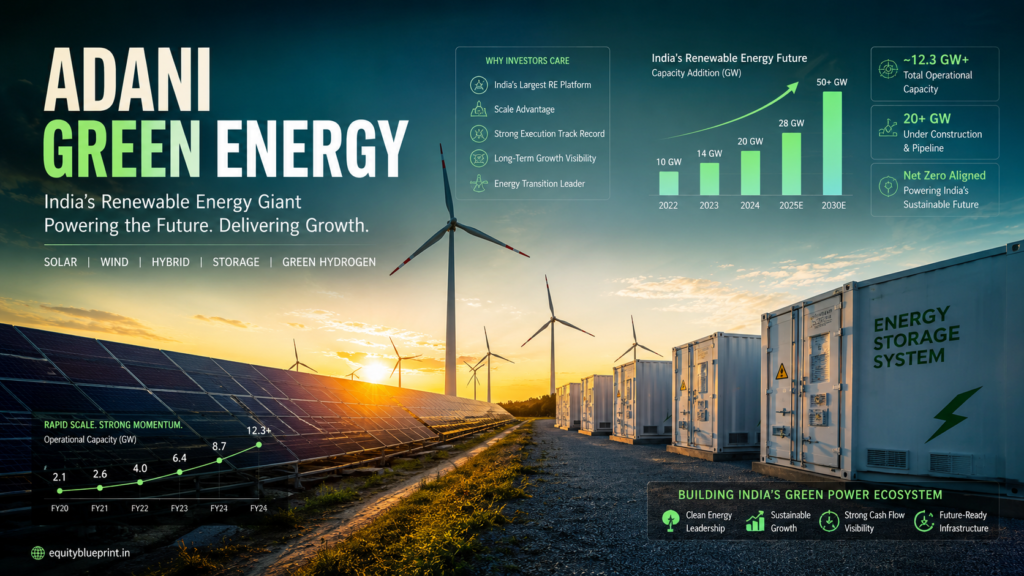
Adani Green Energy Share Analysis: Can India’s Largest Renewable Energy Company Continue Creating Long-Term Wealth?
India is witnessing one of the largest energy transformations in modern history.
For more than a century, economic growth depended heavily on coal, oil and natural gas. Today, however, the equation is changing rapidly. Rising electricity demand, artificial intelligence, electric vehicles, data centres, industrial manufacturing and ambitious climate commitments are driving an unprecedented shift towards renewable energy.
This transition is no longer a distant policy objective—it is becoming an economic necessity.
Few companies are better positioned to benefit from this structural shift than Adani Green Energy Ltd. (AGEL).
In just over a decade, the company has evolved from a relatively small renewable energy developer into India’s largest renewable power producer and one of the world’s largest renewable infrastructure companies. With nearly 19.3 GW of operational renewable capacity, a massive under-construction project pipeline and the world’s largest renewable energy park at Khavda, Adani Green sits at the centre of India’s clean-energy ambitions.
Yet the investment story is far from straightforward.
The company trades at a significant valuation premium, carries substantial debt and continues investing aggressively to fund future growth. These characteristics divide investors into two camps.
One group believes Adani Green is a once-in-a-generation structural compounder capable of benefiting from India’s multi-decade energy transition.
The other argues that the market has already priced in years of optimistic growth, leaving little room for execution mistakes.
So where does the truth lie?
Is Adani Green Energy a high-quality business worthy of long-term ownership, or is its premium valuation creating more risk than opportunity? In this comprehensive Equity Blueprint analysis, we move beyond headlines and short-term market sentiment. Using our proprietary 5-Layer Framework, we examine the renewable energy industry, business model, financial performance, management execution, competitive positioning, valuation, risks and long-term investment potential to help investors make a rational, evidence-based decision.
⚡ TL;DR (Executive Summary)
If you only have one minute, here is the investment thesis.
✅ The Bull Case
- India aims to achieve 500 GW of non-fossil fuel capacity by 2030, creating a multi-decade structural growth opportunity.
- Adani Green is India’s largest renewable energy company with industry-leading project execution, long-term Power Purchase Agreements (PPAs) and one of the world’s largest renewable project pipelines.
- Massive projects like Khavda Renewable Energy Park, battery storage investments and hybrid renewable projects strengthen its long-term competitive position.
⚠️ The Bear Case
- The company trades at an expensive valuation with a PE ratio of around 135, implying very high future growth expectations.
- A Debt-to-Equity ratio above 5 and negative free cash flow reflect the capital-intensive nature of expansion.
- Future shareholder returns depend heavily on flawless execution, disciplined capital allocation and continued access to low-cost financing.
🏆 Equity Blueprint Verdict
Adani Green Energy remains one of India’s highest-quality structural growth companies.
The business deserves a place on every long-term investor’s watchlist, but capital deployment should remain disciplined. Instead of chasing momentum, investors should monitor valuation, cash flow generation, leverage and execution before increasing allocations.
Why This Stock Matters
Every investment begins with one simple question:
Why does this business deserve my capital instead of thousands of other listed companies?
The answer determines whether a stock becomes a long-term wealth creator or simply another short-term market story.
Adani Green matters because it operates in one of the few industries where demand visibility extends well beyond the next business cycle.
Unlike discretionary sectors that fluctuate with consumer sentiment, renewable energy benefits from structural demand created by multiple independent forces:
- India’s rapidly growing economy.
- Rising electricity consumption.
- Urbanisation.
- Manufacturing expansion.
- Electric vehicle adoption.
- AI-driven data centres.
- Corporate ESG commitments.
- Government energy security initiatives.
These drivers are expected to remain relevant for decades rather than quarters. As a result, Adani Green is not merely participating in a growing industry—it is helping build the infrastructure required for India’s future economic growth.
Investment Thesis
Our investment thesis rests on five fundamental observations.
1. Structural Industry Tailwinds
Renewable energy has evolved from a policy-driven sector into one of India’s highest national infrastructure priorities. The industry’s growth is increasingly supported by economics rather than subsidies, creating a stronger foundation for long-term expansion.
2. Market Leadership
Adani Green possesses India’s largest operational renewable portfolio and continues adding capacity faster than most domestic competitors. Scale improves procurement efficiency, financing access and execution capability.
3. Strong Execution Record
Unlike many infrastructure developers that announce ambitious plans without delivering, Adani Green has consistently commissioned projects on schedule while expanding into hybrid renewable assets and battery storage.
4. Premium Valuation Requires Premium Execution
The market has already recognised the company’s quality.
Future returns therefore depend less on whether the business grows and more on whether growth exceeds already optimistic expectations.
5. Capital Efficiency Will Determine Future Returns
The next phase of shareholder value creation will depend on improving return on capital, reducing leverage over time and converting today’s investment cycle into tomorrow’s free cash flow.
At a Glance: Quick Snapshot
| Metric | Value |
| CMP | ₹1,502 |
| Market Capitalisation | ₹2.47 Lakh Crore |
| Industry | Renewable Energy |
| Business Model | Utility-scale Renewable Power Producer |
| Operational Capacity | ~19.3 GW |
| Target Capacity | 50 GW by 2030 |
| PE Ratio | 135 |
| Industry PE | ~24.4 |
| PEG Ratio | 7.79 |
| Price to Book | 12.81 |
| ROE | 11.4% |
| ROCE | 7.39% |
| Debt-to-Equity | 5.19 |
| Current Ratio | 0.49 |
| Quick Ratio | 0.48 |
| Dividend Yield | 0.00% |
| FY20 Revenue | ₹2,549 Cr |
| FY26 Revenue | ₹12,928 Cr |
| FY20 Profit | ₹1,450 Cr |
| FY26 Profit | ₹10,785 Cr |
| 3-Year Free Cash Flow | Negative ₹39,648 Cr |
Key Takeaway
Adani Green is a classic example of a high-quality business that cannot be evaluated using traditional value-investing metrics alone.
Its current financial profile reflects a company in the middle of one of the largest infrastructure expansion programmes in the world.
Consequently, investors must evaluate not only present earnings but also future cash-flow potential, project execution capability and capital allocation discipline.
The remainder of this analysis is designed to answer one central question:
Can Adani Green convert today’s aggressive investments into sustainable shareholder wealth over the next decade?
Beginner’s Glossary
If you are new to stock investing or the renewable energy sector, the following terms will appear frequently throughout this article.
Power Purchase Agreement (PPA)
A long-term contract under which a renewable energy developer agrees to sell electricity to a government utility or corporate customer at a pre-determined price. PPAs provide stable and predictable revenue over many years.
Capacity Utilization Factor (CUF)
CUF measures how efficiently a renewable power plant generates electricity compared with its maximum theoretical capacity.
A higher CUF generally indicates better project quality and stronger operational performance.
Battery Energy Storage System (BESS)
Large-scale batteries that store electricity generated during periods of surplus production and release it during peak demand.
Battery storage is becoming increasingly important as renewable energy penetration rises.
EBITDA
Earnings Before Interest, Taxes, Depreciation and Amortisation.
Infrastructure companies often use EBITDA because it reflects the cash-generating ability of operating assets before financing and accounting adjustments.
EV/EBITDA
Enterprise Value divided by EBITDA.
Professional investors frequently prefer EV/EBITDA over PE for infrastructure businesses because it accounts for debt and is less affected by heavy depreciation charges.
ROCE (Return on Capital Employed)
ROCE measures how efficiently management generates operating profits from the capital invested in the business. For capital-intensive industries like renewable energy, ROCE is one of the most important long-term performance indicators.
Infrastructure Investor Insight
Unlike software or consumer businesses, renewable energy companies invest enormous amounts of capital before generating meaningful cash flows.
As a result:
- High debt is common.
- Free cash flow may remain negative during expansion.
- Depreciation significantly reduces accounting earnings.
- Traditional valuation metrics such as PE should always be interpreted alongside cash-flow and enterprise-value measures.
This distinction will become particularly important when we analyze Adani Green’s valuation in the next section.
What Comes Next?
In the following section, we step away from the company itself and examine the Indian Renewable Energy Industry in depth.
Understanding the industry’s economics, value chain, competitive structure and long-term growth drivers provides the necessary context before evaluating whether Adani Green can continue creating shareholder value over the next decade.
Industry Landscape: Understanding India’s Renewable Energy Industry
Before analysing Adani Green Energy as a business, investors must first understand the industry in which it operates.
History has repeatedly shown that even exceptional management teams struggle to create long-term shareholder wealth in structurally weak industries. Conversely, companies operating in industries with decades of predictable demand often enjoy a much larger margin for execution success.
Renewable energy belongs to the second category.
Unlike many sectors driven primarily by consumer spending or commodity cycles, renewable energy is benefiting from long-term structural changes in the global economy. Governments, corporations and households are simultaneously moving towards cleaner electricity generation, creating one of the largest infrastructure investment opportunities of the twenty-first century.
For Adani Green Energy, understanding this macro backdrop is essential because its future growth depends as much on industry expansion as on company-specific execution.
Industry Overview
Renewable energy refers to electricity generated from naturally replenishing resources such as sunlight, wind, flowing water, biomass and emerging technologies including battery storage and green hydrogen.
Unlike fossil fuels, renewable resources are effectively inexhaustible. Solar panels require sunlight, wind turbines require wind, and hydroelectric plants depend on flowing water rather than finite fuel reserves.
For decades, renewable energy was viewed primarily as an environmental initiative. Today, the narrative has fundamentally changed.
Renewable energy has become an economic necessity driven by falling generation costs, energy security concerns, rapid industrialisation and rising electricity demand.
India’s electricity consumption continues to increase due to:
- Manufacturing expansion
- Urbanisation
- Rising household incomes
- Air-conditioner penetration
- Electric vehicles
- Artificial Intelligence
- Cloud computing
- Data centres
- Railway electrification
- Digital infrastructure
Each of these structural trends requires enormous amounts of reliable electricity.
Renewable energy is increasingly becoming the lowest-cost solution for meeting that demand.
Why Renewable Energy Matters for India
India is currently one of the world’s fastest-growing major economies.
Economic growth naturally requires higher electricity generation.
Historically, this demand would have been met primarily through coal-fired power plants.
However, several factors are changing this equation:
- Rising fossil fuel import dependence
- Climate commitments
- Declining solar costs
- Better battery technology
- Corporate ESG commitments
- Government decarbonisation targets
As a result, renewable energy has moved from being an alternative energy source to becoming one of India’s primary infrastructure priorities.
For investors, this distinction is extremely important.
Industries supported by structural economic necessity typically experience longer growth cycles than industries driven purely by consumer preferences.
Industry Size
India has become one of the largest renewable energy markets in the world.
As of early 2026:
- Total installed power generation capacity exceeds 520 GW.
- Renewable energy capacity including large hydro is approximately 267 GW.
- Renewable capacity excluding large hydro has crossed 215 GW.
- India ranks among the world’s largest solar energy producers.
- India is the third-largest renewable energy market globally.
Solar power contributes the largest share of new renewable installations, followed by wind energy.
Hybrid renewable projects, battery storage systems and pumped hydro storage are emerging as the next major investment opportunities.
Industry Growth Rate
Renewable energy remains one of India’s fastest-growing infrastructure sectors.
Over the past decade:
- Solar capacity has expanded exponentially.
- Wind installations have resumed growth after policy reforms.
- Battery storage has moved from pilot projects to commercial deployment.
- Corporate renewable power demand has accelerated significantly.
The Government of India has established ambitious capacity addition targets extending well beyond the current decade.
This creates unusually strong long-term visibility for renewable developers.
Unlike cyclical industries that experience periods of oversupply and contraction, renewable energy demand continues to benefit from multiple independent growth drivers.
India’s Renewable Energy Targets
India has committed to one of the world’s most ambitious energy transitions.
Key national objectives include:
- 500 GW of non-fossil fuel electricity capacity by 2030
- Net Zero emissions by 2070
- Continued expansion of domestic renewable manufacturing
- Large-scale deployment of battery storage
- Strengthening national transmission infrastructure
- Increased renewable integration across industries
These targets provide a multi-decade growth runway for renewable developers.
However, achieving them will require hundreds of billions of dollars of capital investment, making execution capability and financing access critical competitive advantages.
Major Segments of the Industry
Renewable energy is often discussed as though it were a single industry.
In reality, it consists of several interconnected businesses.
Utility-Scale Solar
Large solar parks remain the industry’s largest investment category.
Solar has become the cheapest source of incremental electricity generation in many regions, making it the preferred technology for new capacity additions.
Wind Energy
Wind projects complement solar generation by producing electricity during different weather conditions.
Wind remains especially important in states such as Gujarat, Rajasthan, Karnataka and Tamil Nadu.
Hybrid Renewable Projects
Hybrid projects combine solar and wind generation.
These systems improve transmission utilisation while delivering more stable electricity output throughout the day.
This segment is expected to witness rapid expansion over the coming decade.
Battery Energy Storage Systems (BESS)
Battery storage allows renewable electricity generated during peak sunlight or wind conditions to be stored and supplied later when demand increases.
As renewable penetration rises, storage becomes increasingly essential for maintaining grid stability. Battery storage is expected to become one of the industry’s fastest-growing segments.
Pumped Hydro Storage
Pumped hydro functions as a natural battery by storing excess electricity through water movement.
Although capital intensive, it offers long-duration storage capabilities that complement renewable generation.
Green Hydrogen
Renewable electricity can also be used to produce hydrogen for industrial applications.
Although still in the early stages, green hydrogen could become a significant long-term demand driver for renewable power.
Renewable Energy Value Chain
Understanding where value is created helps investors identify which companies possess sustainable competitive advantages.
The renewable energy value chain consists of several distinct stages.
Stage 1 — Raw Material Suppliers
The value chain begins with manufacturers of:
- Silicon
- Copper
- Aluminium
- Steel
- Rare earth materials
- Battery minerals
These materials form the foundation of renewable infrastructure.
Stage 2 — Equipment Manufacturers
Raw materials are converted into:
- Solar modules
- Wind turbines
- Inverters
- Batteries
- Transmission equipment
Equipment quality directly influences project performance over decades.
Stage 3 — Project Developers
Developers perform some of the industry’s highest-value activities.
Their responsibilities include:
- Land acquisition
- Government approvals
- Environmental clearances
- Financing
- Securing Power Purchase Agreements (PPAs)
- Designing renewable projects
Obtaining high-quality projects with long-term PPAs significantly enhances long-term cash flow visibility.
Stage 4 — EPC Companies
Engineering, Procurement and Construction (EPC) companies build renewable assets according to project specifications.
Execution quality during this phase strongly influences project economics.
Stage 5 — Power Generation
This is where Adani Green operates.
Once projects become operational, electricity is generated and sold under long-term contracts.
Revenue is generally more predictable than many other industries because electricity sales are supported by long-duration PPAs.
Stage 6 — Transmission & Distribution
Electricity moves through national transmission networks before reaching:
- State utilities
- Industrial customers
- Commercial establishments
- Residential consumers
Where Does Adani Green Operate?
Adani Green primarily participates in the highest-value portions of the chain:
✔ Project Development
✔ Renewable Asset Ownership
✔ Electricity Generation
✔ Long-term Operations
✔ Battery Storage
Rather than manufacturing solar modules or wind turbines, the company focuses on building and operating large-scale renewable infrastructure capable of generating stable contracted cash flows for decades.
This business model generally produces more predictable earnings than equipment manufacturing, although it also requires significantly higher capital investment.
Key Growth Drivers
Renewable energy is being supported by several long-term structural drivers that reinforce one another.
1. Rising Electricity Demand
India’s electricity demand continues growing due to:
- GDP expansion
- Manufacturing
- Urbanisation
- Rising living standards
- Digital infrastructure
Electricity consumption is expected to increase steadily for decades.
2. Artificial Intelligence and Data Centres
AI applications require enormous computing power.
Large data centres consume substantial electricity and increasingly prefer renewable energy to meet sustainability commitments.
This creates a completely new demand source for renewable power producers.
3. Electric Vehicles
Electric mobility shifts transportation energy demand from petroleum to electricity. Higher EV adoption therefore indirectly increases long-term renewable electricity demand.
4. Government Policy Support
Government initiatives include:
- Competitive renewable auctions
- Transmission infrastructure expansion
- Domestic manufacturing incentives
- Renewable Purchase Obligations (RPOs)
- Green hydrogen initiatives
Policy support continues to strengthen the industry’s long-term outlook.
5. Falling Renewable Costs
Solar electricity has become one of the world’s cheapest forms of new power generation.
Improving technology and manufacturing scale continue reducing generation costs.
This makes renewable energy economically attractive even without significant subsidies.
6. Corporate Sustainability
Large corporations increasingly procure renewable electricity through long-term PPAs to reduce carbon emissions and satisfy ESG requirements.
Corporate demand is becoming an increasingly important growth engine.
Key Risks of Investing in Indian Renewable Energy
Despite attractive long-term fundamentals, investors should recognise several important risks.
Capital Intensity
Renewable projects require enormous upfront investment.
Developers therefore rely heavily on long-term debt financing. Higher interest rates can materially reduce project returns.
Execution Risk
Large renewable projects involve:
- Land acquisition
- Environmental approvals
- Equipment procurement
- Transmission connectivity
- Construction management
Project delays increase financing costs while postponing revenue generation.
Policy Risk
Government policies have historically supported renewable energy.
However, changes in:
- Auction structures
- Renewable tariffs
- Taxation
- Regulatory frameworks
could affect future project economics.
Grid Infrastructure
Renewable generation creates value only if adequate transmission infrastructure exists.
Transmission delays can postpone commercial operations.
Competitive Bidding
Aggressive bidding during government auctions may compress future returns if developers prioritize market share over project profitability.
Technology Evolution
Battery technology, solar efficiency and storage solutions continue improving rapidly. Companies that fail to adapt may lose competitiveness.
Industry Structure
The renewable energy industry remains overwhelmingly organised.
Unlike fragmented sectors, renewable development requires:
- Large capital investments
- Technical expertise
- Regulatory approvals
- Strong financing capability
Consequently, the industry is dominated by well-capitalised public and private developers.
Major participants include:
- Adani Green Energy
- NTPC Green Energy
- Tata Power Renewable Energy
- JSW Energy
- NHPC
- SJVN
- ReNew Energy
Competition primarily occurs before projects become operational.
Once long-term PPAs are secured, revenue becomes comparatively stable.
Industry Outlook (2026–2031)
The renewable energy industry appears positioned for another decade of structural expansion.
Several trends support this outlook:
- Continued solar capacity additions
- Rapid battery storage deployment
- Hybrid renewable projects
- Green hydrogen development
- AI-driven electricity demand
- Industrial electrification
- Data centre expansion
- Transmission infrastructure upgrades
Although financing conditions and execution challenges may create short-term volatility, the long-term demand outlook remains favourable. Renewable energy is increasingly becoming the backbone of India’s future electricity system rather than merely an alternative energy source.
Industry Positioning: Where Does Adani Green Stand?
Within India’s renewable energy ecosystem, Adani Green occupies the position of a clear industry leader.
Its competitive advantages include:
- India’s largest operational renewable portfolio
- Industry-leading execution capability
- Large pipeline of contracted renewable projects
- Battery storage expansion
- Hybrid renewable expertise
- Strong access to capital markets
- Integrated project development capabilities
The company’s competitive moat is built less on technology alone and more on execution, scale, financing capability and operational efficiency.
As India’s renewable energy transition accelerates, the critical investment question is no longer whether demand will exist.
Instead, investors must determine whether Adani Green can continue translating that structural demand into profitable, capital-efficient shareholder returns.
Equity Blueprint Industry Verdict
The Indian renewable energy industry remains one of the strongest structural growth opportunities available to long-term investors.
Demand is supported by powerful economic, technological and policy-driven tailwinds that are likely to persist well beyond the current decade.
For Adani Green, the challenge is no longer finding growth opportunities—it is executing projects efficiently, maintaining financial discipline and converting rapid capacity expansion into sustainable shareholder returns.
With this industry backdrop established, we can now evaluate whether Adani Green’s current valuation appropriately reflects both its opportunities and its risks.
Layer 1 – Valuation Discipline: Is Adani Green Worth Its Premium Valuation?
One of the biggest mistakes investors make is confusing a great company with a great investment.
A business may dominate its industry, grow rapidly and possess exceptional management, yet still generate mediocre shareholder returns if investors pay too high a price.
This is particularly relevant for Adani Green Energy.
There is little debate regarding the quality of the underlying business. The real debate revolves around how much investors should pay for that quality.
Adani Green currently trades at valuation multiples that are significantly higher than most listed power and utility companies. The market is clearly pricing the business based on its future growth potential rather than its present earnings.
The critical question therefore is not “Is Adani Green a good company?”
It is:
“Has the market already priced in too much of its future success?”
Let’s examine that through the Equity Blueprint Valuation Framework.
Traditional Valuation Metrics
Price-to-Earnings (PE)
Adani Green currently trades at a Price-to-Earnings (PE) ratio of approximately 135, while the broader renewable power industry trades at roughly 24 times earnings.
At first glance, this immediately suggests that the stock appears expensive.
However, investors should avoid jumping to conclusions.
A high PE ratio simply tells us that the market expects significantly higher future earnings growth.
It does not automatically imply overvaluation.
High-quality businesses often trade at premium valuations because investors expect them to compound earnings over long periods.
Companies like Asian Paints, Titan and Page Industries have historically traded at elevated multiples for exactly this reason.
The important question is whether Adani Green can justify such expectations.
PEG Ratio
The company’s PEG Ratio stands near 7.79.
Traditionally,
- PEG below 1 → Attractive
- PEG around 1–2 → Reasonable
- PEG above 2 → Expensive
A PEG approaching eight indicates investors are paying a substantial premium relative to expected earnings growth.
This means future execution must remain exceptionally strong.
Any slowdown in project commissioning, profitability or capacity expansion could cause valuation multiples to compress.
Price-to-Book (PB)
Adani Green’s Price-to-Book ratio exceeds 12.
For manufacturing businesses, such a valuation might appear excessive.
However, infrastructure companies require a different perspective.
Book value primarily reflects historical investment in assets.
It often fails to capture:
- Long-duration contracted cash flows
- Future commissioned capacity
- Development pipeline
- Strategic land bank
- Execution capability
Consequently, PB should never be viewed in isolation for renewable infrastructure companies.
Why PE Alone Can Mislead Infrastructure Investors
One of the most common valuation mistakes made by retail investors is relying exclusively on the PE ratio when analysing capital-intensive businesses.
Renewable energy companies differ fundamentally from asset-light businesses.
They spend enormous amounts of capital building infrastructure before generating meaningful profits.
Several accounting characteristics distort earnings:
- High depreciation on solar and wind assets.
- Significant interest expenses during expansion.
- Large upfront capital expenditure.
- Long project lives extending beyond 25 years.
Depreciation is particularly important.
A solar plant may continue generating healthy cash flows for decades even though accounting depreciation reduces reported earnings each year.
As a result, the “E” in the PE ratio can understate the underlying cash-generating ability of renewable infrastructure businesses.
Professional investors therefore supplement PE analysis with other valuation metrics.
Why EV/EBITDA Matters
One of the preferred valuation measures for infrastructure companies is Enterprise Value to EBITDA (EV/EBITDA).
Unlike the PE ratio, EV/EBITDA considers:
- Market capitalisation
- Debt
- Cash
- Operating earnings before depreciation and financing costs
This makes it particularly useful for businesses carrying large amounts of debt and long-lived assets.
Why professionals prefer EV/EBITDA
✔ Neutral to capital structure
✔ Less affected by depreciation
✔ Better reflects operating performance
✔ Easier to compare highly leveraged infrastructure companies
Unfortunately, relying solely on EV/EBITDA without historical context can also be misleading.
Investors should compare:
- Current EV/EBITDA
- Five-year historical EV/EBITDA
- Peer EV/EBITDA
rather than treating a single number as an investment decision.
📌 Equity Blueprint Note: Because valuation multiples fluctuate continuously with market prices, always verify the latest EV/EBITDA from reliable financial databases before making an investment decision.
Cash Flow Is More Important Than Accounting Profit
Infrastructure investing is fundamentally about future cash generation.
This is why experienced investors often spend more time analysing operating cash flow than quarterly earnings.
Adani Green has reported negative cumulative free cash flow of approximately ₹39,648 crore during the past three years.
For many companies, this would be a serious warning sign.
For Adani Green, however, context is critical.
The company is simultaneously constructing:
- Utility-scale solar parks
- Wind projects
- Hybrid renewable assets
- Battery Energy Storage Systems
- Pumped hydro projects
- The massive Khavda Renewable Energy Park
These investments require enormous upfront capital.
Cash leaves the business today.
The associated revenues may only begin arriving several years later.
Negative free cash flow therefore reflects aggressive expansion rather than deteriorating operating performance.
The important question becomes:
Will today’s investments generate returns above the company’s cost of capital over the next two decades?
That question—not quarterly free cash flow—will determine long-term shareholder wealth.
Balance Sheet Analysis
Growth financed through debt deserves closer examination.
Adani Green currently reports a Debt-to-Equity ratio of approximately 5.19.
This is substantially higher than most traditional industrial businesses.
However, leverage must always be interpreted within industry context.
Renewable infrastructure companies finance projects through long-term debt because:
- Cash flows remain relatively predictable.
- Power Purchase Agreements extend over decades.
- Renewable assets possess long operating lives.
High leverage therefore represents an industry characteristic rather than necessarily poor financial discipline.
Nevertheless, elevated debt reduces financial flexibility.
If:
- Interest rates rise sharply,
- Refinancing becomes difficult,
- Project execution slows,
then debt can rapidly amplify financial risk.
Consequently, leverage remains the single most important financial metric investors should monitor over the coming decade.
Liquidity Position
Current liquidity also deserves attention.
| Ratio | Value |
| Current Ratio | 0.49 |
| Quick Ratio | 0.48 |
Both ratios remain below one.
Normally, this would indicate that current liabilities exceed liquid assets.
However, renewable developers operate using long-term project financing rather than conventional working-capital financing.
Consequently, liquidity ratios appear structurally lower than those of manufacturing companies.
Even so, investors should continue monitoring refinancing capability and debt maturity profiles.
Relative Valuation Versus Peers
Compared with peers such as:
- NTPC Green Energy
- JSW Energy
- NHPC
- SJVN
Adani Green generally trades at:
- Higher PE
- Higher PB
- Higher growth expectations
- Higher leverage
This premium reflects the market’s confidence in:
- Faster capacity additions.
- Better execution capability.
- Larger renewable pipeline.
- Superior long-term growth prospects.
Whether that premium ultimately proves justified depends entirely upon future execution.
Margin of Safety
Benjamin Graham famously argued that successful investing depends upon maintaining an adequate margin of safety.
At current valuations, Adani Green offers only a limited valuation cushion.
The stock appears priced for:
- Continued execution excellence.
- Stable financing conditions.
- Successful Khavda commissioning.
- Rising renewable demand.
- Improving profitability.
If these assumptions hold, long-term returns may remain attractive. If execution disappoints, valuation compression alone could meaningfully reduce shareholder returns even if the business itself remains fundamentally healthy.
Investor Insight
The market is not paying for today’s earnings.
It is paying for:
- India’s renewable future.
- Adani Green’s execution capability.
- Khavda.
- Battery storage.
- Hybrid projects.
- Future operating leverage.
Investors should therefore recognize that expectations—not current profits—are driving today’s valuation.
Equity Blueprint Valuation Scorecard
| Metric | Assessment |
| PE Ratio | ⚠️ Expensive |
| PEG Ratio | ⚠️ Very Expensive |
| Price-to-Book | ⚠️ Premium |
| Revenue Visibility | ✅ Excellent |
| Cash Flow Visibility | ✅ Strong (Long-term PPAs) |
| Financial Leverage | ⚠️ Elevated |
| Liquidity | ⚠️ Moderate |
| Margin of Safety | ⚠️ Limited |
Layer 1 Verdict
From a pure valuation perspective, Adani Green cannot be classified as a value stock.
Instead, it should be viewed as a premium-priced structural growth company.
The market has already recognised its leadership position, execution capability and long-term opportunity.
Consequently, future shareholder returns will depend less on multiple expansion and more on sustained earnings growth, disciplined capital allocation and improving returns on invested capital.
Investors seeking immediate valuation comfort may find better opportunities elsewhere.
Investors seeking participation in India’s renewable infrastructure transformation may still find Adani Green attractive—but only if they are comfortable paying a premium for quality.
Equity Blueprint Key Takeaway
Great businesses rarely become cheap.
The real question is whether the premium being paid today will still appear reasonable five or ten years from now.
To answer that, valuation alone is not enough.
The next step is determining whether Adani Green’s remarkable financial growth has been profitable, sustainable and capital efficient, or whether it has been driven primarily by debt-fuelled expansion.
That is precisely what we analyse in the next layer.
Layer 2 – Growth Consistency: Is Adani Green Building a Sustainable Business or Simply Expanding Its Balance Sheet?
Growth is one of the most misunderstood concepts in investing.
Many investors instinctively associate higher revenue with a better business. However, seasoned investors know that not all growth creates shareholder value. A company can increase sales rapidly while destroying capital through excessive debt, poor project economics or inefficient capital allocation.
Therefore, the objective is not to identify businesses growing the fastest.
The objective is to identify businesses that are growing profitably, sustainably and with improving capital efficiency.
For Adani Green Energy, this distinction is particularly important.
The company operates in one of the world’s most capital-intensive industries. Every additional gigawatt of renewable capacity requires billions of rupees in upfront investment before generating a single unit of electricity.
Consequently, investors must evaluate not just the pace of expansion but also the quality of that growth.
Revenue Growth: A Remarkable Expansion Story
Adani Green’s revenue trajectory over the past several years reflects one of the fastest growth stories in India’s listed infrastructure sector.
Between FY2020 and FY2026, the company’s revenue increased from approximately ₹2,549 crore to nearly ₹12,928 crore, representing more than a five-fold increase in just six years.
This growth has not been driven by pricing power alone.
Instead, it reflects three structural developments:
- Rapid commissioning of new renewable energy projects.
- Higher electricity generation from an expanding operational portfolio.
- Increasing contribution from long-term contracted assets.
Unlike cyclical industries where revenue can fluctuate sharply with commodity prices or economic slowdowns, Adani Green’s growth has largely been volume-driven. As each new solar, wind or hybrid project becomes operational, electricity generation increases and contracted revenue begins flowing under long-term Power Purchase Agreements (PPAs).
This creates a more predictable growth profile than many traditional industrial businesses.
Profit Growth: Operating Leverage Begins to Emerge
Revenue growth alone is insufficient if profitability fails to improve.
Fortunately, Adani Green’s earnings have also expanded significantly.
Reported profit increased from approximately ₹1,450 crore in FY2020 to around ₹10,785 crore in FY2026.
This substantial improvement highlights one of the key economic advantages of renewable infrastructure.
Once a solar or wind project becomes operational, the incremental cost of generating additional electricity is relatively low because sunlight and wind are free resources. As a result, a larger operating portfolio allows fixed costs to be spread across more assets, creating operating leverage.
This explains why earnings have grown at an even faster pace than revenue.
However, investors should remember that accounting profit is only one measure of business performance. Since renewable companies incur significant depreciation charges and financing costs, operating cash flow and return on capital remain equally important indicators.
Quarterly Performance: Growth Continues Despite a Larger Base
Sustaining high growth becomes increasingly difficult as businesses scale.
Adani Green has nevertheless continued delivering healthy quarterly performance.
Between the March 2025 and March 2026 quarters:
- Revenue increased from approximately ₹3,073 crore to ₹3,502 crore.
- Net profit increased from approximately ₹2,402 crore to ₹2,882 crore.
While percentage growth naturally moderates as the revenue base expands, these figures indicate that the company’s operational momentum remains intact. Importantly, quarterly performance has been supported by actual project commissioning rather than one-off accounting gains or asset sales.
Operational Growth: The Real Driver of Financial Performance
Financial statements tell only part of the story.
For renewable energy companies, the most important performance indicators are operational.
During FY2026, Adani Green achieved several significant milestones:
- Operational renewable capacity increased to approximately 19.3 GW.
- More than 5 GW of new capacity was commissioned during the year.
- Energy sales grew by approximately 34% year-on-year.
- Operational capacity expanded by roughly 35%.
These figures demonstrate that revenue growth is backed by tangible infrastructure rather than financial engineering.
Every additional commissioned megawatt creates the potential for recurring cash flows over the life of the project, provided operational efficiency remains strong.
Khavda: A Growth Engine for the Next Decade
No discussion of Adani Green’s future growth is complete without examining the Khavda Renewable Energy Park.
Located in Gujarat, Khavda is expected to become the world’s largest renewable energy project, with a planned capacity of approximately 30 GW.
For perspective, this single project will be larger than the total installed renewable capacity of many countries.
By FY2026, the company had already commissioned nearly 9.4 GW at the site, reflecting one of the fastest execution rates seen globally for a renewable infrastructure project of this scale.
Khavda is strategically important for several reasons:
- It significantly expands Adani Green’s operational capacity.
- It strengthens economies of scale.
- It improves transmission utilisation.
- It enhances long-term revenue visibility through contracted projects.
Successful execution of Khavda could become one of the defining drivers of shareholder value over the next decade.
Growth Beyond Solar: Building a Diversified Renewable Platform
While utility-scale solar remains the company’s largest business, management has deliberately broadened Adani Green’s growth strategy.
The company is investing across multiple renewable technologies, including:
- Wind energy.
- Hybrid renewable projects.
- Battery Energy Storage Systems (BESS).
- Pumped hydro storage.
This diversification is strategically significant.
As renewable penetration increases, electricity grids require greater flexibility. Storage technologies will play an increasingly important role in balancing intermittent generation.
By investing early in battery storage and hybrid solutions, Adani Green is positioning itself for the next phase of industry evolution rather than relying solely on conventional solar projects.
Is Growth Being Funded Responsibly?
Rapid expansion inevitably raises an important question:
Is the company creating value, or simply adding assets financed by debt?
Infrastructure businesses naturally require substantial borrowing because projects generate returns over decades rather than months.
Adani Green’s expansion has therefore been financed through a combination of:
- Internal cash generation.
- Project finance.
- Long-term borrowings.
- Equity capital.
This funding model is common across the renewable energy industry.
However, it also means that growth must eventually translate into stronger returns on invested capital.
Otherwise, the company risks expanding its asset base without proportionately increasing shareholder value.
Investors should therefore monitor not only megawatts commissioned but also:
- ROCE.
- ROE.
- Operating cash flow.
- Interest coverage.
- Free cash flow.
These metrics reveal whether growth is becoming increasingly efficient over time.
Revenue Quality: Why Long-Term PPAs Matter
One of Adani Green’s greatest strengths is the quality of its revenue.
Unlike commodity businesses that experience volatile pricing, much of the company’s electricity is sold through Power Purchase Agreements (PPAs).
A PPA is a long-term contract under which electricity is sold at pre-agreed pricing, often for 20–25 years.
This provides several important advantages:
- Predictable revenue.
- Stable operating cash flows.
- Better debt servicing capability.
- Lower earnings volatility.
- Improved visibility for future investments.
For infrastructure investors, the predictability of cash flows is often more valuable than rapid but unpredictable growth.
Margin Analysis: Efficiency Remains Exceptional
Another encouraging aspect of Adani Green’s growth story is the consistency of its operating margins.
The company continues to report EBITDA margins exceeding 90%, among the highest in India’s renewable power sector.
Such margins reflect:
- Low operating costs.
- Efficient asset utilisation.
- Strong plant availability.
- Digital monitoring systems.
- Minimal fuel expenses.
While high EBITDA margins are typical for renewable generators, maintaining them during rapid expansion demonstrates disciplined operational management.
Is Growth Structural or Cyclical?
One of the most important questions for long-term investors is whether current growth is temporary or enduring.
Several characteristics suggest that Adani Green’s growth is fundamentally structural:
Structural Growth Drivers
✔ India’s rising electricity demand.
✔ Government renewable energy targets.
✔ Corporate decarbonisation initiatives.
✔ AI-driven data centre expansion.
✔ Electric vehicle adoption.
✔ Falling renewable generation costs.
✔ Battery storage deployment.
These drivers are unlikely to disappear after a single economic cycle.
Consequently, the company’s long-term opportunity extends well beyond the next few quarters.
Potential Constraints to Future Growth
Although the long-term outlook remains attractive, investors should also recognise factors that could moderate future expansion.
These include:
- Higher financing costs.
- Transmission infrastructure bottlenecks.
- Delays in land acquisition.
- Regulatory changes.
- Aggressive bidding in government auctions.
- Slower-than-expected storage adoption.
None of these challenges currently undermine the long-term investment thesis. However, they reinforce the importance of disciplined execution.
Equity Blueprint Growth Scorecard
| Growth Parameter | Assessment |
| Revenue Growth | ⭐⭐⭐⭐⭐ Excellent |
| Profit Growth | ⭐⭐⭐⭐⭐ Excellent |
| Operational Capacity Growth | ⭐⭐⭐⭐⭐ Industry Leading |
| Revenue Visibility | ⭐⭐⭐⭐⭐ Strong |
| Cash Flow Visibility | ⭐⭐⭐⭐☆ Good |
| Capital Efficiency | ⭐⭐⭐☆☆ Improving |
| Growth Sustainability | ⭐⭐⭐⭐⭐ Structural |
| Funding Risk | ⭐⭐⭐☆☆ Moderate |
Layer 2 Verdict
Adani Green’s growth story is not driven by temporary market optimism or cyclical demand.
It is underpinned by three powerful forces:
- A structurally expanding renewable energy industry.
- Exceptional project execution by management.
- Long-term contracted cash flows through Power Purchase Agreements.
However, rapid growth alone does not guarantee superior shareholder returns.
The next phase of value creation will depend on whether management can improve capital efficiency while gradually reducing dependence on external financing.
If recent investments begin generating stronger free cash flow and higher returns on capital, today’s expansion could lay the foundation for many years of compounding.
Equity Blueprint Key Takeaway
Growth is Adani Green’s greatest strength—but also its greatest responsibility.
Building renewable assets is relatively straightforward for companies with access to capital.
Generating consistently attractive returns from those assets over the next twenty-five years is considerably more difficult.
So far, Adani Green has demonstrated an exceptional ability to grow.
The next layer of our analysis examines the people responsible for delivering that growth.
Can management continue converting ambitious plans into operational reality while protecting shareholder capital? That is the question we address next.
Layer 3 – Management Execution: Can Adani Green’s Leadership Continue Delivering Superior Shareholder Value?
In infrastructure investing, management quality is often the single biggest differentiator between companies that merely build assets and those that create lasting shareholder wealth.
Unlike consumer businesses where demand largely determines success, renewable energy companies depend heavily on management’s ability to allocate capital efficiently, secure financing at competitive costs, execute projects on time and operate assets reliably over multiple decades.
For Adani Green Energy, this point is even more important.
The company is investing tens of thousands of crores into renewable infrastructure that will only generate meaningful returns over the next 20–25 years. Every decision made today—from project selection to financing structure—will influence shareholder returns for decades.
Therefore, evaluating management requires looking beyond presentations and earnings calls. Investors should ask a simple but powerful question:
Has management consistently converted its promises into measurable business outcomes?
Based on the evidence from annual reports, investor presentations and conference calls between FY2020 and FY2026, the answer appears to be largely yes.
Leadership Philosophy: Building Scale with Long-Term Vision
Adani Green’s strategy has remained remarkably consistent despite significant changes in market conditions.
Rather than constantly changing direction, management has focused on five long-term priorities:
- Expanding renewable generation capacity.
- Maintaining execution leadership.
- Building long-duration contracted assets.
- Investing in storage technologies.
- Improving operational efficiency through technology.
This consistency deserves recognition.
Infrastructure projects often span several years, making strategic discipline more valuable than frequent tactical adjustments.
Instead of chasing short-term earnings, management has continued investing for the next decade of growth.
Execution: The Company’s Strongest Competitive Advantage
Many companies announce ambitious renewable pipelines.
Far fewer actually commission projects on schedule.
This is where Adani Green has consistently differentiated itself.
During FY2026 alone, the company commissioned more than 5 GW of renewable capacity—one of the largest annual capacity additions achieved by any renewable developer globally outside China.
Operational renewable capacity expanded from approximately 14.3 GW to nearly 19.3 GW, representing around 35% year-on-year growth.
More importantly, these additions translated into higher electricity generation and stronger financial performance.
This distinction is critical.
Announcements create headlines.
Commissioned assets create shareholder value.
Adani Green has repeatedly demonstrated its ability to convert project pipelines into operational infrastructure.
Investor Insight
The renewable industry rewards execution, not ambition.
Land acquisition, environmental approvals, financing, engineering, procurement, transmission connectivity and construction must all work together.
Execution failures at any stage can significantly reduce project returns.
Adani Green’s ability to coordinate these moving parts has become one of its most valuable competitive advantages.
Khavda: A Global Benchmark for Renewable Infrastructure
No discussion of management capability is complete without examining the Khavda Renewable Energy Park.
Located in Gujarat, Khavda is expected to become the largest renewable energy project in the world, with a planned capacity of approximately 30 GW spread across nearly 538 square kilometres.
The scale is difficult to comprehend.
Once completed, Khavda alone will exceed the installed renewable capacity of many countries.
Projects of this magnitude involve enormous complexity:
- Land development.
- Grid integration.
- Supply-chain management.
- Environmental approvals.
- Workforce coordination.
- Financing.
- Equipment logistics.
Despite these challenges, management has executed the project at an impressive pace.
By FY2026, approximately 9.4 GW had already been commissioned.
If this execution momentum continues, Khavda could become one of the defining infrastructure achievements of India’s energy transition.
For shareholders, successful execution would significantly strengthen Adani Green’s competitive position while enhancing future cash-flow visibility.
Operational Excellence Beyond Construction
Building renewable assets is only the first step.
Operating them efficiently for decades is what ultimately determines shareholder returns.
Adani Green has invested heavily in digital infrastructure to improve operational performance.
The company’s Energy Network Operations Centre (ENOC) monitors renewable assets across the country using advanced analytics and automation.
Artificial Intelligence, Machine Learning and predictive maintenance systems are increasingly used to optimise:
- Plant availability.
- Equipment reliability.
- Maintenance scheduling.
- Energy generation.
- Operational efficiency.
These technologies help improve Capacity Utilisation Factor (CUF) and reduce downtime, allowing the company to generate more electricity from existing assets without additional capital expenditure.
This operational focus contributes to the company’s consistently high EBITDA margins.
Capital Allocation: Ambitious but Disciplined?
One of the most difficult responsibilities of management is deciding where shareholder capital should be invested.
Rapid expansion is attractive only if new investments generate returns above the cost of capital.
Adani Green’s management has prioritised investment across:
- Utility-scale solar.
- Wind energy.
- Hybrid renewable projects.
- Battery Energy Storage Systems.
- Pumped hydro storage.
Rather than remaining dependent on a single technology, the company is gradually building an integrated renewable energy platform.
This diversification reduces long-term strategic risk while positioning the company for future changes in electricity demand.
However, such expansion also requires significant capital.
Management has therefore relied heavily on project finance and long-term debt.
This makes capital allocation discipline increasingly important.
Future investments must continue generating attractive returns if leverage is to remain sustainable.
Management’s Long-Term Strategic Priorities
Across annual reports and earnings calls, management has consistently communicated several strategic objectives.
Expand Renewable Capacity
The company aims to achieve 50 GW of operational renewable capacity by 2030.
Achieving this target would significantly strengthen its leadership position within India’s renewable energy sector.
Strengthen Battery Storage
Management increasingly views storage as an integral component of future renewable infrastructure.
FY2026 witnessed meaningful progress in Battery Energy Storage Systems (BESS), reflecting an early-mover strategy.
Improve Digital Operations
Technology remains central to operational efficiency.
Investments in automation, predictive maintenance and AI-enabled asset management are expected to improve long-term operating performance.
Maintain ESG Leadership
Management continues positioning Adani Green as a sustainability-focused infrastructure company.
The business has received multiple ESG recognitions while emphasising responsible development and environmental stewardship.
Although ESG ratings should never replace financial analysis, they increasingly influence institutional capital allocation.
Does Management Deliver What It Promises?
One of the best ways to evaluate management credibility is to compare historical commitments with actual outcomes.
Over multiple years, management has consistently communicated:
- Faster project execution.
- Capacity expansion.
- Digital transformation.
- Battery storage development.
- Operational excellence.
Operational data broadly supports these claims.
The company has:
- Expanded renewable capacity every year.
- Increased electricity generation.
- Improved operational scale.
- Advanced Khavda construction.
- Expanded storage investments.
Importantly, management has generally avoided making unrealistic short-term promises simply to satisfy markets.
Instead, communication has remained focused on long-term infrastructure development.
This consistency enhances credibility.
Competitive Moat Analysis
A business becomes a long-term compounder only if competitors struggle to replicate its advantages.
Adani Green possesses several durable competitive strengths.
| Competitive Advantage | Strength | Why It Matters |
| Scale | ⭐⭐⭐⭐⭐ | India’s largest renewable portfolio lowers procurement costs and strengthens financing access. |
| Execution Capability | ⭐⭐⭐⭐⭐ | Faster commissioning accelerates cash-flow generation and improves returns. |
| Long-Term PPAs | ⭐⭐⭐⭐⭐ | Provides stable and predictable revenue visibility over decades. |
| Access to Capital | ⭐⭐⭐⭐☆ | Large-scale projects require continuous financing; scale improves funding access. |
| Technology & Digital Operations | ⭐⭐⭐⭐☆ | AI-driven monitoring improves reliability and operating efficiency. |
| Storage Integration | ⭐⭐⭐⭐☆ | Early investments strengthen long-term competitive positioning. |
| Brand & Government Relationships | ⭐⭐⭐⭐☆ | Important for securing large infrastructure opportunities. |
Overall, Adani Green’s moat is built less on proprietary technology and more on execution, scale, financing capability and operational excellence.
Management Scorecard
| Evaluation Area | Rating |
| Strategic Vision | ⭐⭐⭐⭐⭐ |
| Project Execution | ⭐⭐⭐⭐⭐ |
| Operational Excellence | ⭐⭐⭐⭐⭐ |
| Capital Allocation | ⭐⭐⭐⭐☆ |
| Financial Discipline | ⭐⭐⭐☆☆ |
| Transparency | ⭐⭐⭐⭐☆ |
| Innovation | ⭐⭐⭐⭐☆ |
| Long-Term Thinking | ⭐⭐⭐⭐⭐ |
The scorecard highlights a key takeaway:
Management excels at building renewable infrastructure.
The next challenge is improving capital efficiency while gradually reducing financial leverage.
SWOT Analysis
| Strengths | Weaknesses |
| Largest renewable portfolio in India | High financial leverage |
| Exceptional execution capability | Negative free cash flow during expansion |
| Strong operational margins | Premium valuation leaves little margin of safety |
| Long-term contracted revenue | High dependence on external financing |
| Opportunities | Threats |
| India’s 500 GW renewable target | Rising interest rates |
| Battery storage | Policy changes |
| Green hydrogen | Aggressive auction competition |
| AI & Data Centre demand | Project execution delays |
| Corporate PPAs | Transmission bottlenecks |
What Could Change Our Investment Thesis?
A disciplined investor should always ask:
What evidence would invalidate the bullish case?
For Adani Green, our view would become materially less constructive if we observed:
- Persistent deterioration in project execution.
- Significant delays at Khavda.
- Rising debt without corresponding capacity additions.
- Sustained decline in ROCE.
- Weak operating cash flow despite asset commissioning.
- Aggressive bidding resulting in uneconomic tariffs.
- Regulatory changes materially affecting project economics.
Conversely, the investment case would strengthen further if management successfully improves free cash flow, reduces leverage and delivers higher returns on capital as newly commissioned assets mature.
Layer 3 Verdict
Management remains Adani Green’s greatest competitive advantage.
The company has consistently demonstrated:
- Industry-leading execution.
- Strategic consistency.
- Strong operational discipline.
- Early investments in future technologies.
- Ability to convert large-scale projects into operational assets.
While financial leverage remains elevated, the evidence suggests that management has generally allocated capital towards productive, long-duration assets rather than pursuing growth for its own sake.
The next phase of value creation will depend less on expanding capacity and more on improving capital efficiency, cash generation and shareholder returns.
Equity Blueprint Key Takeaway
Outstanding infrastructure companies are not built through visionary presentations.
They are built by consistently delivering projects on time, operating them efficiently and allocating capital with discipline.
So far, Adani Green’s management has demonstrated an impressive ability to execute.
However, the real test still lies ahead.
As the company’s asset base matures, investors should increasingly judge management not by the number of gigawatts commissioned, but by improvements in ROCE, free cash flow, debt reduction and long-term shareholder value creation.
In the next section, we shift our attention to the risks that could derail this investment thesis and compare Adani Green with its closest peers to determine whether its premium valuation is ultimately justified.
Layer 4 – Risk Identification: Understanding What Could Go Wrong
Every investment thesis should begin with optimism but end with scepticism.
One of the defining characteristics of successful long-term investors is that they spend as much time analysing downside risks as they do identifying growth opportunities.
Markets rarely punish companies because they stop growing overnight. More often, shareholder wealth is destroyed when investors underestimate risks that were visible all along.
Adani Green Energy is no exception.
The company operates in one of the world’s fastest-growing industries and possesses one of India’s strongest renewable energy portfolios. Yet it also faces meaningful financial, operational and regulatory risks that investors cannot afford to ignore.
The purpose of this section is not to argue against investing in Adani Green. Rather, it is to identify the conditions under which the investment thesis could weaken.
Separating Structural Risks from Cyclical Risks
One of the biggest mistakes retail investors make is treating every risk equally.
Professional investors separate risks into two categories:
Structural Risks
These are long-term risks that can permanently reduce shareholder returns.
Examples include:
- Poor capital allocation
- Excessive leverage
- Weak corporate governance
- Technological disruption
- Deteriorating competitive advantage
These risks require constant monitoring because they affect intrinsic business quality.
Cyclical Risks
These are temporary risks that generally fluctuate with economic or market conditions.
Examples include:
- Rising interest rates
- Commodity inflation
- Election-related uncertainty
- Temporary project delays
- Weather-related generation fluctuations
While cyclical risks may affect quarterly earnings, they do not necessarily damage the long-term investment thesis.
Understanding this distinction allows investors to avoid emotional decisions during temporary market volatility.
Structural Risk 1: High Financial Leverage
The single most important risk facing Adani Green is its balance sheet.
The company currently reports a Debt-to-Equity ratio of approximately 5.19, one of the highest among listed renewable energy companies.
This level of leverage reflects the capital-intensive nature of renewable infrastructure development rather than financial distress.
Nevertheless, high leverage creates several important challenges.
Higher debt increases:
- Interest costs.
- Refinancing requirements.
- Dependence on credit markets.
- Sensitivity to interest-rate changes.
If capital markets remain supportive, leverage can accelerate shareholder returns.
However, if financing conditions tighten significantly, debt can quickly become a constraint on future growth.
For this reason, debt remains the most important financial metric investors should monitor over the next decade.
Structural Risk 2: Capital Allocation
Growth itself is not automatically valuable.
Only growth that generates returns above the cost of capital creates shareholder wealth.
Adani Green continues investing tens of thousands of crores into renewable infrastructure.
If these investments generate attractive returns over their operating lives, today’s expansion will likely appear visionary.
If project economics weaken because of aggressive auction bidding, higher financing costs or lower electricity tariffs, shareholder returns may disappoint despite continued revenue growth.
Investors should therefore evaluate management based on:
- ROCE improvement.
- Operating cash flow.
- Free cash flow generation.
- Debt reduction.
- Capital efficiency.
Rather than simply tracking installed capacity.
Structural Risk 3: Execution Risk
Execution remains Adani Green’s greatest competitive advantage.
Ironically, it is also one of its greatest risks.
Large renewable projects require coordination across multiple stakeholders.
Any delay in:
- Land acquisition.
- Transmission infrastructure.
- Equipment delivery.
- Environmental approvals.
- Construction.
can postpone revenue while financing costs continue accumulating.
The larger the project pipeline becomes, the more difficult execution becomes.
Projects such as Khavda Renewable Energy Park therefore represent both the company’s greatest opportunity and one of its most important execution risks.
Structural Risk 4: Valuation Risk
Not every investment risk originates from the business itself.
Sometimes the greatest risk is the price investors pay.
At roughly 135 times earnings, Adani Green already reflects significant optimism regarding future growth.
This creates two important implications.
First, simply meeting expectations may not be enough to generate attractive shareholder returns.
Second, even a high-quality business can experience prolonged share-price weakness if valuation multiples compress.
Investors should therefore distinguish between:
- Business quality.
- Stock valuation.
They are related—but they are not the same.
Cyclical Risk 1: Interest Rates
Renewable infrastructure depends heavily on long-term financing.
Consequently, interest-rate cycles have a meaningful impact on project economics.
Higher borrowing costs increase:
- Project capital costs.
- Debt servicing expenses.
- Required equity returns.
Lower interest rates generally have the opposite effect.
This makes Adani Green more sensitive to monetary policy than many asset-light businesses.
Cyclical Risk 2: Supply Chain Costs
Renewable projects depend upon several industrial inputs.
These include:
- Steel.
- Copper.
- Aluminium.
- Solar modules.
- Wind turbines.
- Electrical equipment.
Temporary inflation in these materials can reduce project profitability if costs cannot be recovered through tariffs.
Although commodity prices eventually normalise, supply-chain disruptions remain an ongoing operational consideration.
Cyclical Risk 3: Weather Variability
Unlike thermal power plants, renewable generation depends on natural conditions.
Lower solar irradiation.
Reduced wind speeds.
Unexpected seasonal variation.
These factors can temporarily affect quarterly electricity generation.
However, such fluctuations generally average out over long operating periods and should not be interpreted as structural deterioration.
Industry Risks
Beyond company-specific issues, investors should recognise several broader industry risks.
Government Policy
India’s renewable sector benefits from strong policy support.
However, future changes in:
- Renewable auctions.
- Electricity tariffs.
- Environmental regulations.
- Tax incentives.
- Transmission planning.
could influence future project economics.
Fortunately, India’s long-term commitment toward renewable energy currently appears robust.
DISCOM Payment Delays
A significant portion of renewable electricity is sold to state distribution companies.
Historically, delayed payments have occasionally affected industry working capital.
While payment discipline has improved, investors should continue monitoring receivable cycles.
Competitive Intensity
The renewable industry has attracted increasing participation from:
- NTPC Green Energy
- Tata Power Renewable Energy
- JSW Energy
- ReNew Energy
- International infrastructure funds
Greater competition may reduce project returns if developers aggressively bid simply to secure capacity.
Disciplined bidding therefore becomes increasingly important.
Competitive Position: How Does Adani Green Compare with Peers?
To understand whether Adani Green deserves its premium valuation, investors should compare it with other listed renewable and power companies.
| Parameter | Adani Green | NTPC Green | JSW Energy | NHPC | SJVN |
| Renewable Scale | ⭐⭐⭐⭐⭐ | ⭐⭐⭐⭐☆ | ⭐⭐⭐⭐☆ | ⭐⭐⭐☆☆ | ⭐⭐⭐☆☆ |
| Execution Speed | ⭐⭐⭐⭐⭐ | ⭐⭐⭐⭐☆ | ⭐⭐⭐⭐☆ | ⭐⭐⭐☆☆ | ⭐⭐⭐☆☆ |
| Growth Potential | ⭐⭐⭐⭐⭐ | ⭐⭐⭐⭐☆ | ⭐⭐⭐⭐☆ | ⭐⭐⭐☆☆ | ⭐⭐⭐☆☆ |
| Balance Sheet | ⭐⭐⭐☆☆ | ⭐⭐⭐⭐⭐ | ⭐⭐⭐⭐☆ | ⭐⭐⭐⭐☆ | ⭐⭐⭐⭐☆ |
| Valuation Comfort | ⭐⭐☆☆☆ | ⭐⭐⭐⭐☆ | ⭐⭐⭐☆☆ | ⭐⭐⭐⭐☆ | ⭐⭐⭐⭐☆ |
| Operational Margin | ⭐⭐⭐⭐⭐ | ⭐⭐⭐⭐☆ | ⭐⭐⭐⭐☆ | ⭐⭐⭐☆☆ | ⭐⭐⭐☆☆ |
What This Comparison Tells Us
Adani Green clearly leads the industry in:
- Scale.
- Growth.
- Execution.
- Renewable capacity.
However, it also carries:
- Higher leverage.
- Higher valuation.
- Greater execution expectations.
Investors are therefore paying a premium for leadership.
Whether that premium proves worthwhile depends entirely upon continued execution.
Bull vs Bear Debate
One of the most useful ways to evaluate any investment is to present the strongest arguments from both sides.
The Bull Case 🟢
Supporters of Adani Green argue that:
- India is entering a multi-decade renewable investment cycle.
- Adani Green possesses unmatched execution capability.
- Khavda could transform long-term earnings power.
- Battery storage creates a new growth avenue.
- Long-term PPAs provide highly predictable revenue.
- Scale creates sustainable competitive advantages.
- Operational excellence supports industry-leading margins.
If these assumptions hold, today’s premium valuation may eventually appear justified.
The Bear Case 🔴
Critics argue that:
- Valuation already discounts years of future growth.
- High leverage increases financial risk.
- Negative free cash flow limits financial flexibility.
- Aggressive expansion leaves little room for execution mistakes.
- Interest-rate increases could materially affect project economics.
- Returns on capital remain relatively modest considering the scale of investment.
If execution slows or financing conditions deteriorate, valuation compression could significantly reduce shareholder returns.
Risk Heat Map
| Risk | Severity | Probability |
| High Debt | 🔴 High | High |
| Interest Rates | 🟠 Medium | Medium |
| Project Execution | 🟠 Medium | Medium |
| Policy Changes | 🟡 Low | Low |
| Weather Variability | 🟡 Low | Medium |
| Competition | 🟠 Medium | Medium |
| Technology Disruption | 🟡 Low | Low |
| Demand Risk | 🟢 Very Low | Low |
What Should Investors Monitor Every Quarter?
Rather than reacting to short-term share-price movements, investors should focus on measurable business indicators.
Monitor:
✅ Capacity additions.
✅ Khavda project progress.
✅ Battery storage deployment.
✅ Electricity generation.
✅ EBITDA margin.
✅ ROCE improvement.
✅ Operating cash flow.
✅ Debt levels.
✅ Interest costs.
✅ Free cash flow.
These metrics provide a far clearer picture of long-term business health than daily stock-price fluctuations.
Layer 4 Verdict
Adani Green’s investment risks are real but understandable.
Importantly, the majority of risks relate to execution and financing, not demand.
India’s renewable energy opportunity remains one of the strongest structural growth stories in the world.
The question is not whether renewable demand will continue increasing.
The question is whether Adani Green can continue executing at a pace sufficient to justify its premium valuation while simultaneously improving financial discipline.
Based on the evidence available today, management appears capable—but investors should continue monitoring leverage and capital efficiency with the same intensity as revenue growth.
Equity Blueprint Key Takeaway
Adani Green is not a low-risk investment.
It is a high-quality, high-expectation business.
For long-term investors, the greatest risk is unlikely to be temporary market volatility.
Instead, it is the possibility that future execution falls short of the exceptionally high expectations already embedded in the stock price.
The final layer of our framework brings together everything we have learned—from industry dynamics and valuation to growth, management and risks—to answer the most important question of all:
Does Adani Green Energy deserve your capital today?
Layer 5 – Decision Discipline: Should You Allocate Capital to Adani Green Today?
After analysing the renewable energy industry, valuation, growth consistency, management quality and risk profile, we arrive at the most important question for every investor:
Does Adani Green Energy deserve a place in a long-term investment portfolio?
The answer is not as simple as yes or no.
A disciplined investment decision requires balancing business quality, financial strength, future growth potential, valuation, and execution risk.
Adani Green scores exceptionally well in some of these areas while remaining relatively weak in others.
This combination makes it one of the most fascinating investment opportunities in the Indian equity market.
Bringing the Five Layers Together
Let’s revisit what each layer revealed.
Layer 1 — Valuation
The company trades at one of the highest valuation multiples in the Indian renewable sector.
Traditional valuation measures such as PE and Price-to-Book suggest the stock is expensive.
Infrastructure-specific analysis shows that these metrics must be interpreted carefully because of high depreciation and long project lives.
Nevertheless, today’s valuation clearly assumes continued flawless execution.
Verdict: Premium valuation with limited margin of safety.
Layer 2 — Growth
Very few listed companies have delivered operational expansion comparable to Adani Green.
Revenue, profits, electricity generation and renewable capacity have all grown at remarkable rates.
More importantly, this growth is supported by structural demand rather than temporary economic conditions.
Verdict: Outstanding structural growth.
Layer 3 — Management
Management has repeatedly demonstrated:
- Industry-leading execution.
- Strategic consistency.
- Strong operational discipline.
- Long-term thinking.
- Successful commissioning of large renewable projects.
Execution remains one of the company’s strongest competitive advantages.
Verdict: Excellent management quality.
Layer 4 — Risks
The biggest concerns remain:
- High leverage.
- Premium valuation.
- Capital intensity.
- Financing dependence.
None of these risks invalidate the investment thesis today.
However, they deserve continuous monitoring.
Verdict: High-quality business with elevated financial risk.
Does Adani Green Have a Durable Competitive Moat?
One of Warren Buffett’s favourite investment concepts is the economic moat—the durable competitive advantage that allows a company to earn superior returns over long periods.
Adani Green’s moat does not arise from proprietary technology or patented products.
Instead, it is built upon a combination of structural advantages that are difficult to replicate.
Scale
With approximately 19.3 GW of operational renewable capacity, Adani Green is India’s largest renewable energy company.
Scale creates advantages in:
- Procurement.
- Financing.
- Project execution.
- Operating efficiency.
Execution Capability
Infrastructure projects create value only when they become operational.
Adani Green has consistently demonstrated an ability to execute faster than many competitors.
Long-Term Contracts
Power Purchase Agreements provide long-duration revenue visibility.
This reduces earnings volatility and supports long-term financing.
Capital Access
Large infrastructure projects require continuous funding.
The company’s scale and market position improve its ability to access capital compared with smaller developers.
Technology
Digital monitoring, AI-enabled operations and predictive maintenance improve asset utilisation and operating efficiency.
Future Readiness
Investments in battery storage, hybrid renewable projects and pumped hydro indicate that management is preparing for the industry’s next phase rather than relying solely on solar capacity additions.
Collectively, these advantages create a meaningful competitive moat.
Investment Scorecard
| Parameter | Rating |
| Industry Quality | ⭐⭐⭐⭐⭐ |
| Long-Term Growth | ⭐⭐⭐⭐⭐ |
| Competitive Position | ⭐⭐⭐⭐⭐ |
| Business Model | ⭐⭐⭐⭐⭐ |
| Management Quality | ⭐⭐⭐⭐⭐ |
| Operational Execution | ⭐⭐⭐⭐⭐ |
| Financial Strength | ⭐⭐⭐☆☆ |
| Capital Efficiency | ⭐⭐⭐☆☆ |
| Balance Sheet | ⭐⭐☆☆☆ |
| Valuation | ⭐⭐☆☆☆ |
| Margin of Safety | ⭐⭐☆☆☆ |
| Long-Term Investment Potential | ⭐⭐⭐⭐☆ |
Equity Blueprint Investment Checklist
Before investing in any company, we ask twelve questions.
| Question | Verdict |
| Is the industry growing? | ✅ Yes |
| Is the company a leader? | ✅ Yes |
| Does it possess a competitive moat? | ✅ Yes |
| Is management trustworthy? | ✅ Yes |
| Is revenue predictable? | ✅ Yes |
| Is growth structural? | ✅ Yes |
| Is profitability improving? | ✅ Yes |
| Is cash flow visible? | ✅ Yes (Long-term PPAs) |
| Is debt comfortable? | ⚠️ Needs Monitoring |
| Is valuation attractive? | ❌ Not Currently |
| Is there sufficient margin of safety? | ⚠️ Limited |
| Would we own this business for 10 years? | ✅ Yes |
This checklist highlights an important distinction.
The company passes almost every business-quality test.
The only major concerns are valuation and leverage.
What Could Change Our View?
A disciplined investment framework should always define the conditions under which the thesis would strengthen or weaken.
The Bullish Case Becomes Stronger If…
- ROCE improves consistently above current levels.
- Free cash flow turns sustainably positive.
- Debt-to-Equity gradually declines.
- Khavda continues to be commissioned on schedule.
- Battery storage scales profitably.
- EBITDA remains resilient despite rapid expansion.
- Management maintains disciplined bidding in new auctions.
The Bearish Case Strengthens If…
- Project execution slows materially.
- Cost overruns become frequent.
- Debt rises faster than operating cash flow.
- Interest costs increase significantly.
- Renewable auction tariffs become uneconomical.
- Returns on capital remain weak despite asset commissioning.
- Policy changes adversely affect project economics.
Should Beginners Buy Adani Green?
This is one of the most frequently asked questions.
The answer depends on investment temperament rather than intelligence.
Suitable For
✔ Long-term investors.
✔ Investors comfortable with infrastructure businesses.
✔ Investors seeking exposure to India’s renewable energy transition.
✔ Investors willing to tolerate short-term volatility.
May Not Be Suitable For
❌ Investors seeking undervalued stocks.
❌ Investors uncomfortable with leverage.
❌ Short-term traders expecting quick gains.
❌ Investors who cannot tolerate valuation-driven corrections.
Is This a Trading Stock or a Compounding Story?
Adani Green should not be viewed primarily as a trading opportunity.
The business is best understood as a long-duration infrastructure compounding story.
Short-term share prices may fluctuate due to:
- Interest rates.
- Market sentiment.
- Quarterly earnings.
- Regulatory developments.
However, long-term shareholder returns are more likely to be determined by:
- Renewable capacity growth.
- Project execution.
- Capital allocation.
- Cash-flow generation.
- Return on invested capital.
Investors who focus solely on quarterly price movements may miss the larger structural investment opportunity.
Final Verdict
🏆 Equity Blueprint Rating
Structural Buy (High Conviction • Valuation Sensitive)
Adani Green Energy represents one of India’s highest-quality renewable infrastructure businesses.
It combines:
- Industry leadership.
- Strong execution.
- Long-term contracted revenue.
- Significant growth opportunities.
- Structural demand tailwinds.
These characteristics make it an attractive business for long-term investors.
However, quality alone does not eliminate investment risk.
The stock currently trades at a premium valuation while carrying elevated leverage.
This combination leaves relatively little room for execution mistakes.
Rather than aggressively chasing momentum, investors should allow business performance and valuation to work together.
Future shareholder returns are likely to depend more on:
- Improving ROCE.
- Better free cash flow generation.
- Gradual deleveraging.
- Continued execution excellence.
than on simple revenue growth.
How Would Equity Blueprint Approach This Stock?
If we were building a long-term portfolio today, our approach would be disciplined rather than emotional.
We Would Not:
- Buy solely because the industry is attractive.
- Buy simply because revenue is growing rapidly.
- Ignore leverage.
- Ignore valuation.
We Would:
- Continuously monitor operational execution.
- Track improvements in ROCE and cash generation.
- Watch debt reduction carefully.
- Review quarterly capacity additions.
- Increase conviction only if business quality continues improving.
This approach aligns with our core philosophy:
Great investing is not about predicting the future. It is about consistently allocating capital to businesses with durable competitive advantages while refusing to compromise on discipline.
Key Factors to Monitor Every Quarter
Rather than focusing on daily share-price movements, investors should monitor the variables that truly influence intrinsic value.
Operational Metrics
- Renewable capacity commissioned.
- Electricity generation.
- Energy sales.
- Plant Availability.
- Capacity Utilisation Factor (CUF).
Financial Metrics
- Revenue growth.
- EBITDA.
- Operating Cash Flow.
- Free Cash Flow.
- ROCE.
- ROE.
- Debt-to-Equity.
- Interest Coverage.
Strategic Metrics
- Khavda project progress.
- Battery Energy Storage deployment.
- New Power Purchase Agreements.
- Auction wins.
- Refinancing costs.
- Management commentary.
These indicators provide a far more reliable picture of long-term business performance than short-term market volatility.
Equity Blueprint Final Takeaway
Adani Green Energy has successfully established itself as India’s renewable energy leader.
Its competitive strengths are rooted in scale, execution capability, operational excellence and a clear long-term strategy aligned with one of the country’s most powerful structural growth themes.
Yet disciplined investors must remember an equally important truth:
A wonderful business does not automatically become a wonderful investment at every price.
For long-term wealth creation, both business quality and purchase discipline matter.
At present, Adani Green clearly passes the first test.
Whether it passes the second depends on each investor’s return expectations, valuation comfort and investment horizon.
For patient investors who believe in India’s clean-energy future, Adani Green remains one of the most compelling companies to follow over the coming decade—but it deserves to be followed with discipline, not emotion.
Frequently Asked Questions (FAQ)
Is Adani Green Energy a Good Long-Term Investment?
Adani Green Energy is one of India’s leading renewable energy companies with a large operational portfolio, strong execution capabilities and exposure to one of the country’s biggest structural growth opportunities. However, the stock currently trades at a premium valuation and carries significant debt. Long-term investors should evaluate both business quality and valuation before investing.
Is Adani Green Overvalued?
Based on conventional valuation metrics such as the Price-to-Earnings (PE) ratio and Price-to-Book (PB) ratio, Adani Green appears expensive relative to most listed power companies.
However, renewable infrastructure businesses are capital intensive and are often valued using metrics such as Enterprise Value to EBITDA (EV/EBITDA) because accounting earnings are affected by depreciation and financing costs.
Whether the stock is truly overvalued depends on its ability to sustain rapid earnings growth, improve capital efficiency and execute future projects successfully.
What Does Adani Green Energy Do?
Adani Green Energy develops, owns and operates utility-scale renewable energy projects across India.
Its portfolio includes:
- Solar power projects
- Wind power projects
- Hybrid renewable energy projects
- Battery Energy Storage Systems (BESS)
- Pumped Hydro Storage
The company generates electricity and sells it through long-term Power Purchase Agreements (PPAs) to government utilities and commercial customers.
Why Is Adani Green Growing So Fast?
Several factors are driving the company’s growth:
- India’s increasing electricity demand
- Government renewable energy policies
- Expansion of solar and wind capacity
- Battery storage opportunities
- Corporate demand for clean electricity
- Industry-leading project execution
- Development of the Khavda Renewable Energy Park
These structural drivers are expected to remain relevant over the coming decade.
What Is the Biggest Risk for Adani Green?
The company’s largest risk is its high financial leverage.
Renewable energy projects require substantial upfront investment, resulting in significant borrowing.
Other important risks include:
- Rising interest rates
- Project execution delays
- Policy changes
- Aggressive auction bidding
- Valuation risk
- Capital allocation discipline
Investors should continuously monitor these variables.
What Is the Khavda Renewable Energy Project?
Khavda, located in Gujarat, is expected to become the world’s largest renewable energy park, with a planned capacity of approximately 30 GW.
The project represents one of the largest renewable infrastructure developments globally and is expected to become one of Adani Green’s most important long-term growth drivers.
Why Are Power Purchase Agreements (PPAs) Important?
A Power Purchase Agreement (PPA) is a long-term contract under which electricity is sold at predetermined prices.
PPAs provide:
- Stable revenue
- Predictable cash flow
- Lower earnings volatility
- Better debt servicing capability
This makes renewable infrastructure businesses more predictable than many cyclical industries.
What Should Investors Monitor Every Quarter?
Long-term investors should focus on business fundamentals rather than daily share-price movements.
Important indicators include:
- Capacity additions
- Electricity generation
- EBITDA
- Operating cash flow
- Free cash flow
- ROCE
- Debt levels
- Khavda project progress
- Battery storage deployment
- New PPAs
- Management guidance
Conclusion
Adani Green Energy is more than a renewable power producer—it is one of the principal architects of India’s clean energy transition.
Over the past decade, the company has transformed itself into the country’s largest renewable energy platform through disciplined execution, large-scale project development and a long-term strategic vision. The scale of its operational portfolio, the progress of the Khavda Renewable Energy Park and its early investments in battery storage position it favourably within one of the world’s fastest-growing infrastructure sectors.
Yet successful investing requires looking beyond exciting narratives.
Our analysis highlights a business with exceptional growth prospects, a durable competitive position and a management team that has consistently demonstrated execution capability. At the same time, investors must recognise the challenges associated with a capital-intensive business model, elevated leverage and a valuation that already reflects significant future optimism.
Ultimately, Adani Green’s investment case is not determined by whether renewable energy will grow—it almost certainly will. Instead, the key question is whether the company can continue converting rapid capacity expansion into stronger free cash flow, higher returns on capital and sustainable shareholder value.
For investors who believe in India’s long-term renewable energy story, Adani Green remains one of the most compelling businesses to study. However, like all high-quality companies, it deserves to be approached with patience, valuation discipline and continuous monitoring rather than blind optimism.
Equity Blueprint Final Investment Framework
Before investing in Adani Green—or any company—ask yourself these five questions:
1. Is the industry structurally growing?
Yes. Renewable energy remains one of India’s strongest long-term infrastructure opportunities.
2. Does the company possess a durable competitive advantage?
Yes. Scale, execution capability, long-term PPAs and integrated project development provide meaningful competitive strengths.
3. Is management creating shareholder value?
Largely yes. Execution has been outstanding, though future success will increasingly depend on improving capital efficiency and free cash flow generation.
4. Are the risks understandable and manageable?
Yes. The principal risks—high leverage, execution and valuation—are visible and measurable.
5. Does the valuation provide a sufficient margin of safety?
This remains the most important debate. Investors should balance business quality with valuation discipline before allocating capital.
Data Sources & Attribution:
Market Data: Real-time price action and corporate announcements provided via the National Stock Exchange of India https://www.nseindia.com/
Financial Metrics: Historical fundamental data, ratios, and peer comparisons sourced from Screener.in https://www.screener.in/
Company Disclosures: Statutory filings, annual reports, and investor presentations sourced directly from the Company’s Investor Relations desk. https://www.adanigreenenergy.com/
Related Analysis:
Renewable Energy Industry Explained: Growth Drivers, Risks & Future Outlook https://equityblueprint.in/renewable-energy-industry-analysis-india/
Suzlon Energy Ltd (NSE: SUZLON): India’s Renewable Revival Story or a Late-Cycle Euphoria Trade? Suzlon Energy Ltd (NSE: SUZLON): India’s Renewable Revival Story or a Late-Cycle Euphoria Trade?
Waaree Renewable Technologies Ltd (NSE: WAAREERTL): Hypergrowth EPC Story or Narrative Premium Ahead of Reality? Waaree Renewable Technologies Ltd (NSE: WAAREERTL): Hypergrowth EPC Story or Narrative Premium Ahead of Reality?
Suzlon Energy vs Waaree Renewable Technologies: The Phoenix vs The Speedster — Which Renewable Stock Is Better for the Next Decade? Suzlon Energy vs Waaree Renewable Technologies: The Phoenix vs The Speedster — Which Renewable Stock Is Better for the Next Decade?
JSW Energy Share Analysis 2026: Can India’s Renewable Energy Challenger Create Long-Term Wealth Despite Massive Expansion? https://equityblueprint.in/jsw-energy-share-analysis-2026-can-indias-renewable-energy-challenger-create-long-term-wealth-despite-massive-expansion/
NTPC Green Energy Share Analysis (FY2026): Is This Renewable Energy Giant Worth Buying at Its Premium Valuation? NTPC Green Energy Share Analysis (FY2026): Is This Renewable Energy Giant Worth Buying at Its Premium Valuation?
Disclaimer
The analysis provided on this blog, including the “5-Layer Framework,” is for educational and informational purposes only. I am not a SEBI-registered investment advisor. Stock market investing involves significant risk, and past performance is not indicative of future results. The views expressed here are my personal opinions based on my research and study of financial literature. This is not a buy or sell recommendation. Please conduct your own due diligence or consult a qualified, SEBI-registered financial advisor before making any investment decisions. The author may or may not hold positions in the stocks discussed.
About the Author

Nilendu Chatterjee is the founder of Equity Blueprint, a platform focused on helping retail investors approach the stock market with clarity, structure, and discipline. With over a decade of experience in the industrial sector and a strong passion for equity research, he brings a practical, ground-level perspective to fundamental analysis.
Through a framework-driven approach, Nilendu breaks down complex businesses into simple, decision-oriented insights—bridging the gap between professional-grade research and everyday investing. His work is centered on one goal: enabling long-term wealth creation by replacing speculation with structured thinking.