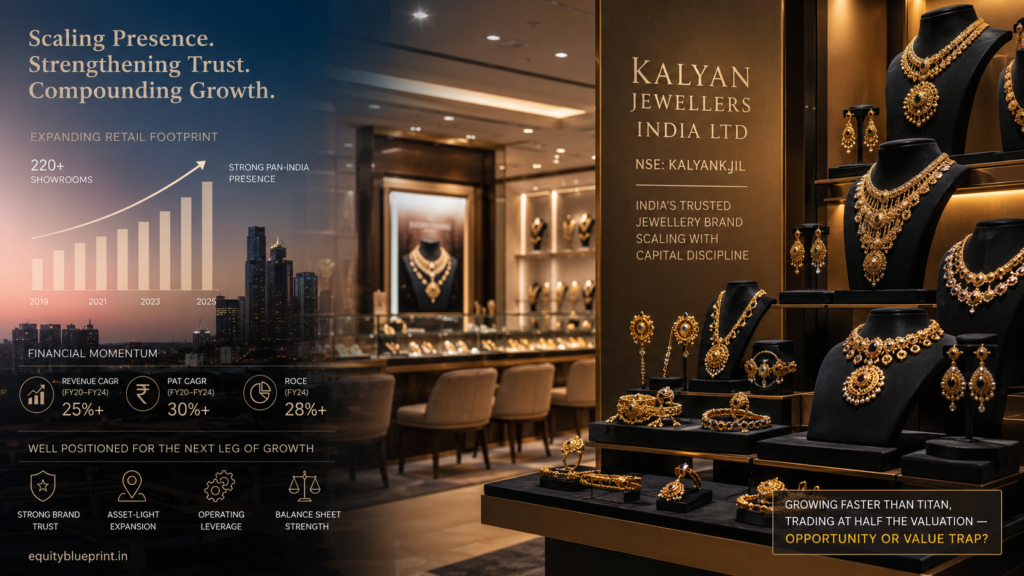
Kalyan Jewellers Analysis: Why Investors Are Suddenly Paying Attention
For decades, India’s jewellery market was controlled by thousands of local family-owned stores.
Trust was local.
Branding was limited.
Quality standards varied.
Customers often bought jewellery from the same shop their parents and grandparents used.
That model is changing.
Today, a young customer purchasing a wedding necklace worth ₹5 lakh increasingly wants hallmark certification, transparent pricing, exchange guarantees, financing options, digital convenience, and a trusted national brand.
This shift may appear subtle.
But for investors, it represents one of the largest formalization opportunities in Indian consumer history.
Every year, market share gradually moves away from unorganized jewellers toward organized brands such as Titan, Kalyan Jewellers, Senco Gold, and Thangamayil Jewellery.
The biggest question is not whether this shift is happening.
The question is:
Which company will capture the largest share of this migration?
Titan remains the undisputed leader.
However, Kalyan Jewellers has quietly emerged as one of the fastest-growing beneficiaries of this structural transformation.
Over the past several years, the company has expanded aggressively across India, improved profitability, strengthened cash generation, and delivered earnings growth that few consumer businesses have matched.
Yet despite this performance, the stock trades at a valuation significantly below Titan.
That discrepancy creates an interesting investment debate.
Is the market underestimating Kalyan’s long-term potential?
Or is the lower valuation simply compensation for higher balance-sheet and execution risks?
This Equity Blueprint analysis aims to answer that question through a structured framework focused on valuation discipline, growth quality, management execution, risk identification, and investment decision-making.
⚡ The Quick Take
Kalyan Jewellers is one of the strongest beneficiaries of India’s jewellery formalization trend.
Revenue has grown from approximately ₹10,505 crore in FY18 to ₹35,743 crore in FY26, while profits have increased from ₹774 crore to ₹2,491 crore during the same period.
Despite this growth, the stock trades at around 28x earnings compared with Titan’s 70x+ valuation.
The opportunity is clear:
You are buying into the same long-term industry theme at a significantly lower multiple.
The risk is equally clear:
Jewellery retail remains inventory-intensive, debt-supported, and highly dependent on consumer demand and gold prices.
For investors comfortable with short-term volatility, Kalyan currently represents one of the most interesting structural growth stories in the Indian consumer space.
🔄 Equity Blueprint Analysis Update Log
Initial Publication Basis: FY2026 Annual Report, FY2026 Quarterly Results, Investor Presentations, Earnings Calls, Industry Research and Management Commentary.
Reference Stock Price Used: ₹379
Reference Market Capitalization: ₹39,094 Crore
Important Note: Valuation multiples and stock prices will naturally change over time. The core investment thesis should be evaluated based on business performance, market-share gains, profitability trends, and capital allocation discipline rather than short-term stock movements.
Equity Blueprint Scorecard
| Factor | Score | Commentary |
| Valuation | 8/10 | Attractive relative to growth and Titan comparison |
| Growth Consistency | 10/10 | Exceptional revenue and profit compounding |
| Balance Sheet Strength | 6/10 | Inventory-heavy business with meaningful leverage |
| Management Execution | 9/10 | Strong expansion and franchise-led growth execution |
| Industry Tailwinds | 9/10 | Formalization trend remains powerful |
| Risk Profile | 7/10 | Gold prices, inventory and competition remain key risks |
| Overall Score | 8.2/10 | Strong long-term structural candidate |
Quick Snapshot
| Metric | Value | Retail Investor’s Take |
| Current Price | ₹379 | Important only as a starting point, not the investment thesis |
| Market Cap | ₹39,094 Cr | Large enough to be institutionally relevant |
| PE Ratio | 28.4 | Reasonable considering profit growth |
| Industry PE | 15.8 | Premium justified by growth quality |
| 10-Year Median PE | 45.4 | Current valuation below historical premium |
| PEG Ratio | 0.64 | Attractive; growth exceeds valuation expansion |
| Price to Book | 6.2 | Reflects brand value and franchise strength |
| Debt-to-Equity | 0.97 | Needs monitoring but common in jewellery retail |
| ROE | 24.8% | Strong shareholder returns |
| ROCE | 20.5% | Healthy capital efficiency |
| Current Ratio | 1.30 | Adequate short-term liquidity |
| Quick Ratio | 0.17 | Cash is largely tied up in jewellery inventory |
| 3-Year Free Cash Flow | ₹2,789 Cr | Positive sign of improving business quality |
| FY26 Revenue | ₹35,743 Cr | More than 3x growth since FY18 |
| FY26 Profit | ₹2,491 Cr | Significant earnings expansion |
Why Investors Are Watching Kalyan Jewellers
Many stocks become popular because of narratives.
Very few become popular because of numbers.
Kalyan belongs in the second category.
The company has quietly delivered some of the strongest financial performance among listed consumer-facing businesses in India.
Consider the scale of growth.
Revenue increased from approximately ₹10,505 crore in FY18 to ₹35,743 crore in FY26.
Net profit increased from approximately ₹774 crore to ₹2,491 crore.
Even more impressive is the acceleration visible in recent quarters.
During the March 2025 quarter, Kalyan generated revenue of approximately ₹6,182 crore and profit of ₹399 crore.
One year later, March 2026 revenue jumped to approximately ₹10,275 crore while profit surged to ₹736 crore.
These are not small improvements.
They indicate a business that is simultaneously gaining market share, expanding geographically, and improving operating leverage.
The market has begun recognizing this transformation.
However, unlike Titan, which already commands a premium valuation reflecting years of investor confidence, Kalyan still trades as a company that must prove itself.
That difference creates the central investment debate.
If Kalyan eventually earns even partial valuation convergence with industry leaders, investors could benefit from both earnings growth and valuation expansion.
If execution slows, the discount may remain permanent.
Understanding which outcome is more likely requires understanding the industry itself.
Before evaluating valuation, growth, and management quality, investors must first understand the forces reshaping India’s jewellery market.
That industry landscape is where the real investment thesis begins.
Industry Landscape: Understanding the Real Engine Behind Kalyan Jewellers’ Growth
Before analyzing Kalyan Jewellers itself, investors must understand a critical reality:
The company’s future will be determined as much by industry structure as by management execution.
Many successful long-term investments are not simply great companies.
They are great companies operating inside favorable industries.
The Indian jewellery sector currently sits at the intersection of multiple structural trends including rising incomes, increasing formalization, stronger regulatory oversight, and changing consumer preferences.
The result is an industry undergoing one of the largest market-share shifts in modern Indian retail. Understanding this transformation is essential to understanding the Kalyan Jewellers investment thesis.
Industry Overview
India’s jewellery industry is among the largest consumer industries in the country.
Beyond its economic importance, jewellery occupies a unique position in Indian society.
Unlike many discretionary products, jewellery functions simultaneously as:
- A consumption product
- A cultural asset
- A status symbol
- A savings vehicle
- A store of wealth
This combination creates demand characteristics that differ significantly from traditional retail categories.
A consumer may postpone purchasing a television during uncertain economic conditions.
The same consumer may still purchase gold jewellery for a wedding, religious ceremony, or long-term wealth preservation.
This dual role gives the industry a level of resilience that many consumer sectors lack.
Today, India remains one of the world’s largest consumers of gold and jewellery.
The domestic jewellery market is estimated to be worth several lakh crore rupees and continues to expand steadily, supported by demographics, urbanization, and increasing household incomes.
The industry broadly consists of:
Gold Jewellery
The largest segment and the primary profit pool for most retailers.
Studded Jewellery
Higher-margin products featuring diamonds and precious stones.
Silver Jewellery
An increasingly important category benefiting from affordability and rising consumer interest.
Wedding Jewellery
The most significant demand driver within the industry.
Luxury Watches and Accessories
An adjacent category offered by several organized jewellery retailers.
Among these segments, gold jewellery continues to dominate the Indian market and remains the foundation of Kalyan Jewellers’ business model.
Why the Jewellery Industry Matters to the Indian Economy
Few industries are as deeply integrated into India’s economic and cultural fabric as jewellery.
The sector generates employment across:
- Mining
- Refining
- Manufacturing
- Designing
- Logistics
- Retail distribution
Millions of workers depend directly or indirectly on the jewellery ecosystem.
The industry also contributes significantly to:
- Exports
- Tax revenues
- Foreign exchange flows
- Financial savings
Importantly, Indian households continue to view gold as a long-term wealth-preservation asset.
This cultural behavior creates a structural demand base that has remained remarkably durable across generations.
For investors, this means the industry’s long-term growth story is supported not only by economics but also by deeply embedded social behavior.
The Industry Value Chain: Where Is Value Actually Created?
To understand competitive advantage in jewellery retail, investors must understand how value moves through the industry.
The value chain typically follows five stages:
Stage 1: Raw Material Sourcing
Gold, diamonds, silver, and precious stones enter the system through imports, refiners, and wholesalers.
At this stage, product differentiation is minimal.
Gold is largely a commodity.
Stage 2: Refining and Processing
Raw materials are refined into usable forms suitable for manufacturing.
Margins remain relatively modest.
Stage 3: Jewellery Manufacturing
Designers and manufacturers convert raw materials into finished jewellery products.
Here, craftsmanship begins creating additional value.
Stage 4: Branding and Retailing
This is where the largest value creation occurs.
Retailers differentiate themselves through:
- Brand trust
- Product variety
- Store experience
- Certification
- Exchange policies
- Financing options
- Customer relationships
Stage 5: After-Sales Ecosystem
Buyback guarantees, exchange programs, loyalty schemes, and customer retention initiatives further strengthen competitive positioning.
Where Does Kalyan Jewellers Operate?
Kalyan primarily operates in the highest value-added portion of the chain:
Organized jewellery retailing.
This positioning is important because retail brands capture benefits from:
- Rising consumer trust
- Market-share gains
- Premium pricing
- Customer loyalty
The company’s success is therefore less dependent on gold prices themselves and more dependent on its ability to attract customers away from unorganized competitors.
Key Growth Drivers Shaping the Industry
Several powerful forces continue supporting industry growth.
These drivers form the foundation of the long-term investment case for organized jewellery retailers.
1. Rising Disposable Income
India’s growing middle class continues to increase spending on discretionary and aspirational purchases.
As household incomes rise, jewellery demand tends to grow disproportionately because jewellery serves both emotional and financial purposes. This creates a favorable demand environment for organized retailers.
2. Wedding Demand Remains Structural
India hosts millions of weddings every year.
Jewellery remains one of the largest expenditure categories during wedding celebrations.
Unlike many consumer trends that fluctuate, wedding-related jewellery demand has demonstrated remarkable consistency over decades. For companies like Kalyan, this creates a recurring and highly visible revenue stream.
3. Formalization of the Jewellery Market
This may be the single most important driver for investors.
Historically, India’s jewellery industry was dominated by local unorganized players.
However, GST implementation, mandatory hallmarking, stricter compliance standards, and increasing consumer awareness have accelerated formalization.
Consumers increasingly prefer retailers that provide:
- Transparent pricing
- Certified purity
- Buyback guarantees
- Better customer experience
Every percentage point of market share moving from unorganized to organized retail creates a growth opportunity for companies like Kalyan.
4. Expansion Into Tier-2 and Tier-3 Cities
Many organized retailers initially focused on major metropolitan markets.
Today, growth increasingly comes from smaller cities where branded jewellery penetration remains relatively low.
Kalyan’s expansion strategy is heavily aligned with this trend.
This significantly increases the company’s future addressable market.
5. Growing Acceptance of Franchise Models
The franchise-led expansion model is transforming the economics of jewellery retail.
Instead of investing large amounts of capital into every new showroom, companies can partner with local entrepreneurs.
This allows faster expansion while improving return on capital.
Kalyan has aggressively adopted this strategy in recent years.
6. Digital and Omnichannel Adoption
Consumer purchasing behavior continues to evolve.
While jewellery remains a high-touch category, digital research increasingly influences purchasing decisions.
Customers often:
- Browse online
- Compare designs digitally
- Visit stores later
- Complete purchases offline
Companies capable of integrating digital engagement with physical retail may gain a competitive advantage over traditional local jewellers.
Industry Structure: Organized vs Unorganized Market
Perhaps the most important factor for investors is the industry’s fragmented structure.
For decades, local jewellers dominated the market.
These businesses benefited from:
- Family relationships
- Community trust
- Regional presence
However, they often lacked:
- Scale advantages
- Standardized quality controls
- National branding
- Advanced technology systems
This created an opportunity for organized retailers.
Today, the industry is increasingly divided into two categories.
Unorganized Segment
Thousands of local retailers serving regional markets.
Organized Segment
Large brands such as:
- Titan (Tanishq)
- Kalyan Jewellers
- Senco Gold
- Thangamayil Jewellery
The organized segment continues gaining market share every year.
This shift is arguably the most important long-term growth driver for listed jewellery companies.
Competitive Intensity: Who Is Fighting for Market Share?
The jewellery industry is attractive, but it is not easy.
Competition remains intense.
Titan
The undisputed market leader.
Titan benefits from exceptional brand equity, strong balance-sheet quality, and premium positioning.
Kalyan Jewellers
The leading challenger with aggressive expansion and strong execution momentum.
Senco Gold
A rapidly growing organized player with strong regional presence.
Thangamayil Jewellery
A respected regional competitor with deep roots in South India.
Local Jewellers
Still represent the largest collective competitive force due to their fragmented market share.
The battle over the next decade will largely revolve around which organized players capture the greatest share from the unorganized market.
Industry Risks Investors Must Understand
Even strong industries contain risks.
Ignoring them leads to poor investment decisions.
Gold Price Volatility
Sharp movements in gold prices can temporarily impact demand, inventory valuation, and consumer purchasing behavior. Although long-term demand remains resilient, short-term volatility can affect quarterly results.
Regulatory Risk
Changes in:
- Import duties
- GST policies
- Hallmarking regulations
- Compliance requirements
can influence profitability and demand dynamics.
Working Capital Intensity
Jewellery retail requires large inventory investments.
Retailers must continuously finance substantial quantities of gold and finished products.
This makes balance-sheet management critical.
Competitive Pressure
Organized players are expanding aggressively. Store additions, advertising expenditure, and customer acquisition costs could increase over time.
Economic Slowdowns
While wedding demand remains relatively stable, discretionary purchases can weaken during periods of economic uncertainty.
Industry Outlook (2026–2031)
The next five years appear favorable for organized jewellery retailers.
Several structural trends remain intact:
- Rising incomes
- Increasing formalization
- Expansion into smaller cities
- Brand-driven purchasing behavior
- Franchise-led store growth
These factors create a substantial runway for market-share gains.
However, the biggest opportunity is not necessarily industry growth itself.
The larger opportunity lies in the continued migration from unorganized retailers to branded national chains.
That migration remains far from complete.
As a result, organized players may continue growing faster than the industry for many years.
Industry Positioning: Where Does Kalyan Jewellers Stand?
Kalyan Jewellers is neither a niche player nor a turnaround story.
It is best described as an Industry Challenger with Emerging Leadership Characteristics.
Titan remains the dominant category leader.
However, Kalyan has successfully evolved from a regional South Indian jeweller into a national retail brand.
The company’s rapid expansion, improving profitability, franchise-led growth model, and growing market share position it among the most important beneficiaries of India’s jewellery formalization story.
The central investment thesis is therefore not dependent on gold prices alone.
It is dependent on Kalyan’s ability to continue capturing market share from both local jewellers and competing organized retailers.
If that trend persists, the company’s growth runway may be significantly longer than many investors currently expect.
Layer 1 – Valuation Discipline: Is Kalyan Jewellers Stock Overvalued at ₹379?
One of the biggest mistakes investors make is assuming that a good company automatically becomes a good investment.
It doesn’t.
A business can execute brilliantly while still delivering poor shareholder returns if investors overpay for future growth.
Conversely, a company can generate outstanding returns when purchased at a reasonable valuation despite carrying certain operational risks.
This is why valuation discipline remains the first layer of the Equity Blueprint framework.
Before discussing growth stories, store expansion, or management optimism, investors must answer a simple question:
How much are we paying for every rupee of earnings, growth, and business quality?
For Kalyan Jewellers, the answer is more nuanced than it initially appears.
Valuation Snapshot
| Metric | Kalyan Jewellers |
| Current Price | ₹379 |
| Market Capitalization | ₹39,094 Cr |
| PE Ratio | 28.4 |
| Industry PE | 15.8 |
| 10-Year Median PE | 45.4 |
| PEG Ratio | 0.64 |
| Price to Book | 6.2 |
| Debt-to-Equity | 0.97 |
| ROE | 24.8% |
| ROCE | 20.5% |
At first glance, a PE ratio of 28.4 may not appear cheap.
Many value investors would immediately argue that paying nearly 30 times earnings for a retailer is expensive.
However, valuation without context often leads to incorrect conclusions.
The real question is not whether the stock is cheap.
The real question is whether the valuation is justified by growth, returns, and competitive positioning.
The Titan Discount: Buying the Same Theme at Half the Valuation?
Every investment story needs a benchmark.
In India’s organized jewellery sector, that benchmark is Titan.
Titan is widely regarded as one of India’s highest-quality consumer businesses.
Its Tanishq brand dominates organized jewellery retail and enjoys exceptional customer trust.
As a result, investors have historically awarded Titan a substantial valuation premium.
| Company | PE Ratio |
| Titan | 73.5 |
| Kalyan Jewellers | 28.4 |
| Thangamayil Jewellery | 47.1 |
| Senco Gold | 9.87 |
| PC Jeweller | 12.5 |
This comparison immediately raises an important question.
Why does Titan trade at more than 70 times earnings while Kalyan trades below 30?
The answer lies in market perception.
Titan enjoys:
- A longer operating history
- Stronger balance-sheet quality
- Superior return metrics
- Higher investor confidence
- Proven execution across cycles
Kalyan, despite delivering strong growth, is still viewed as a challenger rather than an industry leader.
This perception gap creates both opportunity and risk.
If Kalyan continues executing successfully, the valuation gap may narrow over time.
If execution weakens, the discount may remain justified.
For investors, the key takeaway is simple:
You are buying exposure to the same formalization trend at a significantly lower multiple than the market leader.
Whether that discount is attractive depends on the sustainability of future growth.
The PEG Ratio: The Most Interesting Number in the Entire Valuation Story
Many investors stop their analysis after looking at the PE ratio.
That can be a costly mistake.
Growth matters.
A company growing profits at 30–40% annually deserves a higher multiple than a company growing at 5%.
This is where the PEG ratio becomes useful.
Kalyan’s PEG ratio stands at:
PEG = 0.64
As a general rule:
| PEG Ratio | Interpretation |
| Below 1 | Growth exceeds valuation |
| Around 1 | Fairly valued |
| Above 1.5 | Valuation may be ahead of growth |
Kalyan’s PEG ratio below 1 suggests that earnings growth has significantly outpaced valuation expansion.
In simple terms:
The market is not fully charging investors for the growth they are currently receiving.
That does not guarantee future returns.
However, it does indicate that the stock’s valuation remains supported by fundamentals rather than pure optimism.
For long-term investors, this is one of the strongest arguments in favor of the stock.
Price-to-Book Ratio: Expensive or Deserved?
Kalyan currently trades at approximately:
Price-to-Book = 6.2
Traditional value investors often dislike high price-to-book multiples.
However, retail businesses should not be judged solely through asset values.
A jewellery retailer’s most valuable assets are often invisible on the balance sheet:
- Brand trust
- Customer relationships
- Distribution network
- Store economics
- Franchise ecosystem
- Management capability
These intangible advantages rarely appear in book value calculations.
As a result, high-quality consumer businesses frequently trade at elevated price-to-book ratios.
The more important question is whether those premiums are supported by returns.
With:
- ROE of 24.8%
- ROCE of 20.5%
Kalyan currently generates returns high enough to justify a premium valuation relative to book value.
The Inventory Trap: What Does a Quick Ratio of 0.17 Actually Mean?
This is one of the most misunderstood aspects of jewellery retail.
Kalyan’s Quick Ratio stands at:
Quick Ratio = 0.17
For many industries, this would be alarming.
But before panicking, investors must understand how jewellery businesses operate.
Most of Kalyan’s assets are tied up in:
- Gold inventory
- Finished jewellery
- Precious stones
This inventory represents future sales.
As a result, cash balances often appear lower than investors expect.
However, the low quick ratio still carries an important message.
Plain-English Translation
If Kalyan suddenly needed to pay all short-term obligations immediately, it could not do so using cash alone.
The company would depend on:
- Inventory turnover
- Working-capital financing
- Normal business operations
This is not unusual for jewellery retailers.
But it remains a risk that deserves continuous monitoring.
The market generally rewards companies with stronger liquidity profiles.
That partly explains why Titan commands a higher valuation multiple.
Debt-to-Equity: A Necessary Risk or a Warning Sign?
Another number that immediately attracts attention is:
Debt-to-Equity = 0.97
Many investors instinctively avoid companies with debt approaching equity levels.
However, context matters.
Jewellery retail is an inventory-heavy business.
Gold inventory requires financing.
Store expansion requires capital.
Working-capital requirements are substantial.
As a result, moderate leverage is common across the industry.
The key question is not whether debt exists.
The key question is whether debt is being used productively.
Current evidence suggests it is.
The company continues generating:
- Strong revenue growth
- Rising profitability
- Healthy return ratios
- Positive free cash flow
These indicators suggest debt remains manageable rather than dangerous.
Nevertheless, leverage remains one of the most important variables to monitor in future quarters.
If debt rises significantly faster than earnings, the investment thesis would weaken.
Free Cash Flow: The Quiet Improvement Most Investors Miss
Many fast-growing companies struggle to convert accounting profits into real cash.
Kalyan’s recent cash-flow performance deserves recognition.
Over the last three years, the company generated approximately:
₹2,789 Crore Free Cash Flow
This matters because cash flow validates earnings quality.
Strong free cash flow indicates:
- Better inventory management
- Improved working-capital efficiency
- Higher financial flexibility
- Reduced dependence on external capital
For long-term investors, improving free cash flow often signals a business transitioning from growth-at-any-cost to disciplined value creation.
That transition appears increasingly visible at Kalyan.
Valuation Verdict: Expensive, Cheap, or Fair?
After reviewing valuation metrics individually, the bigger picture becomes clearer.
Reasons the Stock Looks Attractive
✔ PEG ratio below 1
✔ Strong earnings growth
✔ Trading significantly below Titan’s valuation
✔ Healthy ROE and ROCE
✔ Improving cash generation
✔ Industry tailwinds remain intact
Reasons Investors Should Remain Cautious
⚠ Inventory-heavy balance sheet
⚠ Quick ratio remains weak
⚠ Debt levels require monitoring
⚠ Execution must remain strong to justify future rerating
Equity Blueprint Valuation Verdict
Kalyan Jewellers is not a deep-value stock.
It is not a distressed turnaround.
It is not a speculative momentum trade.
Instead, it occupies a much more interesting position.
The company appears reasonably valued relative to its growth profile while still trading at a meaningful discount to the industry’s premium leader.
The market is acknowledging Kalyan’s success.
What it has not fully done yet is award the company the valuation premium typically associated with dominant consumer franchises.
Whether that premium eventually arrives will depend on one thing:
Can management sustain growth without compromising balance-sheet quality?
That question leads directly into the next layer of analysis.
Because valuation only matters if the growth supporting it is real, durable, and repeatable.
Layer 2 – Growth Consistency: Can Kalyan Jewellers Sustain Its Exceptional Growth?
Investors often become fascinated by growth stories.
The problem is that not all growth is equal.
Some companies grow because they benefit from temporary industry tailwinds.
Some grow through aggressive debt-funded expansion.
Others grow through acquisitions that inflate revenue but fail to create shareholder value.
The most valuable type of growth is different.
It is growth driven by increasing market share, improving customer trust, disciplined expansion, and strengthening competitive advantages.
That type of growth tends to be durable.
The central question for investors is therefore not whether Kalyan Jewellers has grown.
The numbers clearly prove that it has.
The real question is:
Can the company continue growing at attractive rates over the next five to ten years?
To answer that, we need to examine both the quality and sustainability of growth.
Revenue Growth: A Business That Has More Than Tripled
The first thing investors notice is the sheer scale of expansion.
| Financial Year | Revenue |
| FY18 | ₹10,505 Crore |
| FY26 | ₹35,743 Crore |
In less than a decade, Kalyan Jewellers has increased revenue by more than three times.
This is not the growth profile of a mature retailer struggling for relevance.
It reflects a company that is successfully expanding its footprint, attracting new customers, and capturing market share.
Importantly, this growth has occurred across multiple economic environments.
The company has navigated:
- Pandemic disruptions
- Inflationary pressures
- Gold price volatility
- Interest-rate fluctuations
Yet the long-term trajectory remains intact.
That consistency deserves attention.
Profit Growth: Revenue Is Growing, But Earnings Are Growing Faster
Revenue growth alone tells only part of the story.
Investors ultimately own earnings.
The stronger signal comes from profit expansion.
| Financial Year | Net Profit |
| FY18 | ₹774 Crore |
| FY26 | ₹2,491 Crore |
Profit has increased more than threefold during the same period.
This matters because it indicates growth is not being purchased through endless discounting or margin sacrifice.
The company is not simply selling more jewellery.
It is generating more economic value from every rupee of revenue.
This distinction is critical.
Many retailers can grow sales. Far fewer can grow profits at a similar pace.
Recent Momentum: Growth Is Accelerating, Not Slowing
One concern investors often have with rapidly growing companies is saturation.
Eventually growth slows.
Eventually expansion opportunities become limited.
Recent results suggest Kalyan is not yet facing that challenge.
Consider the comparison:
| Quarter | Revenue | Profit |
| March 2025 | ₹6,182 Crore | ₹399 Crore |
| March 2026 | ₹10,275 Crore | ₹736 Crore |
The scale of growth within a single year is remarkable.
Revenue increased sharply.
Profit expanded even faster.
This indicates operating leverage is beginning to emerge.
As store networks scale and brand awareness improves, profitability can grow faster than revenue. Investors should pay close attention to this trend because operating leverage often becomes a powerful earnings accelerator during successful expansion phases.
Where Is the Growth Coming From?
A common mistake among investors is assuming Kalyan’s growth is simply the result of rising gold prices.
If that were true, the investment thesis would be significantly weaker.
Gold prices can fluctuate.
Structural competitive advantages are much more valuable.
Management commentary and operating performance suggest growth is being driven by multiple sources.
Market Share Gains
The formalization of India’s jewellery industry continues to transfer customers from unorganized players to branded retailers.
Kalyan remains one of the largest beneficiaries of this trend. Every customer choosing a trusted national brand over a local jeweller strengthens the company’s long-term growth runway.
Aggressive Store Expansion
Store additions remain one of the most important drivers of growth.
Management has consistently expanded the showroom network across India while increasing penetration into underrepresented markets.
Expansion is not merely increasing revenue.
It is strengthening brand visibility and customer acquisition.
Franchise-Led Growth Model
One of the smartest strategic decisions made by management has been the increasing use of franchise-owned showrooms.
This model offers several advantages:
- Faster geographic expansion
- Lower capital requirements
- Better return on capital
- Reduced balance-sheet pressure
This allows Kalyan to grow without proportionately increasing financial risk. For shareholders, this improves the quality of growth.
Geographic Diversification
Historically, Kalyan was heavily associated with South India.
Today the company is increasingly becoming a national jewellery retailer.
This diversification reduces dependence on any single regional market and creates a much larger addressable opportunity.
Growth in Higher-Margin Categories
Management has consistently emphasized expansion in:
- Studded jewellery
- Wedding jewellery
- Premium categories
These segments generally carry stronger margins than plain gold jewellery.
If their contribution increases over time, profitability could improve even faster than revenue.
Is Growth Being Bought With Debt?
Whenever investors see rapid expansion, an important question follows:
Is the company genuinely creating value, or is it simply borrowing aggressively to fund growth?
This concern is particularly relevant in inventory-heavy businesses.
The evidence today suggests Kalyan’s growth is not purely debt-driven.
Several factors support this conclusion:
Strong Return Ratios
ROE of 24.8% and ROCE of 20.5% indicate capital is being deployed productively.
Positive Free Cash Flow
The company generated approximately ₹2,789 crore of free cash flow over the past three years. Businesses dependent on unsustainable debt expansion rarely produce meaningful free cash flow.
Improving Profitability
Margins and earnings continue improving alongside expansion.
This suggests operational efficiency is improving rather than deteriorating.
Asset-Light Expansion
The franchise model significantly reduces capital intensity.
This allows growth without requiring proportional increases in debt. While leverage remains a factor investors should monitor, current evidence suggests growth is being supported by execution rather than financial engineering.
Can Growth Continue?
This is the most important question in the entire investment thesis.
Historical growth is useful.
Future growth determines returns.
Several factors suggest Kalyan still has a meaningful runway.
Formalization Is Far From Complete
A large portion of India’s jewellery market remains unorganized.
The migration toward branded retailers continues. This provides a long-term growth engine.
Store Expansion Opportunities Remain Large
Management continues identifying new markets for expansion.
Many Tier-2 and Tier-3 cities remain underpenetrated.
Brand Recognition Is Improving
As Kalyan’s brand becomes stronger nationally, customer acquisition becomes easier and more efficient.
This can create a self-reinforcing growth cycle.
Rising Income Levels
Increasing disposable incomes support long-term jewellery demand.
This creates a favorable macroeconomic backdrop.
Growth Verdict
Not all growth deserves investor attention.
Some growth disappears as quickly as it arrives.
Kalyan’s growth appears different.
The company is benefiting from a structural industry transformation rather than a temporary economic cycle.
Revenue has more than tripled.
Profit has more than tripled.
Return ratios remain healthy.
Cash generation is improving.
Expansion remains disciplined.
Most importantly, the key drivers of growth appear likely to persist for years rather than quarters.
For now, Kalyan’s growth profile looks structural rather than cyclical.
That is exactly the type of growth long-term investors should seek.
Layer 3 – Management Execution: Is Leadership Delivering What It Promises?
Growth stories often begin with ambitious presentations.
Shareholders eventually discover whether management can convert those promises into results.
The stock market rewards execution, not presentations.
Many companies announce aggressive targets.
Very few consistently deliver them.
This makes management quality one of the most important variables in any long-term investment.
For Kalyan Jewellers, the central question is straightforward:
Has management earned investor trust through actions rather than words?
Based on recent years, the answer appears increasingly positive.
The Leadership Behind Kalyan Jewellers
Kalyan Jewellers was founded by T.S. Kalyanaraman in 1993.
The company emerged from a family deeply rooted in the jewellery business.
Unlike many modern startups built around financial engineering or aggressive fundraising, Kalyan’s foundation was built on decades of industry experience.
This industry knowledge remains an important competitive advantage.
Jewellery retail is a trust-based business.
Understanding customer behavior, inventory management, regional preferences, and wedding-related demand requires expertise developed over long periods.
Management’s industry experience has helped the company navigate multiple economic cycles successfully.
Did Management Deliver on Expansion?
One of the clearest ways to evaluate management is to compare promises with outcomes.
In recent investor presentations and earnings calls, management repeatedly emphasized:
- National expansion
- Franchise-led growth
- Market-share gains
- Improved profitability
- Strong cash generation
The evidence suggests execution has largely matched the narrative.
Revenue has expanded dramatically.
Profitability has improved.
The store network continues growing.
Market share has increased.
Importantly, growth has not come at the cost of collapsing returns or deteriorating operating performance. This alignment between communication and results is a positive signal.
The Franchise Strategy: A Smart Capital Allocation Decision
Perhaps the most important management decision in recent years has been the shift toward a franchise-led expansion model.
Traditional jewellery expansion can be capital intensive.
Every new store requires:
- Real estate investment
- Inventory investment
- Working capital
- Operating expenses
Management recognized that scaling exclusively through company-owned stores would require significantly more capital.
The franchise model changes the equation.
Instead of carrying the full burden of expansion, local partners contribute capital while Kalyan contributes brand strength, systems, and operational expertise.
This creates several benefits:
✔ Faster expansion
✔ Higher return on capital
✔ Lower balance-sheet pressure
✔ Reduced execution risk
For investors, this represents thoughtful capital allocation rather than growth at any cost.
Capital Allocation: Following the Money
Ultimately, investors should judge management based on how capital is deployed.
The best management teams allocate capital into opportunities that create long-term shareholder value.
Recent evidence suggests Kalyan has allocated capital toward:
- Store expansion
- Brand development
- Geographic diversification
- Operational efficiency
At the same time, the company has maintained healthy return ratios and positive free cash flow.
This combination is important.
Many growth companies can expand.
Far fewer can expand while simultaneously creating shareholder value.
Management Credibility Verdict
Management credibility is not built through conference calls.
It is built through results.
Kalyan’s leadership team has successfully transformed the company from a regional jeweller into one of India’s largest organized jewellery retailers.
Expansion has been disciplined.
Profitability has improved.
Cash generation has strengthened.
The franchise strategy demonstrates thoughtful capital allocation.
While investors should always maintain healthy skepticism and continue monitoring execution, management currently appears to be delivering on its strategic commitments.
That credibility strengthens the overall investment thesis and explains why the market has become increasingly willing to assign higher valuations to the business over time.
However, even excellent management cannot eliminate risk.
The next layer of analysis focuses on the factors that could challenge the investment thesis and potentially derail future returns.
Layer 4 – Risk Identification: What Could Cause Kalyan Jewellers Stock to Underperform?
Every investment thesis should be stress-tested.
Not because investors should become pessimistic.
But because capital preservation matters just as much as capital growth.
Many investors spend hours studying growth opportunities and only minutes studying risks.
Unfortunately, markets rarely punish investors for missing upside.
They frequently punish investors for ignoring downside.
This is why risk identification forms the fourth layer of the Equity Blueprint Framework.
The objective is not to find reasons to avoid the stock.
The objective is to understand what could go wrong and whether those risks are temporary, cyclical, or structural.
For Kalyan Jewellers, the good news is that most major risks appear cyclical rather than existential.
However, they still deserve careful monitoring.
Cyclical Risks vs Structural Risks
Before discussing specific risks, investors should understand an important distinction.
Cyclical Risks
These risks fluctuate with economic conditions and often reverse over time.
Examples include:
- Gold price volatility
- Economic slowdowns
- Interest rate cycles
- Temporary demand weakness
Structural Risks
These risks can permanently damage a business.
Examples include:
- Poor governance
- Weak business model
- Technological disruption
- Loss of competitive advantage
The difference matters enormously.
Cyclical risks often create buying opportunities.
Structural risks destroy long-term wealth. Fortunately, most of Kalyan’s key risks currently belong to the first category.
Risk #1: Gold Price Volatility
This is the most obvious risk in the jewellery business.
Gold is not merely an input cost.
It is the product itself.
Large movements in gold prices can influence:
- Customer purchasing behavior
- Inventory valuation
- Working capital requirements
- Short-term profitability
When gold prices rise sharply, consumers sometimes postpone purchases due to affordability concerns.
When gold prices fall rapidly, inventory values can come under pressure.
The reality is more nuanced than many investors assume.
Historically, Indian jewellery demand has proven surprisingly resilient.
Weddings still happen.
Festivals still occur.
Consumers continue viewing gold as a long-term store of wealth.
However, quarterly fluctuations can become volatile.
Investor Takeaway
Gold price volatility is a cyclical risk.
It can impact short-term earnings but does not currently threaten the long-term investment thesis.
Risk #2: The Inventory Dependence Problem
One of the most important balance-sheet risks in jewellery retail is inventory concentration.
Unlike software companies or service businesses, jewellery retailers must continuously maintain large quantities of inventory.
For Kalyan, inventory represents a substantial portion of assets.
This creates several challenges.
Working Capital Pressure
Large inventory requires financing. More inventory means more capital tied up inside the business.
Liquidity Constraints
The company’s Quick Ratio of 0.17 highlights this reality.
Most short-term liquidity is embedded inside physical jewellery rather than cash.
Inventory Misjudgment Risk
If management overestimates demand, excess inventory can reduce efficiency and pressure returns.
Although Kalyan has managed inventory effectively in recent years, this remains one of the most important operational metrics investors should track every quarter.
Investor Takeaway
Inventory risk is normal for jewellery retail but requires constant monitoring.
The business cannot avoid it. It can only manage it efficiently.
Risk #3: Debt and Financial Leverage
Kalyan’s Debt-to-Equity Ratio currently stands at approximately:
Debt-to-Equity = 0.97
This level is manageable but not insignificant.
Leverage creates both advantages and risks.
Why Debt Exists
The jewellery business naturally requires:
- Inventory financing
- Store expansion capital
- Working-capital support
Some leverage is therefore expected.
Why Investors Must Monitor It
If debt grows faster than:
- Revenue
- Earnings
- Cash flow
the risk profile changes rapidly.
Higher interest costs can compress profitability and reduce financial flexibility.
At present, earnings growth and cash generation appear sufficient to support existing leverage levels.
However, balance-sheet discipline remains essential.
Investor Takeaway
Debt is not currently a red flag. It is a yellow flag that requires monitoring.
Risk #4: Competitive Pressure Is Intensifying
Success attracts competition.
The organized jewellery industry has become one of India’s most attractive retail segments.
As a result, competition continues increasing.
Kalyan faces pressure from multiple directions.
Titan
Titan remains the industry’s dominant force.
Its Tanishq brand enjoys exceptional consumer trust and premium positioning.
Senco Gold
A rapidly expanding organized retailer targeting many of the same growth opportunities.
Thangamayil Jewellery
A strong regional player with deep roots in South India.
Thousands of Local Jewellers
Although fragmented, local retailers collectively remain a major competitive force.
Many continue to possess strong community relationships and customer loyalty.
Investor Takeaway
Competition will remain intense.
Future growth will require continuous execution rather than simply benefiting from industry expansion.
Risk #5: Execution Risk
Many companies succeed during their first expansion phase.
Far fewer succeed during their second and third phases.
As Kalyan expands nationally, execution becomes increasingly important.
Potential challenges include:
- New-store productivity
- Franchise management
- Hiring and training
- Brand consistency
- Supply-chain efficiency
Rapid growth often creates operational complexity.
Management has executed well so far.
However, maintaining quality while expanding aggressively remains a challenge for every retail business.
Investor Takeaway
Execution risk is currently one of the most important factors determining future valuation rerating.
Risk #6: Economic Slowdown Risk
Jewellery occupies a unique position between discretionary spending and wealth preservation.
This provides some protection during economic downturns.
However, the company is not immune to economic weakness.
Potential effects include:
- Lower discretionary purchases
- Delayed wedding spending
- Reduced consumer confidence
While wedding demand tends to remain resilient, premium jewellery purchases can slow during periods of economic stress.
Investor Takeaway
Economic slowdowns may affect short-term performance but are unlikely to permanently alter the industry’s long-term trajectory.
Risk #7: Regulatory and Policy Risk
The jewellery sector operates within a highly regulated environment.
Changes in:
- Import duties
- GST rates
- Hallmarking rules
- Gold regulations
can influence both demand and profitability.
Historically, organized players have often adapted better than smaller competitors.
In some cases, tighter regulation has actually accelerated industry formalization.
Nevertheless, policy changes remain an external risk investors cannot ignore.
Investor Takeaway
Regulatory changes are unpredictable but generally manageable for large organized retailers.
The Risk Scorecard
| Risk Factor | Severity | Current Assessment |
| Gold Price Volatility | Medium | Manageable but unavoidable |
| Inventory Dependence | High | Core industry risk |
| Debt Levels | Medium | Requires monitoring |
| Competition | Medium | Intensifying but manageable |
| Execution Risk | Medium | Key determinant of future growth |
| Economic Slowdown | Low-Medium | Short-term impact possible |
| Regulatory Risk | Low-Medium | Mostly manageable |
Equity Blueprint Risk Verdict
Every investment carries risk.
The goal is not to eliminate risk.
The goal is to ensure risks are proportionate to potential rewards.
For Kalyan Jewellers, most major risks appear operational and cyclical rather than structural.
The business model remains sound.
Industry tailwinds remain favorable.
Management credibility remains intact.
The key areas requiring continuous monitoring are:
- Inventory efficiency
- Debt levels
- Store productivity
- Market-share gains
As long as management continues executing effectively, the current risk profile appears acceptable relative to the company’s growth potential.
Peer Comparison: How Does Kalyan Stack Up Against Competitors?
Investors rarely buy a stock in isolation.
They allocate capital among competing opportunities.
Therefore, understanding Kalyan’s relative positioning is essential. The following comparison highlights where Kalyan stands among major listed jewellery retailers.
Valuation and Quality Comparison
| Company | PE | PEG | Debt-to-Equity | ROE (%) | ROCE (%) |
| Kalyan Jewellers | 28.4 | 0.64 | 0.97 | 24.8 | 20.5 |
| Titan Company | 73.5 | 4.44 | 0.93 | 37.7 | 25.8 |
| Thangamayil Jewellery | 47.1 | 0.73 | 0.64 | 28.1 | 25.5 |
| PC Jeweller | 12.5 | 0.16 | 0.14 | 9.96 | 9.58 |
| Senco Gold | 9.87 | 0.18 | 1.07 | 25.6 | 20.9 |
What This Comparison Tells Us
Titan: Premium Quality, Premium Valuation
Titan remains the benchmark.
The market rewards it with an extremely high valuation because of:
- Superior brand strength
- Longer operating history
- Stronger investor confidence
- Exceptional capital efficiency
The challenge for new investors is obvious.
Much of Titan’s excellence is already reflected in its valuation.
Kalyan: Growth at a Reasonable Price
Kalyan occupies an interesting middle ground.
It offers:
✔ Strong growth
✔ Healthy returns
✔ Improving execution
✔ A significantly lower valuation than Titan
This combination makes it one of the most attractive risk-reward profiles in the sector.
Thangamayil: Strong Regional Operator
Thangamayil delivers strong returns but remains more regionally concentrated than Kalyan. Investors seeking national expansion exposure may prefer Kalyan’s broader opportunity set.
Senco Gold: Extremely Cheap, Higher Uncertainty
Senco appears statistically cheap.
However, markets rarely offer low valuations without reasons.
Investors must determine whether the discount reflects opportunity or risk.
PC Jeweller: Turnaround Candidate
PC Jeweller remains fundamentally different from the other businesses in this comparison.
Its investment thesis revolves around recovery rather than structural growth.
Peer Comparison Verdict
If investors are searching for:
- The safest operator → Titan remains the benchmark.
- The cheapest statistical valuation → Senco Gold and PC Jeweller appear cheaper.
- The most balanced combination of growth, quality, and valuation → Kalyan becomes extremely interesting.
This balance is precisely why the stock continues attracting increasing investor attention.
However, valuation, growth, management quality, and risk analysis ultimately mean little without a final capital allocation decision.
The final layer answers the most important question of all:
Does Kalyan Jewellers deserve a place in a long-term investor’s portfolio?
Layer 5 – Decision Discipline: Does Kalyan Jewellers Deserve a Place in a Long-Term Portfolio?
After studying the industry, valuation, growth trajectory, management quality, and risks, we arrive at the most important part of the analysis.
Not whether Kalyan Jewellers is a good company.
Not whether the jewellery industry is attractive.
Not whether management has executed well.
The real question is:
Should investors allocate capital to Kalyan Jewellers today?
This is where many investment analyses fail.
They spend thousands of words describing a company but never reach a clear conclusion.
At Equity Blueprint, the objective is different.
The objective is decision-making.
Every piece of research must ultimately answer whether a business deserves capital allocation.
The Bull Case: Why Kalyan Could Continue Creating Wealth
Several factors support a constructive long-term investment thesis.
1. The Formalization Story Is Far From Over
India’s jewellery industry remains one of the most fragmented large retail categories.
A significant portion of demand still flows through unorganized players.
As consumers increasingly prioritize:
- Hallmarked products
- Brand trust
- Transparent pricing
- Exchange guarantees
organized retailers should continue gaining market share.
This structural shift is unlikely to reverse.
For Kalyan, this remains the single most powerful long-term growth driver.
2. Revenue and Profit Growth Remain Exceptional
Many companies promise growth.
Kalyan has delivered it.
Between FY18 and FY26:
- Revenue increased from ₹10,505 crore to ₹35,743 crore.
- Profit increased from ₹774 crore to ₹2,491 crore.
Importantly, growth remains visible in recent quarterly performance.
This suggests the company’s expansion story is still unfolding rather than approaching maturity.
3. Franchise-Led Expansion Improves Economics
Historically, retail expansion often required significant capital.
Kalyan’s increasing focus on franchise-operated showrooms changes the economics.
Benefits include:
✔ Faster expansion
✔ Better return on capital
✔ Reduced balance-sheet pressure
✔ Lower execution risk
This model should help sustain growth while preserving financial flexibility.
4. Valuation Remains Reasonable
A PE ratio of 28.4 is not cheap.
However, relative to:
- Earnings growth
- PEG ratio
- Industry opportunity
- Titan’s valuation
the stock does not appear excessively priced.
In fact, one could argue that the market still values Kalyan as a strong challenger rather than a future category leader.
That distinction matters.
If investor confidence continues improving, valuation expansion could become an additional return driver.
5. Improving Business Quality
Several metrics indicate improving quality:
- Positive free cash flow
- Strong ROE
- Healthy ROCE
- Improving profitability
- Strong execution consistency
These characteristics are often associated with long-term compounders.
The Bear Case: Why Investors Should Remain Cautious
No investment thesis is complete without acknowledging counterarguments.
Several concerns deserve attention.
1. Inventory Intensity Remains High
Jewellery retail will always require substantial inventory.
The business cannot operate without maintaining large quantities of gold and finished products.
This creates:
- Working-capital pressure
- Liquidity constraints
- Financing requirements
Investors seeking asset-light businesses should recognize this structural characteristic.
2. Debt Requires Monitoring
A debt-to-equity ratio of 0.97 is manageable but not insignificant.
As long as earnings continue growing, leverage should remain controllable.
If growth slows meaningfully, the balance-sheet discussion becomes more important.
3. Titan Remains a Powerful Competitor
Competing against Titan is not easy.
Titan possesses:
- Superior brand equity
- Exceptional customer trust
- Stronger balance-sheet quality
- Decades of execution credibility
Kalyan does not need to defeat Titan to succeed.
However, it must continue growing despite Titan’s presence.
4. Valuation Is No Longer Deeply Cheap
Five years ago, the investment case was heavily supported by valuation.
Today, investors are paying a premium for growth.
The stock still appears reasonably valued, but future returns will increasingly depend on business execution rather than valuation rerating alone.
The Most Important Question: What Must Go Right?
Every successful investment requires certain assumptions to remain valid.
For Kalyan, the thesis largely depends on four variables.
Market Share Gains Must Continue
The formalization story only benefits shareholders if Kalyan captures a meaningful portion of migrating demand.
Store Expansion Must Remain Productive
Opening new stores is easy.
Generating attractive returns from those stores is much harder.
Management must continue balancing growth with profitability.
Debt Must Remain Controlled
Future expansion should not come at the cost of excessive leverage.
Balance-sheet discipline remains essential.
Brand Strength Must Continue Improving
Ultimately, jewellery retail is a trust business.
The stronger Kalyan’s brand becomes, the easier it becomes to sustain growth and improve economics.
Equity Blueprint Final Verdict
Verdict: Structural Buy
Kalyan Jewellers is no longer a turnaround story.
It is no longer a speculative recovery candidate.
It is increasingly becoming a high-quality organized retail franchise benefiting from one of India’s strongest structural consumption trends.
The investment thesis rests on three pillars:
Pillar One: Industry Tailwinds
The migration from unorganized to organized jewellery retail remains a multi-year opportunity.
Pillar Two: Execution Quality
Management has consistently delivered growth, expansion, and improving profitability.
Pillar Three: Reasonable Valuation
While not cheap in absolute terms, the stock remains attractively valued relative to:
- Growth profile
- Industry opportunity
- Titan comparison
For long-term investors focused on business quality rather than short-term price fluctuations, Kalyan currently appears worthy of serious consideration.
Equity Blueprint Investment Classification
| Category | Verdict |
| Business Quality | Strong |
| Growth Visibility | Strong |
| Management Quality | Strong |
| Balance Sheet | Acceptable |
| Valuation | Reasonable |
| Risk Level | Moderate |
| Long-Term Wealth Creation Potential | High |
| Overall Rating | 8.2 / 10 |
| Final Verdict | Structural Buy |
Key Factors to Watch in Upcoming Quarters
Investors should monitor the following metrics closely.
Business Performance
- Same-store sales growth
- Revenue growth
- Profit growth
- Margin trends
Expansion Quality
- New showroom additions
- Franchise expansion progress
- Store productivity
Financial Health
- Debt-to-equity ratio
- Inventory levels
- Free cash flow generation
- Working-capital efficiency
Competitive Position
- Market-share gains
- Studded jewellery growth
- Brand visibility versus Titan and other peers
If these indicators remain positive, the long-term investment thesis remains intact.
Frequently Asked Questions (FAQ)
Is Kalyan Jewellers a good long-term investment?
Kalyan appears attractive for long-term investors because it operates within a structurally growing industry, continues gaining market share, and has demonstrated strong revenue and profit growth. However, investors must remain comfortable with inventory-related risks and moderate leverage.
Why is Kalyan Jewellers cheaper than Titan?
Titan commands a premium valuation because of its longer operating history, stronger balance sheet, superior brand equity, and higher investor confidence. Kalyan trades at a discount because investors still view it as a challenger rather than a category leader.
What is the biggest risk for Kalyan Jewellers?
The most important risks include inventory intensity, leverage, competitive pressure, and execution risk associated with rapid expansion.
Is Kalyan Jewellers dependent on gold prices?
Gold price movements influence short-term demand and inventory economics. However, the long-term investment thesis is driven more by market-share gains, formalization, and brand expansion than by gold prices alone.
What could trigger future upside?
Potential catalysts include:
- Continued market-share gains
- Faster franchise expansion
- Margin improvement
- Debt reduction
- Higher free cash flow generation
- Valuation rerating toward premium organized retail peers
Can Kalyan become as large as Titan?
That remains uncertain. Titan possesses significant competitive advantages and brand leadership. However, Kalyan does not need to become Titan to generate attractive shareholder returns. Sustained market-share gains and disciplined execution may be sufficient.
Final Thoughts
The stock market often rewards investors who identify structural winners before consensus fully recognizes them.
Kalyan Jewellers appears to be moving through that transition phase.
The company has already proven it can grow.
The next challenge is proving it can sustain growth while strengthening its balance sheet and expanding profitability.
If management succeeds, today’s debate may eventually shift from whether Kalyan deserves a premium valuation to how large that premium should be.
For now, the evidence supports a constructive long-term outlook.
The business remains fundamentally strong.
The industry remains favorable.
Execution remains credible.
And the valuation, while no longer cheap, still appears reasonable relative to the opportunity ahead.
Data Sources & Attribution:
Market Data: Real-time price action and corporate announcements provided via the National Stock Exchange of India https://www.nseindia.com/
Financial Metrics: Historical fundamental data, ratios, and peer comparisons sourced from Screener.in https://www.screener.in/
Company Disclosures: Statutory filings, annual reports, and investor presentations sourced directly from the Company’s Investor Relations desk. https://www.kalyanjewellers.net/
Related Analysis:
Titan Company Ltd (NSE: TITAN): India’s Jewellery King at 70x P/E — Premium Quality or Premium Risk? https://equityblueprint.in/titan-company-ltd-nse-titan-indias-jewellery-king-at-70x-p-e-premium-quality-or-premium-risk/
Rajesh Exports: Revenue Up 15x, Profit Down 91% — What Are The Numbers Trying To Tell Investors? https://equityblueprint.in/rajesh-exports-revenue-up-15x-profit-down-91-what-are-the-numbers-trying-to-tell-investors/
Disclaimer
The analysis provided on this blog, including the “5-Layer Framework,” is for educational and informational purposes only. I am not a SEBI-registered investment advisor. Stock market investing involves significant risk, and past performance is not indicative of future results. The views expressed here are my personal opinions based on my research and study of financial literature. This is not a buy or sell recommendation. Please conduct your own due diligence or consult a qualified, SEBI-registered financial advisor before making any investment decisions. The author may or may not hold positions in the stocks discussed.
About the Author

Nilendu Chatterjee is the founder of Equity Blueprint, a platform focused on helping retail investors approach the stock market with clarity, structure, and discipline. With over a decade of experience in the industrial sector and a strong passion for equity research, he brings a practical, ground-level perspective to fundamental analysis.
Through a framework-driven approach, Nilendu breaks down complex businesses into simple, decision-oriented insights—bridging the gap between professional-grade research and everyday investing. His work is centered on one goal: enabling long-term wealth creation by replacing speculation with structured thinking.